


-
Book Overview & Buying
-
Table Of Contents

Mastering LibGDX Game Development
By :


Mastering LibGDX Game Development
By:
Overview of this book
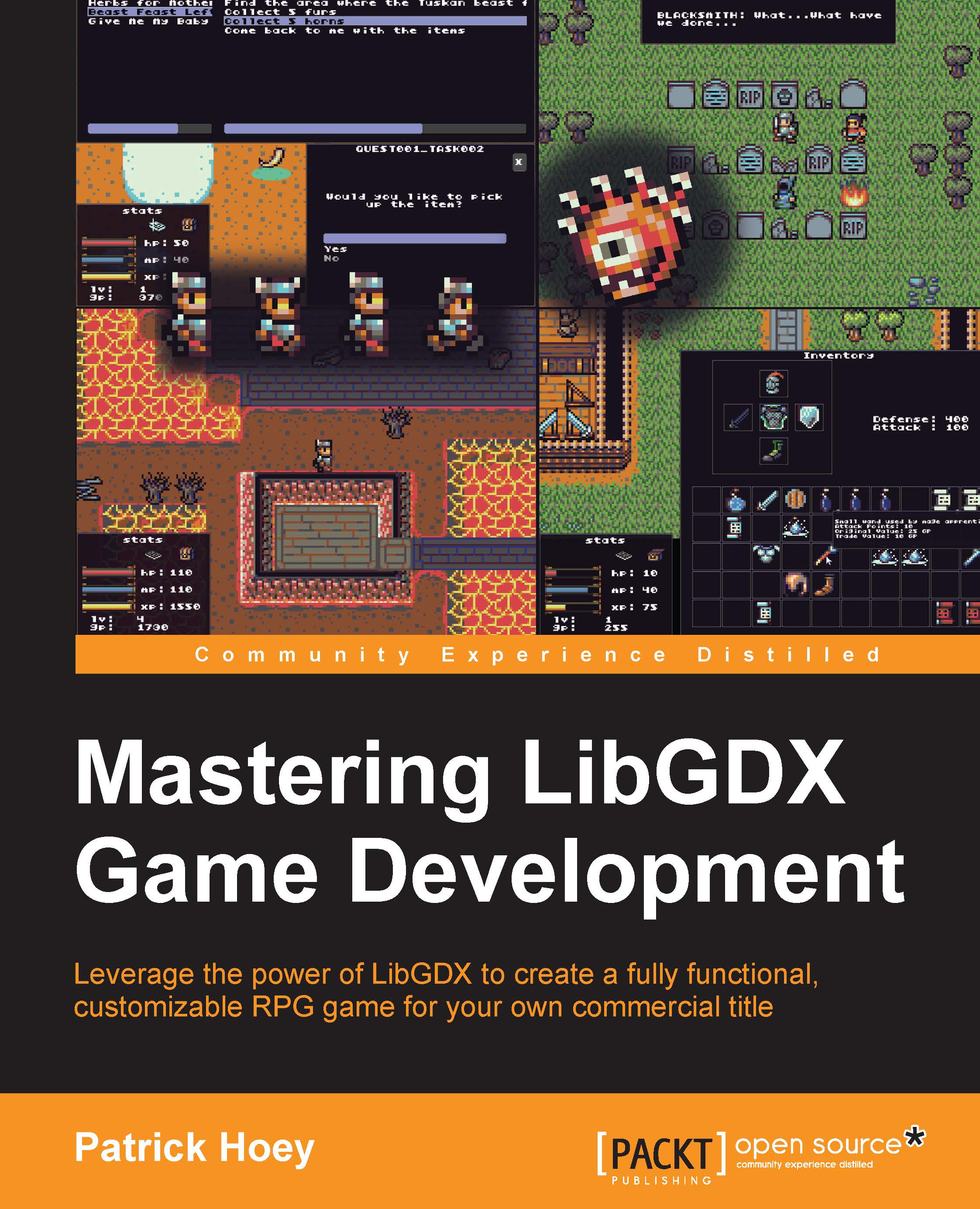
Leverage the power of LibGDX to create a fully functional, customizable RPG game for your own commercial title
About This Book
Learn game architecture and design patterns with concrete examples using proper software engineering principles
Save time and money with this handy reference guide for future game development with LibGDX
Design and develop a fully functional RPG video game from scratch with a hands on, step-by-step approach using LibGDX
Who This Book Is For
If you are an intermediate-level game developer who wants to create an RPG video game but found the creation process overwhelming, either by lack of tutorials or by getting lost in a sea of game-related technologies, engines, or frameworks, then this book is for you. This book assumes familiarity with Java and some basic knowledge of LibGDX.
What You Will Learn
Develop characters with stat attributes, player movement, animation, physics, and collision detection
Create interactive NPC characters with speech windows and build immersion via dialog trees
Build inventory management system UIs with drag and drop items to sell, buy, and equip
Design a quest system to expand out the content of your game
Form interesting enemies with battle mechanics and spawn points
Devise scripted cutscenes to add an element of story and drama
Develop save and load game profiles
Create special effects to give the game extra “juiciness” and polish, and help build the atmosphere
In Detail
LibGDX is a Java-based framework developed with a heavy emphasis on performance, and includes cross-platform support out of the box (Windows, OS X, Linux, iOS, Android, and HTML5) as well as providing all the low-level functionality so that you can focus on developing your game and not battling with the platform. LibGDX also has an engaged and responsive community, active maintenance, and is available for free without a prohibitive license.
Starting from the beginning, this book will take you through the entire development process of creating an RPG video game using LibGDX.
First, this book will introduce you to the features specific to RPG games, as well as an overview of game architecture. Then, you will create map locations, develop character movement, add animation, integrate collision detection, and develop a portal system. Next, you will learn and develop a HUD and other UI components, as well as an inventory management system. You will then develop NPC interactions including dialog trees, shopkeepers, and quest givers. After this, you will design and create battle features for fighting enemies, as well as event triggers for world events. Finally, you will add the final polish with sound, music, and lighting effects.
By the end of this book, you will have learned and applied core components from the LibGDX framework, as well as have a finished game to use as a springboard for customization and story development for your own commercial video game.
Style and approach
This book walks you through the concepts and implementation of developing a complete RPG game, unfolding chapter by chapter and building upon previous concepts. Each chapter can be used as an individual reference with diagrams to explain core concepts with concrete example code explained in detail.
Table of Contents (12 chapters)
Preface


 Free Chapter
1. As the Prophecy Foretold, a Hero is Born
2. Welcome to the Land of BludBourne

3. It's Pretty Lonely in BludBourne…
4. Where Do I Put My Stuff?
5. Time to Breathe Some Life into This Town
6. So Many Quests, So Little Time…
7. Time to Show These Monsters Who's the Boss
8. Oh, No! Looks Like Drama!
9. Time to Set the Mood
10. Prophecy Fulfilled, Our Hero Awaits the Next Adventure
Index


