
Sign In Start Free Trial
Account

Add to playlist

Create a Playlist

Modal Close icon
You need to login to use this feature.
  • Book Overview & Buying Practical Game Design
  • Table Of Contents Toc
  • Feedback & Rating feedback
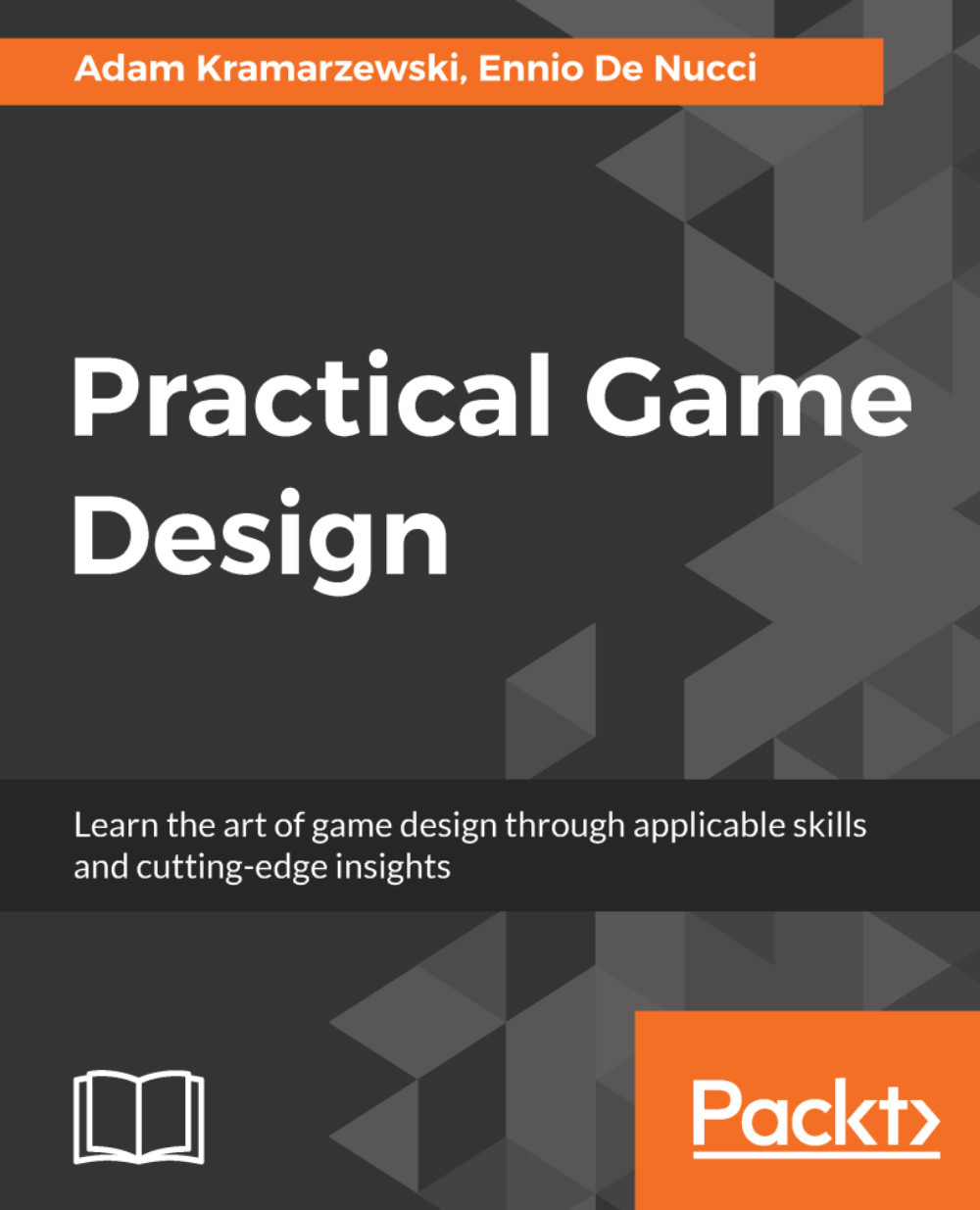
Practical Game Design

Practical Game Design

By : Kramarzewski, Ennio De Nucci
5 (2)
close
close
Practical Game Design

Practical Game Design

5 (2)
By: Kramarzewski, Ennio De Nucci

Overview of this book

If you are looking for an up-to-date and highly applicable guide to game design, then you have come to the right place! Immerse yourself in the fundamentals of game design with this book, written by two highly experienced industry professionals to share their profound insights as well as give valuable advice on creating games across genres and development platforms. Practical Game Design covers the basics of game design one piece at a time. Starting with learning how to conceptualize a game idea and present it to the development team, you will gradually move on to devising a design plan for the whole project and adapting solutions from other games. You will also discover how to produce original game mechanics without relying on existing reference material, and test and eliminate anticipated design risks. You will then design elements that compose the playtime of a game, followed by making game mechanics, content, and interface accessible to all players. You will also find out how to simultaneously ensure that the gameplay mechanics and content are working as intended. As the book reaches its final chapters, you will learn to wrap up a game ahead of its release date, work through the different challenges of designing free-to-play games, and understand how to significantly improve their quality through iteration, polishing and playtesting.
Table of Contents (17 chapters)
close
close

Introducing the Game Production Process

Welcome to the games industry! It's an ever-changing world where competition is fierce, publishing platforms and business models come and go (crowdfunding has appeared and seemingly peaked in just a few years), whole genres of products disappear (only to be revived or reinvented 15 years later), and big publishers and small independent studios alike fight for an ever-limited resource: player attention. We're often giving away more and more (if not all) of our content for free, hoping to monetize users later down the line.

At the time writing, Valve's Steam dominates publishing on PC, while Sony, Microsoft, and Nintendo keep fighting for their share of the console pie. Exclusively handheld consoles are on the back foot, quick being replaced by phones and tablets. The mobile industry itself is all but dominated by Google's Play Store and Apple's App Store and while the mobile market keeps on growing, it has become much, much harder for small developers to break through and make a profit. User acquisition is extremely challenging (read: expensive) and lack of support from the platform holder can sink your profitability. Premium (paid-for) mobile games are a minority, and most financially successful products are what we consider freemium or free to play. In this crowded market, games are becoming more and more expensive to make, market, and operate. What worked in 2010 works no more; the best bet for small groups of indie devs is now with Steam, though that market has also been flooded with the introduction of the now-defunct Steam Greenlight. According to the data exposed by http://steamspy.com/, there were 379 games published on Steam in 2012; by 2016, that number grew to 4,207. Developers now face a market that's increasingly hit-driven, and unless you sit on a billion-dollar brand such as FIFA or Call of Duty, playing it safe is no longer an option. If you do not adapt and innovate quick enough, you're sure to face commercial failure. As the stakes go higher, teams either balloon out of proportion or grow ever leaner.

Now, the reality might have sounded a little grim, and make no mistake, while it's very difficult to make a great game, it's even harder to make it successful. But for those who keep on trying, for those who do not hold back and surrender after their first, fifth, or even twentieth canceled or failed game, this can be the best industry on the planet and within it, being a game designer can be the most rewarding and fulfilling job.

We'll start this book by delving briefly into the basic machinations of the games industry, exploring game design roles and responsibilities, production methods, and development milestones. There's a lot to cover, and probably much more exciting stuff to follow so... Are you ready? Let's begin!

Visually different images
CONTINUE READING
83
Tech Concepts
36
Programming languages
73
Tech Tools
Icon Unlimited access to the largest independent learning library in tech of over 8,000 expert-authored tech books and videos.
Icon Innovative learning tools, including AI book assistants, code context explainers, and text-to-speech.
Icon 50+ new titles added per month and exclusive early access to books as they are being written.
Practical Game Design
notes
bookmark Notes and Bookmarks search Search in title playlist Add to playlist font-size Font size

Change the font size

margin-width Margin width

Change margin width

day-mode Day/Sepia/Night Modes

Change background colour

Close icon Search
Country selected

Close icon Your notes and bookmarks

Confirmation

Modal Close icon
claim successful

Buy this book with your credits?

Modal Close icon
Are you sure you want to buy this book with one of your credits?
Close
YES, BUY

Submit Your Feedback

Modal Close icon
Modal Close icon
Modal Close icon