
Sign In Start Free Trial
Account

Add to playlist

Create a Playlist

Modal Close icon
You need to login to use this feature.
  • Book Overview & Buying Unity Artificial Intelligence Programming
  • Table Of Contents Toc
Unity Artificial Intelligence Programming

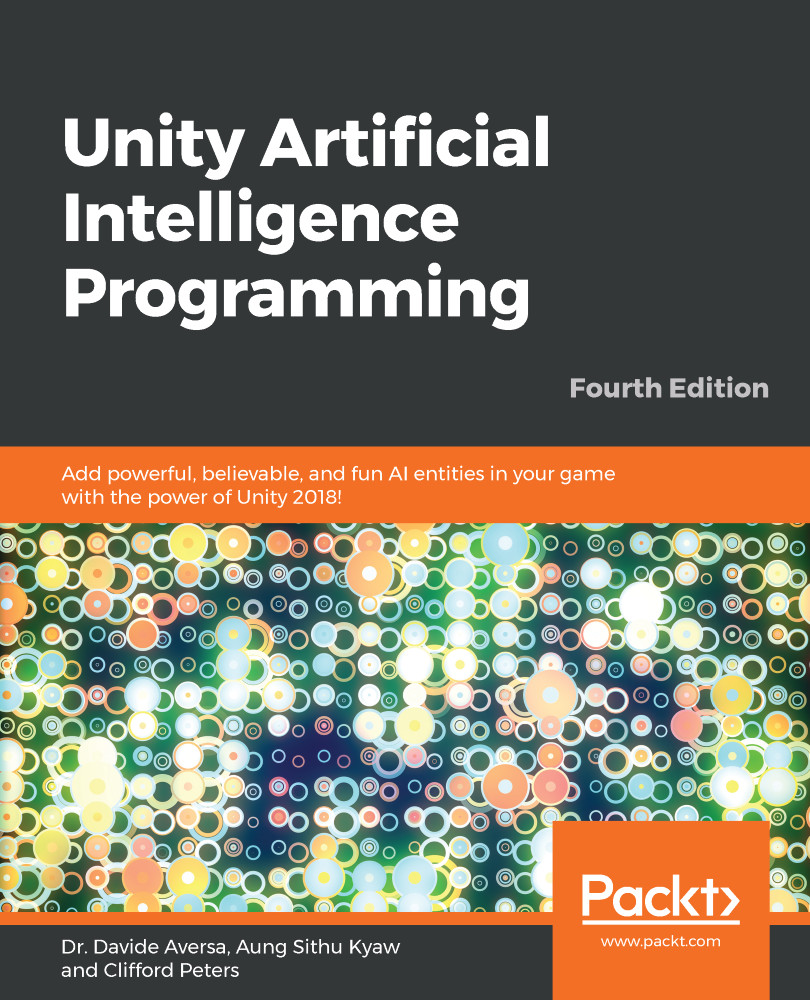
Unity Artificial Intelligence Programming - Fourth Edition

By : Dr. Davide Aversa, Aung Sithu Kyaw, Clifford Peters
4.3 (3)
close
close
Unity Artificial Intelligence Programming

Unity Artificial Intelligence Programming

4.3 (3)
By: Dr. Davide Aversa, Aung Sithu Kyaw, Clifford Peters

Overview of this book

Developing Artificial Intelligence (AI) for game characters in Unity 2018 has never been easier. Unity provides game and app developers with a variety of tools to implement AI, from the basic techniques to cutting-edge machine learning-powered agents. Leveraging these tools via Unity's API or built-in features allows limitless possibilities when it comes to creating your game's worlds and characters. This fourth edition with Unity will help you break down AI into simple concepts to give you a fundamental understanding of the topic to build upon. Using a variety of examples, the book then takes those concepts and walks you through actual implementations designed to highlight key concepts and features related to game AI in Unity. Further on, you'll learn how to distinguish the state machine pattern and implement one of your own. This is followed by learning how to implement a basic sensory system for your AI agent and coupling it with a Finite State Machine (FSM). Next, you'll learn how to use Unity's built-in NavMesh feature and implement your own A* pathfinding system. You'll then learn how to implement simple ?ocks and crowd dynamics, which are key AI concepts in Unity. Moving on, you'll learn how to implement a behavior tree through a game-focused example. Lastly, you'll apply all the concepts in the book to build a popular game.
Table of Contents (13 chapters)
close
close

Flocking

In the early summer evenings, you have probably seen flocks of birds flying in the sky. You have probably noted how they seem to move as a single living object: they all move in a particular direction, turn around, and grow and shrink. In games, a flocking system aims to replicate this behavior: we want to implement an algorithm to move many objects as an organic group.

In games, we call each element of a flock a boid. To implement a flocking behavior, we do not need to tell each boid what to do; instead, all we need to do is implement a few rules for each boid to follow so that they can flock on their own. In fact, flocking is an excellent example of emergent behavior: each boid reacts exclusively to its neighbor's behaviors; nevertheless, the flock seems to move as if someone were coordinating it.

In this chapter, we will learn what these rules are and how to implement...

Visually different images
CONTINUE READING
83
Tech Concepts
36
Programming languages
73
Tech Tools
Icon Unlimited access to the largest independent learning library in tech of over 8,000 expert-authored tech books and videos.
Icon Innovative learning tools, including AI book assistants, code context explainers, and text-to-speech.
Icon 50+ new titles added per month and exclusive early access to books as they are being written.
Unity Artificial Intelligence Programming
notes
bookmark Notes and Bookmarks search Search in title playlist Add to playlist font-size Font size

Change the font size

margin-width Margin width

Change margin width

day-mode Day/Sepia/Night Modes

Change background colour

Close icon Search
Country selected

Close icon Your notes and bookmarks

Confirmation

Modal Close icon
claim successful

Buy this book with your credits?

Modal Close icon
Are you sure you want to buy this book with one of your credits?
Close
YES, BUY

Submit Your Feedback

Modal Close icon
Modal Close icon
Modal Close icon