Sign In Start Free Trial
Account

Add to playlist

Create a Playlist

Modal Close icon
You need to login to use this feature.
  • Book Overview & Buying Leap Motion Development Essentials
  • Table Of Contents Toc
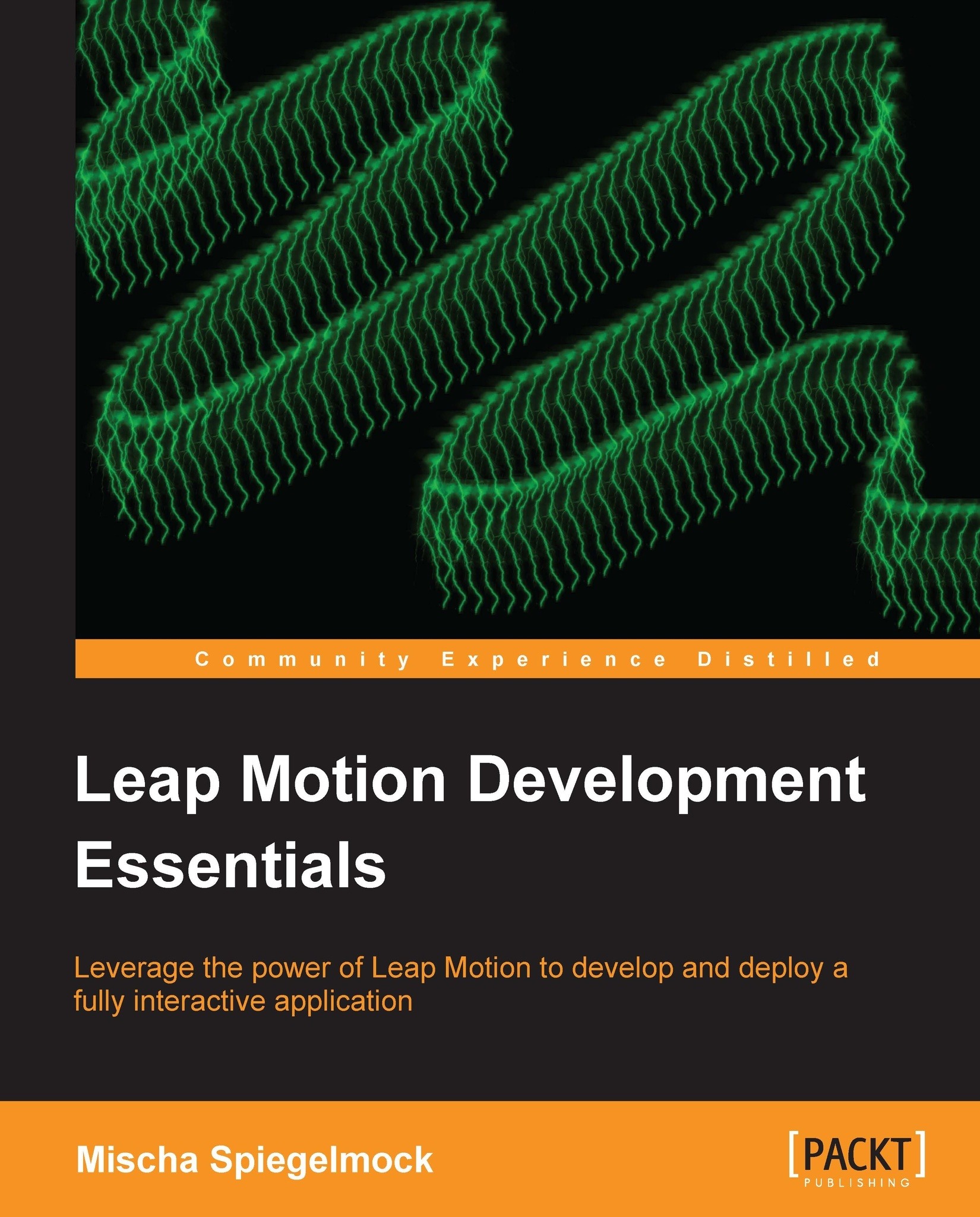
Leap Motion Development Essentials

Leap Motion Development Essentials

By : Mischa Spiegelmock
4.3 (3)
close
close
Leap Motion Development Essentials

Leap Motion Development Essentials

4.3 (3)
By: Mischa Spiegelmock

Overview of this book

Leap Motion is a company developing advanced motion sensing technology for human–computer interaction. Originally inspired by the level of difficulty of using a mouse and keyboard for 3D modeling, Leap Motion believe that moulding virtual clay should be as easy as moulding clay in your hands. Leap Motion now focus on bringing this motion sensing technology closer to the real world. Leap Motion Development Essentials explains the concepts and practical applications of gesture input for developers who want to take full advantage of Leap Motion technology. This guide explores the capabilities available to developers and gives you a clear overview of topics related to gesture input along with usable code samples. Leap Motion Development Essentials shows you everything you need to know about the Leap Motion SDK, from creating a working program with gesture input to more sophisticated applications covering a range of relevant topics. Sample code is provided and explained along with details of the most important and central API concepts. This book teaches you the essential information you need to design a gesture-enabled interface for your application, from specific gesture detection to best practices for this new input. You will be given guidance on practical considerations along with copious runnable demonstrations of API usage which are explained in step-by-step, reusable recipes.
Table of Contents (12 chapters)
close
close

Chapter 2. Real Talk – Real Time

When we create an application that acts on gestural input, a major concern is responsiveness. Not only is using a laggy application no fun, but there are many situations in which we desire to process and respond to the hand motion with as little latency as possible. In this chapter we'll discuss the following:

  • Blocking

  • Describing raw input as simple gestures

  • Shared-memory concurrency with pthreads

  • Building a MIDI controller for real-time audio applications

With this in mind, we will walk through creating a controller suitable for live musical performances. Because our code will be interacting with music software and hardware, we must use our operating system interfaces for transmitting MIDI (the standard musical control protocol that all devices support), which is not guaranteed to happen without blocking. While using routines that can potentially involve sending messages to hardware, it's generally good to assume that the execution of our program may be paused...

CONTINUE READING
83
Tech Concepts
36
Programming languages
73
Tech Tools
Icon Unlimited access to the largest independent learning library in tech of over 8,000 expert-authored tech books and videos.
Icon Innovative learning tools, including AI book assistants, code context explainers, and text-to-speech.
Icon 50+ new titles added per month and exclusive early access to books as they are being written.
Leap Motion Development Essentials
notes
bookmark Notes and Bookmarks search Search in title playlist Add to playlist font-size Font size

Change the font size

margin-width Margin width

Change margin width

day-mode Day/Sepia/Night Modes

Change background colour

Close icon Search
Country selected

Close icon Your notes and bookmarks

Confirmation

Modal Close icon
claim successful

Buy this book with your credits?

Modal Close icon
Are you sure you want to buy this book with one of your credits?
Close
YES, BUY

Submit Your Feedback

Modal Close icon
Modal Close icon
Modal Close icon