


-
Book Overview & Buying
-
Table Of Contents

Artificial Intelligence for Robotics - Second Edition
By :


Artificial Intelligence for Robotics
By:
Overview of this book
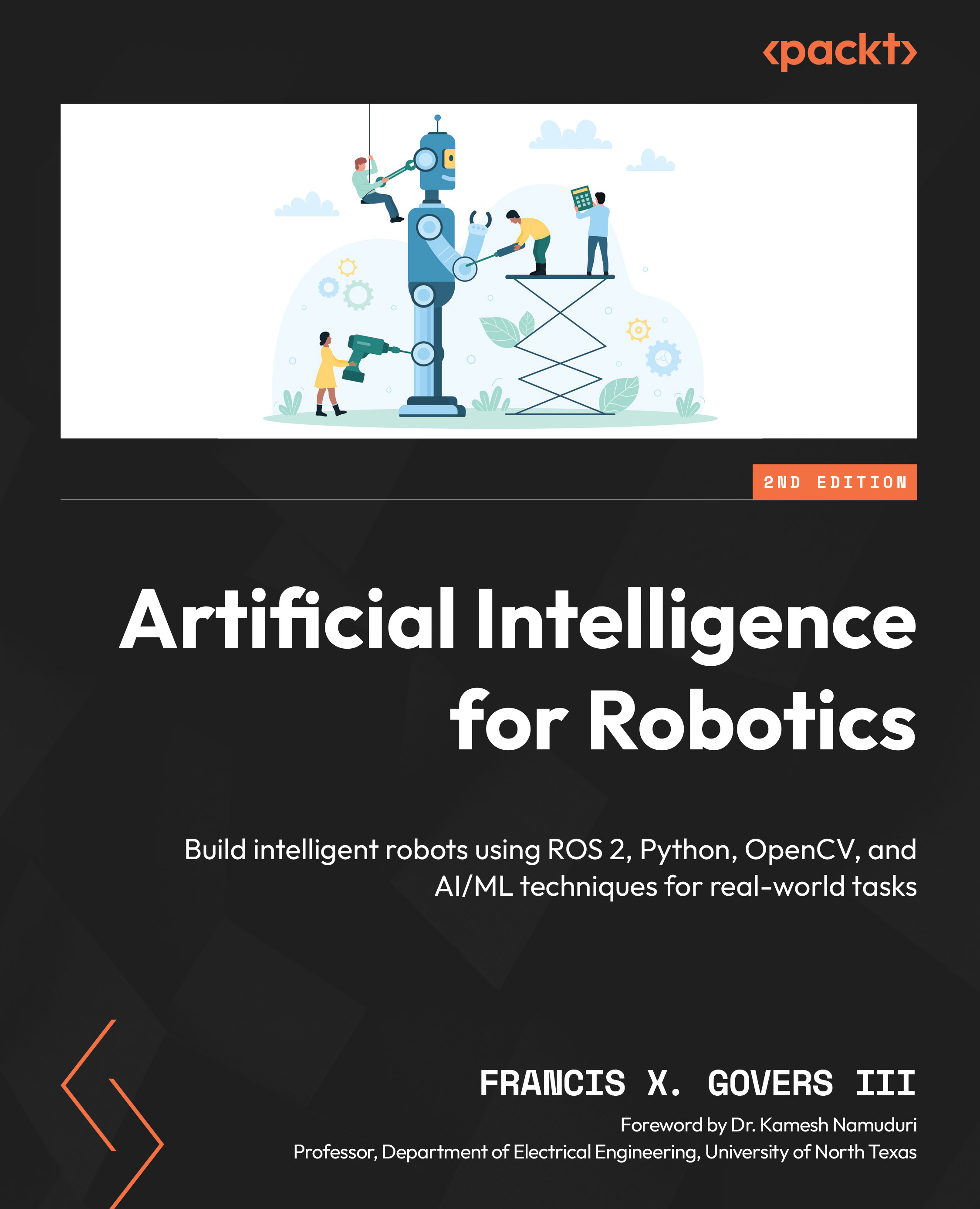
Unlock the potential of your robots by enhancing their perception with cutting-edge artificial intelligence and machine learning techniques. From neural networks to computer vision, this second edition of the book equips you with the latest tools, new and expanded topics such as object recognition and creating artificial personality, and practical use cases to create truly smart robots.
Starting with robotics basics, robot architecture, control systems, and decision-making theory, this book presents systems-engineering methods to design problem-solving robots with single-board computers. You'll explore object recognition using YOLO and genetic algorithms to teach your robot to identify and pick up objects, leverage natural language processing to give your robot a voice, and master neural networks to classify and separate objects and navigate autonomously, before advancing to guiding your robot arms using reinforcement learning and genetic algorithms. The book also covers path planning and goal-oriented programming to prioritize your robot's tasks, showing you how to connect all software using Python and ROS 2 for a seamless experience.
By the end of this book, you'll have learned how to transform your robot into a helpful assistant with NLP and give it an artificial personality, ready to tackle real-world tasks and even crack jokes.
Table of Contents (18 chapters)
Preface


Part 1: Building Blocks for Robotics and Artificial Intelligence
 Free Chapter
Chapter 1: The Foundation of Robotics and Artificial Intelligence
Chapter 2: Setting Up Your Robot
Chapter 3: Conceptualizing the Practical Robot Design Process

Part 2: Adding Perception, Learning, and Interaction to Robotics
Chapter 4: Recognizing Objects Using Neural Networks and Supervised Learning
Chapter 5: Picking Up and Putting Away Toys using Reinforcement Learning and Genetic Algorithms
Chapter 6: Teaching a Robot to Listen
Part 3: Advanced Concepts – Navigation, Manipulation, Emotions, and More
Chapter 7: Teaching the Robot to Navigate and Avoid Stairs
Chapter 8: Putting Things Away
Chapter 9: Giving the Robot an Artificial Personality
Chapter 10: Conclusions and Reflections
Answers
Index
Other Books You May Enjoy


