Sign In Start Free Trial
Account

Add to playlist

Create a Playlist

Modal Close icon
You need to login to use this feature.
  • Book Overview & Buying ROS Robotics By Example
  • Table Of Contents Toc
ROS Robotics By Example

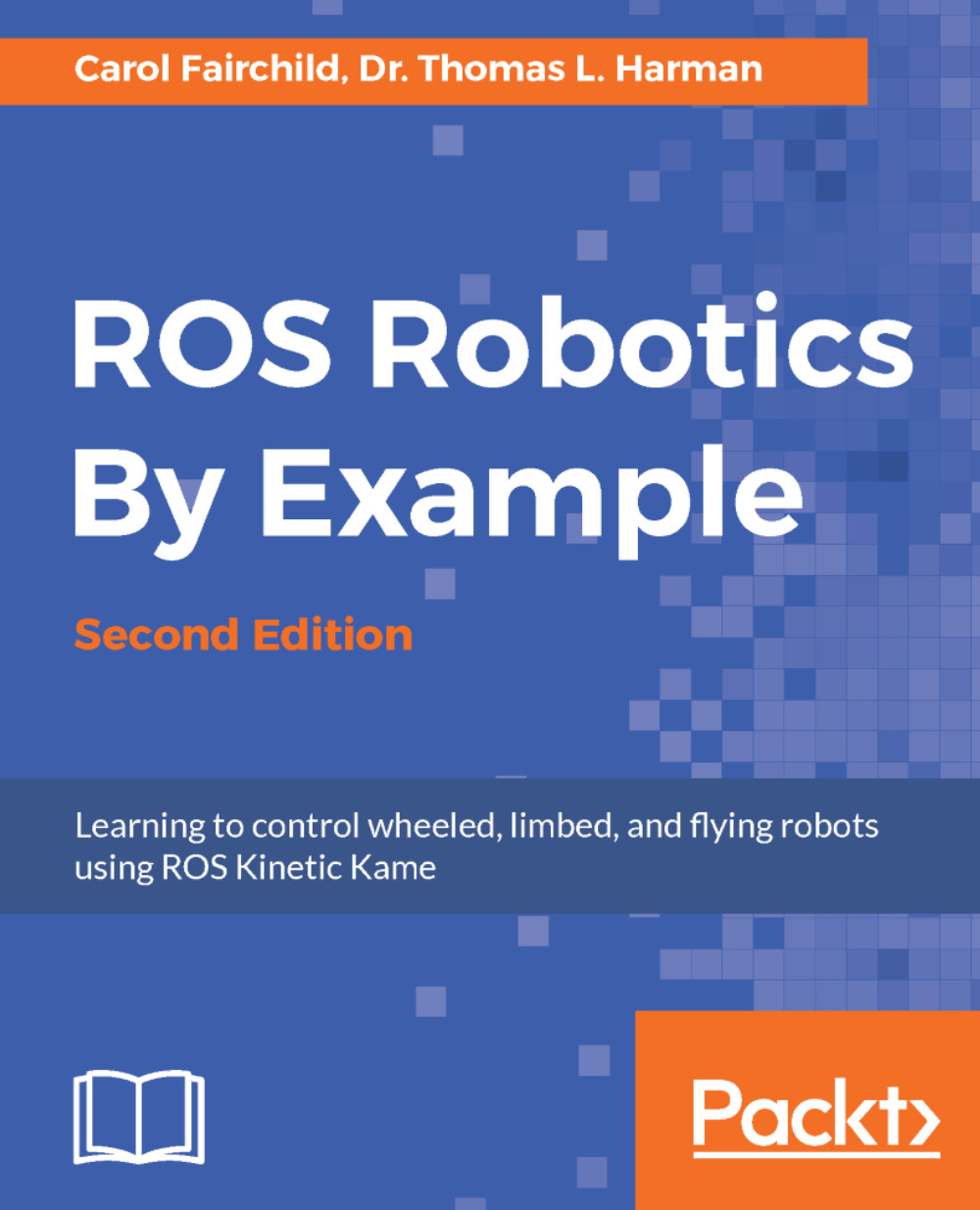
ROS Robotics By Example - Second Edition

By : Lentin Joseph, Carol Fairchild, Dr. Thomas L. Harman
4.3 (6)
close
close
ROS Robotics By Example

ROS Robotics By Example

4.3 (6)
By: Lentin Joseph, Carol Fairchild, Dr. Thomas L. Harman

Overview of this book

ROS is a robust robotics framework that works regardless of hardware architecture or hardware origin. It standardizes most layers of robotics functionality from device drivers to process control and message passing to software package management. But apart from just plain functionality, ROS is a great platform to learn about robotics itself and to simulate, as well as actually build, your first robots. This does not mean that ROS is a platform for students and other beginners; on the contrary, ROS is used all over the robotics industry to implement flying, walking and diving robots, yet implementation is always straightforward, and never dependent on the hardware itself. ROS Robotics has been the standard introduction to ROS for potential professionals and hobbyists alike since the original edition came out; the second edition adds a gradual introduction to all the goodness available with the Kinetic Kame release. By providing you with step-by-step examples including manipulator arms and flying robots, the authors introduce you to the new features. The book is intensely practical, with space given to theory only when absolutely necessary. By the end of this book, you will have hands-on experience on controlling robots with the best possible framework.
Table of Contents (12 chapters)
close
close
11
Index

Chapter 2. Creating Your First Two-Wheeled ROS Robot (in Simulation)

Your first robot will be created in simulation so that even if you do not have a physical robot to learn ROS on, you will be able to follow along and do the exercises in this book. We will build a simple two-wheeled robot named dd_robot (dd is short for differential drive). We will build a Unified Robot Description Format (URDF) file for the robot that will describe the main components of our robot and enable it to be visualized and controlled by ROS tools, such as rviz and Gazebo. Rviz is a visualization tool in which we will view our dd_robot URDF file as we build it in increments. When the visual model is complete, we will modify the URDF file for use in the Gazebo simulator. In Gazebo, we can view the effects of physics on our model as we move our model around the 3D environment.

In this chapter, we will cover the following topics:

  • An introduction to rviz, installation instructions, and instructions for use...
CONTINUE READING
83
Tech Concepts
36
Programming languages
73
Tech Tools
Icon Unlimited access to the largest independent learning library in tech of over 8,000 expert-authored tech books and videos.
Icon Innovative learning tools, including AI book assistants, code context explainers, and text-to-speech.
Icon 50+ new titles added per month and exclusive early access to books as they are being written.
ROS Robotics By Example
notes
bookmark Notes and Bookmarks search Search in title playlist Add to playlist download Download options font-size Font size

Change the font size

margin-width Margin width

Change margin width

day-mode Day/Sepia/Night Modes

Change background colour

Close icon Search
Country selected

Close icon Your notes and bookmarks

Confirmation

Modal Close icon
claim successful

Buy this book with your credits?

Modal Close icon
Are you sure you want to buy this book with one of your credits?
Close
YES, BUY

Submit Your Feedback

Modal Close icon
Modal Close icon
Modal Close icon