


-
Book Overview & Buying
-
Table Of Contents

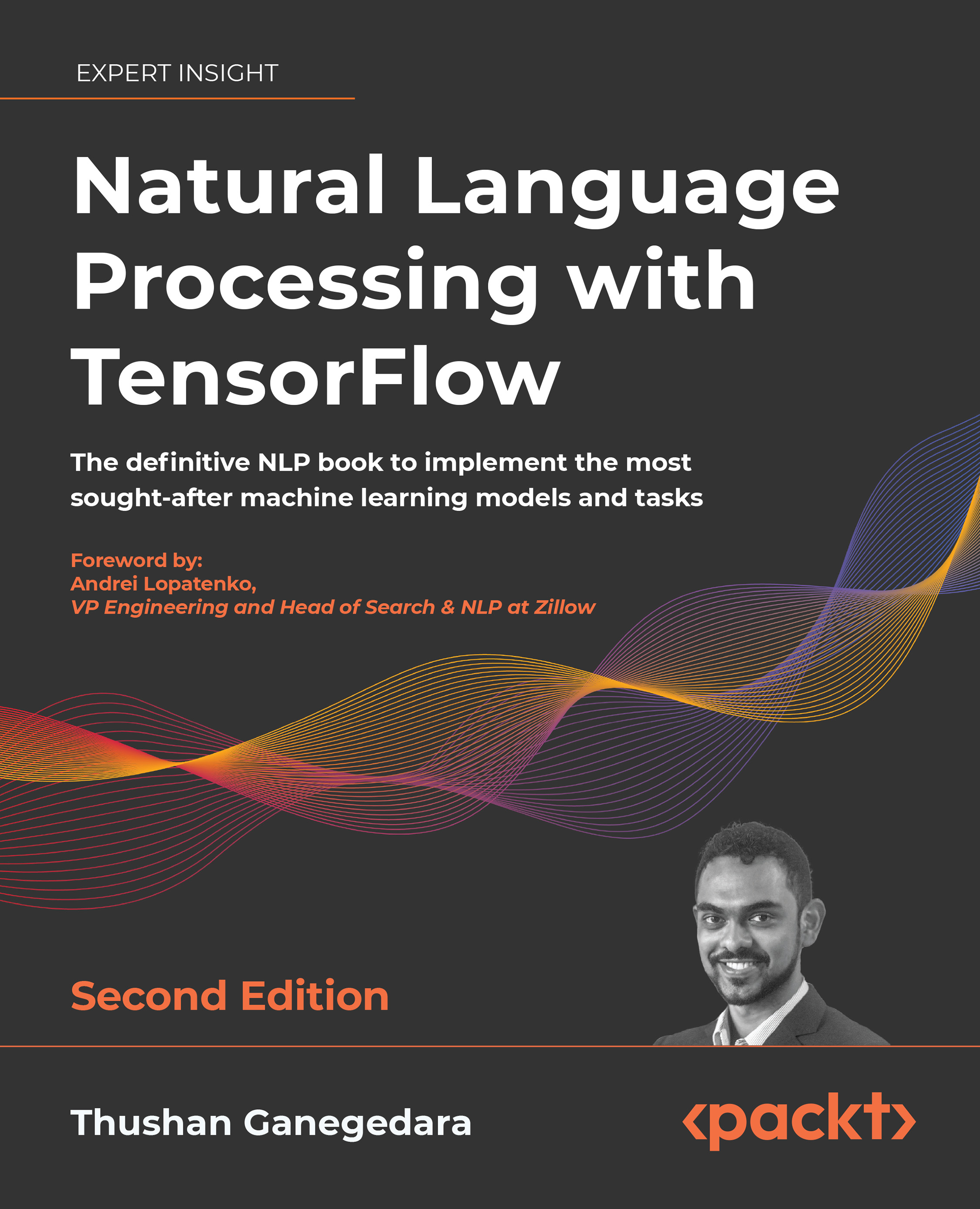
Natural Language Processing with TensorFlow - Second Edition
By :


Natural Language Processing with TensorFlow
By:
Overview of this book
Learning how to solve natural language processing (NLP) problems is an important skill to master due to the explosive growth of data combined with the demand for machine learning solutions in production. Natural Language Processing with TensorFlow, Second Edition, will teach you how to solve common real-world NLP problems with a variety of deep learning model architectures.
The book starts by getting readers familiar with NLP and the basics of TensorFlow. Then, it gradually teaches you different facets of TensorFlow 2.x. In the following chapters, you then learn how to generate powerful word vectors, classify text, generate new text, and generate image captions, among other exciting use-cases of real-world NLP.
TensorFlow has evolved to be an ecosystem that supports a machine learning workflow through ingesting and transforming data, building models, monitoring, and productionization. We will then read text directly from files and perform the required transformations through a TensorFlow data pipeline. We will also see how to use a versatile visualization tool known as TensorBoard to visualize our models.
By the end of this NLP book, you will be comfortable with using TensorFlow to build deep learning models with many different architectures, and efficiently ingest data using TensorFlow Additionally, you’ll be able to confidently use TensorFlow throughout your machine learning workflow.
Table of Contents (15 chapters)
Preface


 Free Chapter
Introduction to Natural Language Processing
Understanding TensorFlow 2
Word2vec – Learning Word Embeddings
Advanced Word Vector Algorithms
Sentence Classification with Convolutional Neural Networks

Recurrent Neural Networks
Understanding Long Short-Term Memory Networks
Applications of LSTM – Generating Text
Sequence-to-Sequence Learning – Neural Machine Translation
Transformers
Image Captioning with Transformers
Other Books You May Enjoy
Index
Appendix A: Mathematical Foundations and Advanced TensorFlow


