
Sign In Start Free Trial
Account

Add to playlist

Create a Playlist

Modal Close icon
You need to login to use this feature.
  • Book Overview & Buying Natural Language Processing with Java Cookbook
  • Table Of Contents Toc
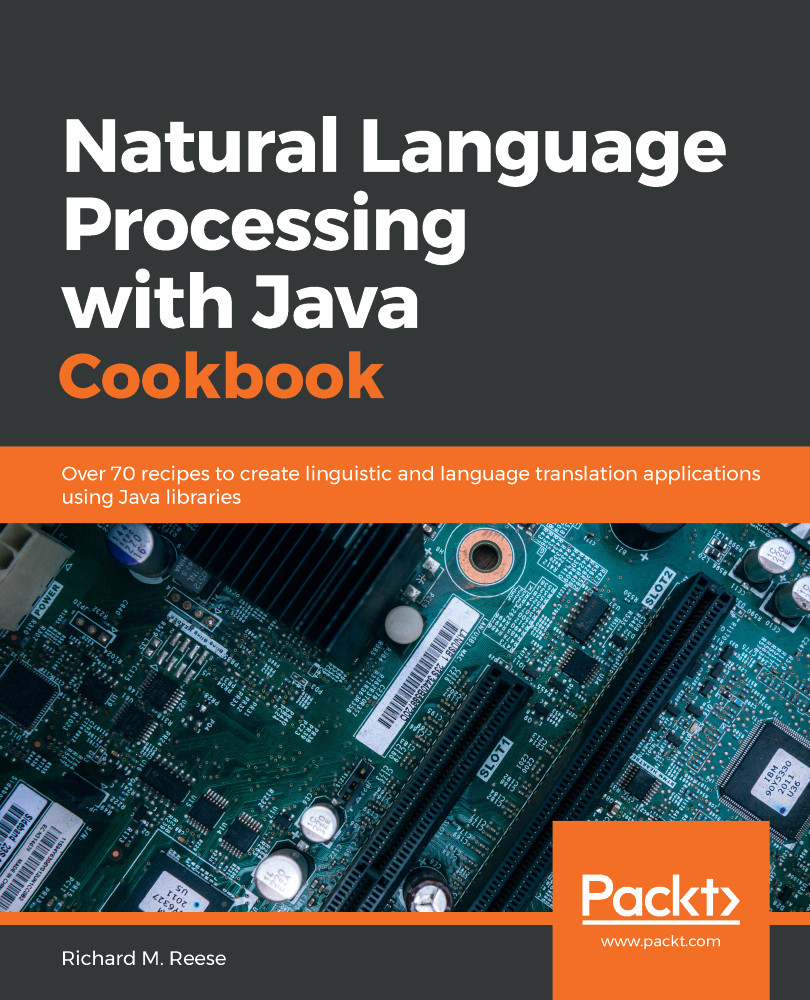
Natural Language Processing with Java Cookbook

Natural Language Processing with Java Cookbook

By : Richard M. Reese , Richard M Reese
close
close
Natural Language Processing with Java Cookbook

Natural Language Processing with Java Cookbook

By: Richard M. Reese , Richard M Reese

Overview of this book

Natural Language Processing (NLP) has become one of the prime technologies for processing very large amounts of unstructured data from disparate information sources. This book includes a wide set of recipes and quick methods that solve challenges in text syntax, semantics, and speech tasks. At the beginning of the book, you'll learn important NLP techniques, such as identifying parts of speech, tagging words, and analyzing word semantics. You will learn how to perform lexical analysis and use machine learning techniques to speed up NLP operations. With independent recipes, you will explore techniques for customizing your existing NLP engines/models using Java libraries such as OpenNLP and the Stanford NLP library. You will also learn how to use NLP processing features from cloud-based sources, including Google and Amazon Web Services (AWS). You will master core tasks, such as stemming, lemmatization, part-of-speech tagging, and named entity recognition. You will also learn about sentiment analysis, semantic text similarity, language identification, machine translation, and text summarization. By the end of this book, you will be ready to become a professional NLP expert using a problem-solution approach to analyze any sort of text, sentence, or semantic word.
Table of Contents (14 chapters)
close
close

Detecting POS Using Neural Networks

The Java core SDK does not provide ready techniques for detecting Part-Of-Speech (POS). This necessitates using specialized NLP APIs. Tags are an important part of identifying POS. A tag is typically an abbreviation such as NN, which specifies that the corresponding word is a noun. There are different sets of tags, which vary somewhat by API. We will reference these lists as they are encountered.

In this chapter, we will cover the following recipes:

  • Finding POS using tagging
  • Using a chunker to find POS
  • Using a tag dictionary
  • Finding POS using the Penn Treebank
  • Finding POS from textese
  • Using a pipeline to perform tagging
  • Using a hidden Markov model to perform POS
  • Training a specialized POS model
Visually different images
CONTINUE READING
83
Tech Concepts
36
Programming languages
73
Tech Tools
Icon Unlimited access to the largest independent learning library in tech of over 8,000 expert-authored tech books and videos.
Icon Innovative learning tools, including AI book assistants, code context explainers, and text-to-speech.
Icon 50+ new titles added per month and exclusive early access to books as they are being written.
Natural Language Processing with Java Cookbook
notes
bookmark Notes and Bookmarks search Search in title playlist Add to playlist download Download options font-size Font size

Change the font size

margin-width Margin width

Change margin width

day-mode Day/Sepia/Night Modes

Change background colour

Close icon Search
Country selected

Close icon Your notes and bookmarks

Confirmation

Modal Close icon
claim successful

Buy this book with your credits?

Modal Close icon
Are you sure you want to buy this book with one of your credits?
Close
YES, BUY

Submit Your Feedback

Modal Close icon
Modal Close icon
Modal Close icon