Sign In Start Free Trial
Account

Add to playlist

Create a Playlist

Modal Close icon
You need to login to use this feature.
  • Book Overview & Buying Mastering Transformers
  • Table Of Contents Toc
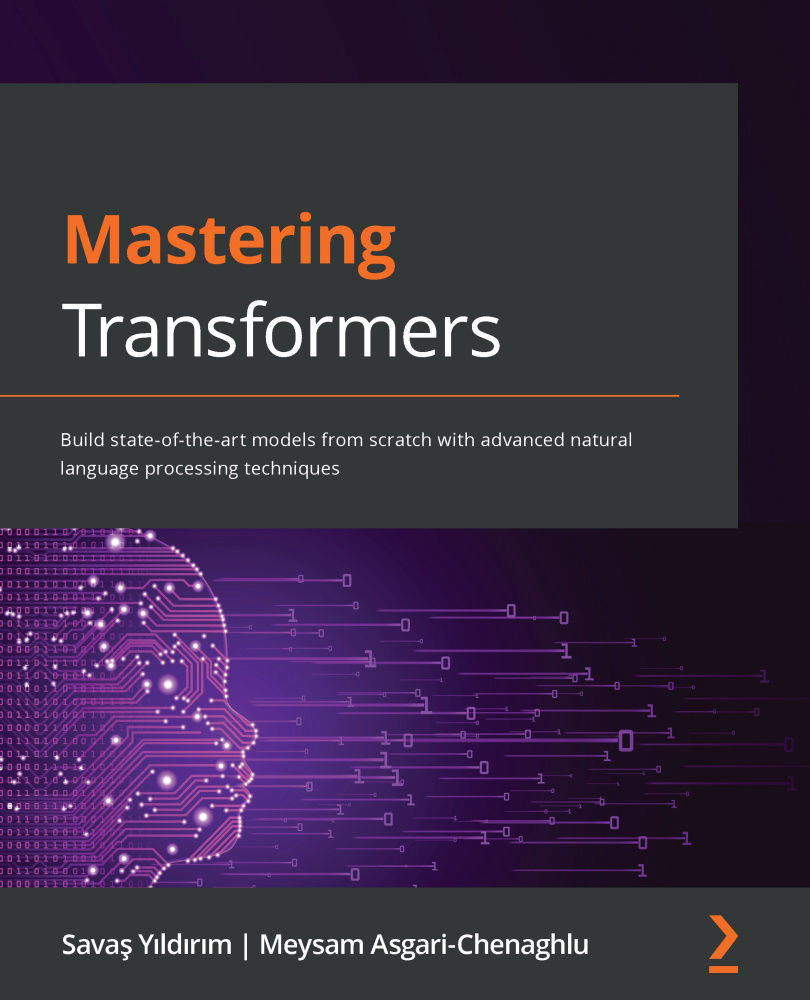
Mastering Transformers

Mastering Transformers

By : Savaş Yıldırım, Meysam Asgari- Chenaghlu
4 (9)
close
close
Mastering Transformers

Mastering Transformers

4 (9)
By: Savaş Yıldırım, Meysam Asgari- Chenaghlu

Overview of this book

Transformer-based language models have dominated natural language processing (NLP) studies and have now become a new paradigm. With this book, you'll learn how to build various transformer-based NLP applications using the Python Transformers library. The book gives you an introduction to Transformers by showing you how to write your first hello-world program. You'll then learn how a tokenizer works and how to train your own tokenizer. As you advance, you'll explore the architecture of autoencoding models, such as BERT, and autoregressive models, such as GPT. You'll see how to train and fine-tune models for a variety of natural language understanding (NLU) and natural language generation (NLG) problems, including text classification, token classification, and text representation. This book also helps you to learn efficient models for challenging problems, such as long-context NLP tasks with limited computational capacity. You'll also work with multilingual and cross-lingual problems, optimize models by monitoring their performance, and discover how to deconstruct these models for interpretability and explainability. Finally, you'll be able to deploy your transformer models in a production environment. By the end of this NLP book, you'll have learned how to use Transformers to solve advanced NLP problems using advanced models.
Table of Contents (16 chapters)
close
close
1
Section 1: Introduction – Recent Developments in the Field, Installations, and Hello World Applications
4
Section 2: Transformer Models – From Autoencoding to Autoregressive Models
10
Section 3: Advanced Topics

Chapter 1: From Bag-of-Words to the Transformer

In this chapter, we will discuss what has changed in Natural Language Processing (NLP) over two decades. We experienced different paradigms and finally entered the era of Transformer architectures. All the paradigms help us to gain a better representation of words and documents for problem-solving. Distributional semantics describes the meaning of a word or a document with vectorial representation, looking at distributional evidence in a collection of articles. Vectors are used to solve many problems in both supervised and unsupervised pipelines. For language-generation problems, n-gram language models have been leveraged as a traditional approach for years. However, these traditional approaches have many weaknesses that we will discuss throughout the chapter.

We will further discuss classical Deep Learning (DL) architectures such as Recurrent Neural Networks (RNNs), Feed-Forward Neural Networks (FFNNs), and Convolutional Neural Networks (CNNs). These have improved the performance of the problems in the field and have overcome the limitation of traditional approaches. However, these models have had their own problems too. Recently, Transformer models have gained immense interest because of their effectiveness in all NLP tasks, from text classification to text generation. However, the main success has been that Transformers effectively improve the performance of multilingual and multi-task NLP problems, as well as monolingual and single tasks. These contributions have made Transfer Learning (TL) more possible in NLP, which aims to make models reusable for different tasks or different languages.

Starting with the attention mechanism, we will briefly discuss the Transformer architecture and the differences between previous NLP models. In parallel with theoretical discussions, we will show practical examples with the popular NLP framework. For the sake of simplicity, we will choose introductory code examples that are as short as possible.

In this chapter, we will cover the following topics:

  • Evolution of NLP toward Transformers
  • Understanding distributional semantics
  • Leveraging DL
  • Overview of the Transformer architecture
  • Using TL with Transformers
Visually different images
CONTINUE READING
83
Tech Concepts
36
Programming languages
73
Tech Tools
Icon Unlimited access to the largest independent learning library in tech of over 8,000 expert-authored tech books and videos.
Icon Innovative learning tools, including AI book assistants, code context explainers, and text-to-speech.
Icon 50+ new titles added per month and exclusive early access to books as they are being written.
Mastering Transformers
notes
bookmark Notes and Bookmarks search Search in title playlist Add to playlist download Download options font-size Font size

Change the font size

margin-width Margin width

Change margin width

day-mode Day/Sepia/Night Modes

Change background colour

Close icon Search
Country selected

Close icon Your notes and bookmarks

Confirmation

Modal Close icon
claim successful

Buy this book with your credits?

Modal Close icon
Are you sure you want to buy this book with one of your credits?
Close
YES, BUY

Submit Your Feedback

Modal Close icon
Modal Close icon
Modal Close icon