


-
Book Overview & Buying
-
Table Of Contents

Mastering Transformers
By :


Mastering Transformers
By:
Overview of this book
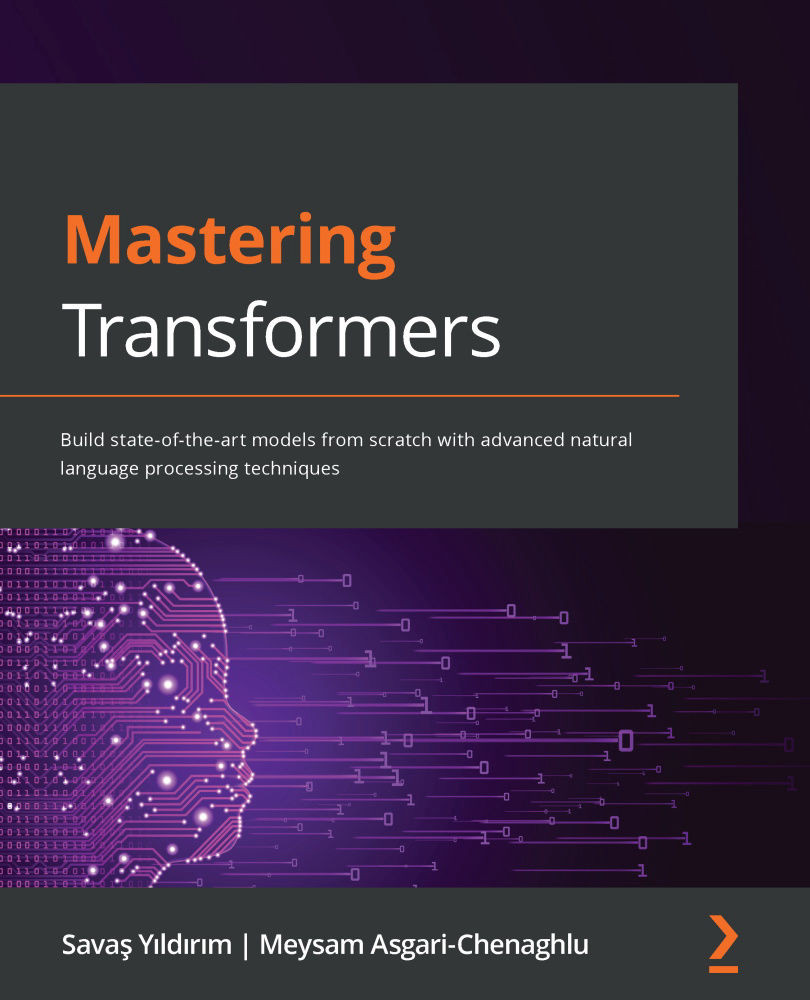
Transformer-based language models have dominated natural language processing (NLP) studies and have now become a new paradigm. With this book, you'll learn how to build various transformer-based NLP applications using the Python Transformers library.
The book gives you an introduction to Transformers by showing you how to write your first hello-world program. You'll then learn how a tokenizer works and how to train your own tokenizer. As you advance, you'll explore the architecture of autoencoding models, such as BERT, and autoregressive models, such as GPT. You'll see how to train and fine-tune models for a variety of natural language understanding (NLU) and natural language generation (NLG) problems, including text classification, token classification, and text representation. This book also helps you to learn efficient models for challenging problems, such as long-context NLP tasks with limited computational capacity. You'll also work with multilingual and cross-lingual problems, optimize models by monitoring their performance, and discover how to deconstruct these models for interpretability and explainability. Finally, you'll be able to deploy your transformer models in a production environment.
By the end of this NLP book, you'll have learned how to use Transformers to solve advanced NLP problems using advanced models.
Table of Contents (16 chapters)
Preface


Section 1: Introduction – Recent Developments in the Field, Installations, and Hello World Applications
 Free Chapter
Chapter 1: From Bag-of-Words to the Transformer
Chapter 2: A Hands-On Introduction to the Subject
Section 2: Transformer Models – From Autoencoding to Autoregressive Models
Chapter 3: Autoencoding Language Models
Chapter 4:Autoregressive and Other Language Models
Chapter 5: Fine-Tuning Language Models for Text Classification
Chapter 6: Fine-Tuning Language Models for Token Classification

Chapter 7: Text Representation
Section 3: Advanced Topics
Chapter 8: Working with Efficient Transformers
Chapter 9:Cross-Lingual and Multilingual Language Modeling
Chapter 10: Serving Transformer Models
Chapter 11: Attention Visualization and Experiment Tracking
Other Books You May Enjoy


