Sign In Start Free Trial
Account

Add to playlist

Create a Playlist

Modal Close icon
You need to login to use this feature.
  • Book Overview & Buying Machine Learning Techniques for Text
  • Table Of Contents Toc
Machine Learning Techniques for Text

Machine Learning Techniques for Text

By : Nikos Tsourakis
4.8 (6)
close
close
Machine Learning Techniques for Text

Machine Learning Techniques for Text

4.8 (6)
By: Nikos Tsourakis

Overview of this book

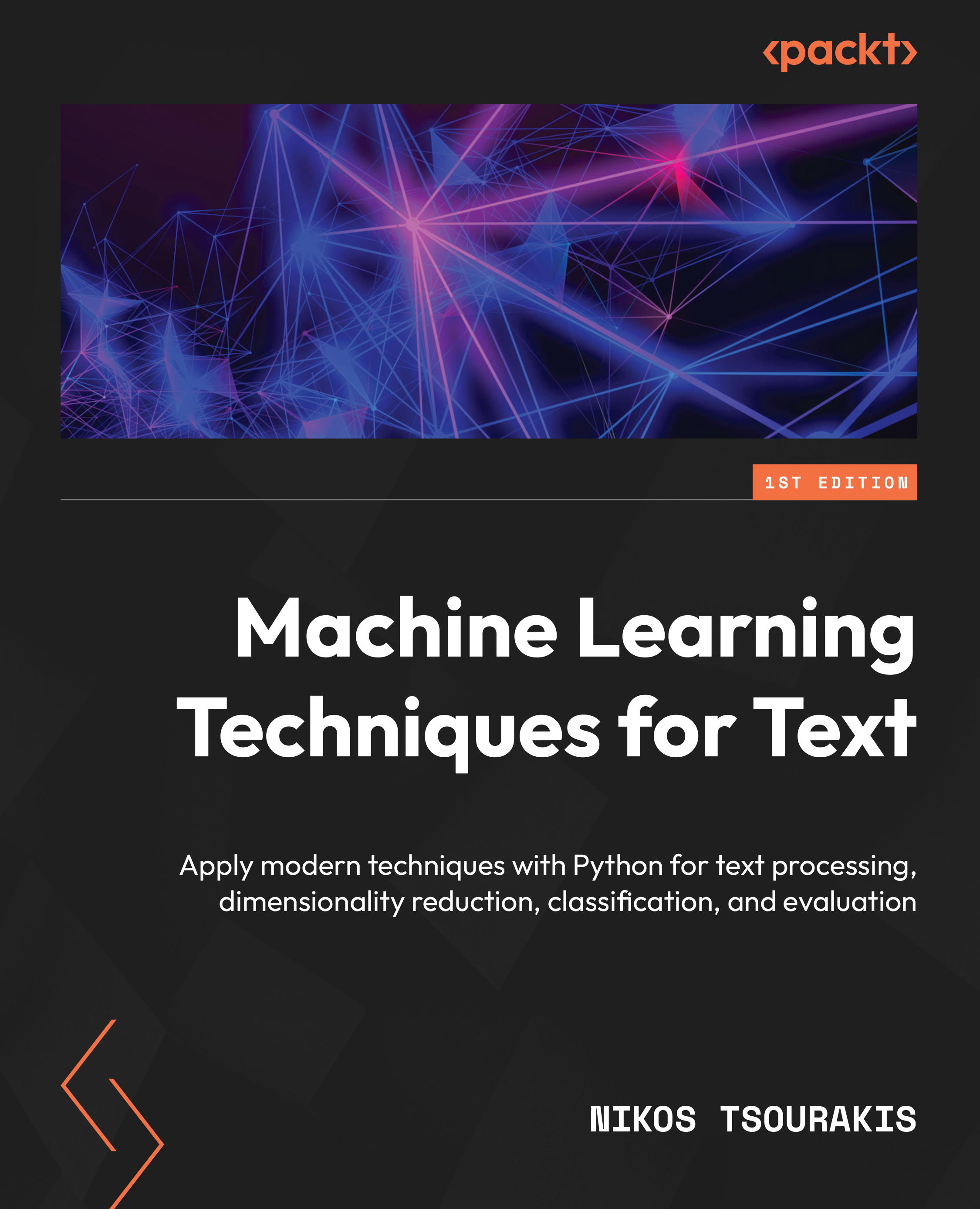
With the ever-increasing demand for machine learning and programming professionals, it's prime time to invest in the field. This book will help you in this endeavor, focusing specifically on text data and human language by steering a middle path among the various textbooks that present complicated theoretical concepts or focus disproportionately on Python code. A good metaphor this work builds upon is the relationship between an experienced craftsperson and their trainee. Based on the current problem, the former picks a tool from the toolbox, explains its utility, and puts it into action. This approach will help you to identify at least one practical use for each method or technique presented. The content unfolds in ten chapters, each discussing one specific case study. For this reason, the book is solution-oriented. It's accompanied by Python code in the form of Jupyter notebooks to help you obtain hands-on experience. A recurring pattern in the chapters of this book is helping you get some intuition on the data and then implement and contrast various solutions. By the end of this book, you'll be able to understand and apply various techniques with Python for text preprocessing, text representation, dimensionality reduction, machine learning, language modeling, visualization, and evaluation.
Table of Contents (13 chapters)
close
close

Preface

Crafting machines that can learn from data to perform intelligent decisions is becoming the dominant paradigm in many areas of technology. Acquiring the necessary skill set to perform this task will definitely boost your career. Machine Learning Techniques for Text aims to help you in this endeavor, focusing specifically on text data and human language. The book will show you how to analyze text data, get started with machine learning, and work effectively with the Python libraries often used for these tasks, such as pandas, NumPy, matplotlib, seaborn, and scikit-learn. You will also have the opportunity to work with state-of-the-art deep learning frameworks such as TensorFlow, Keras, and PyTorch.

There is a plethora of resources for mastering the field of machine learning for text, including complex theoretical concepts often expressed in a demanding mathematical language. Conversely, other resources focus disproportionately on Python code, and the theoretical foundations behind the design choices remain shallow. This book steers a middle path to keep the right balance between theory and practice. A good metaphor the book’s content builds upon is the relationship between an experienced craftsperson and their trainee. Based on the problem, the craftsperson picks a tool from the toolbox, explains its utility, and puts it into action. This approach will help you to identify at least one practical usage for the method or technique presented.

In each chapter, we focus on one specific case study using real-world datasets. For that reason, the book is solution oriented, and it’s accompanied by Python code in the form of Jupyter notebooks to help you obtain hands-on experience. This case study approach will allow you to engage more readily in learning and not just passively absorb information. Each time, the problem statement is set from the beginning, and everybody is aware of the challenge. Even if the discussion temporarily diverts from the principal aim, for instance, presenting some fundamental concept, you will be easily reoriented on the problem under study. A recurring pattern in the chapters is that we first try to gain some intuition on the data and then implement and contrast various solutions.

By the end of this book, you’ll be able to understand and apply various techniques with Python for text preprocessing, text representation, dimensionality reduction, machine learning, language modeling, visualization, and evaluation. This diverse skillset will allow you to work on similar problems seamlessly.

CONTINUE READING
83
Tech Concepts
36
Programming languages
73
Tech Tools
Icon Unlimited access to the largest independent learning library in tech of over 8,000 expert-authored tech books and videos.
Icon Innovative learning tools, including AI book assistants, code context explainers, and text-to-speech.
Icon 50+ new titles added per month and exclusive early access to books as they are being written.
Machine Learning Techniques for Text
notes
bookmark Notes and Bookmarks search Search in title playlist Add to playlist download Download options font-size Font size

Change the font size

margin-width Margin width

Change margin width

day-mode Day/Sepia/Night Modes

Change background colour

Close icon Search
Country selected

Close icon Your notes and bookmarks

Confirmation

Modal Close icon
claim successful

Buy this book with your credits?

Modal Close icon
Are you sure you want to buy this book with one of your credits?
Close
YES, BUY

Submit Your Feedback

Modal Close icon
Modal Close icon
Modal Close icon