


-
Book Overview & Buying
-
Table Of Contents

-
Feedback & Rating

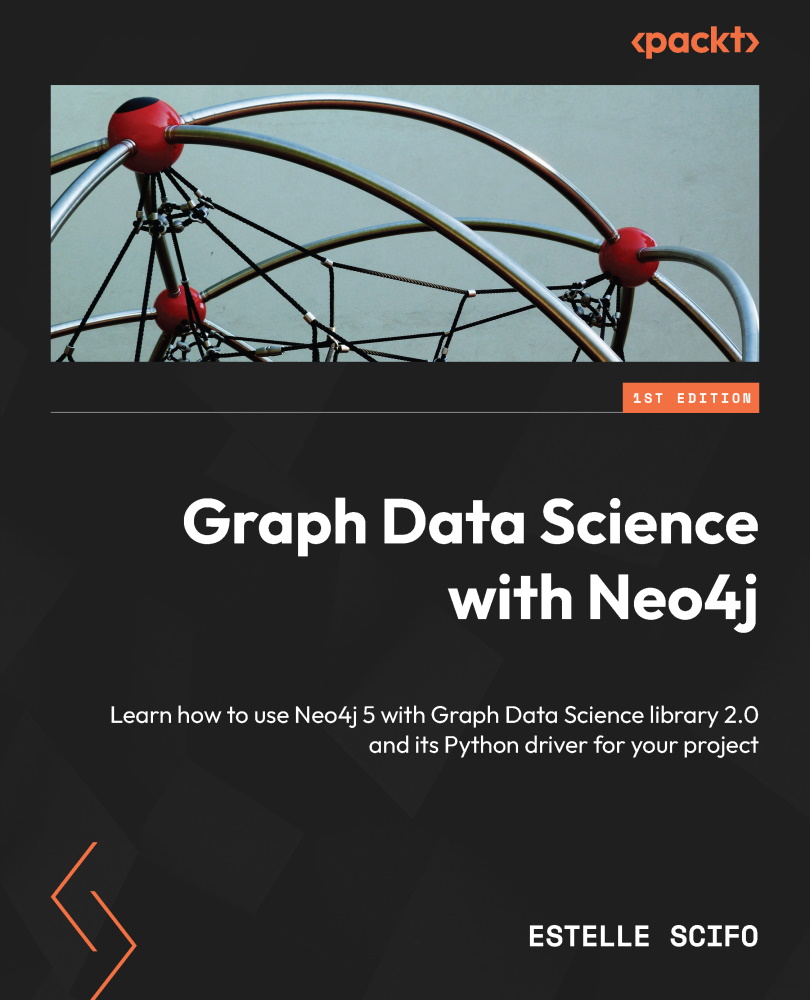
Graph Data Science with Neo4j
By :


Graph Data Science with Neo4j
By:
Overview of this book
Neo4j, along with its Graph Data Science (GDS) library, is a complete solution to store, query, and analyze graph data. As graph databases are getting more popular among developers, data scientists are likely to face such databases in their career, making it an indispensable skill to work with graph algorithms for extracting context information and improving the overall model prediction performance.
Data scientists working with Python will be able to put their knowledge to work with this practical guide to Neo4j and the GDS library that offers step-by-step explanations of essential concepts and practical instructions for implementing data science techniques on graph data using the latest Neo4j version 5 and its associated libraries. You’ll start by querying Neo4j with Cypher and learn how to characterize graph datasets. As you get the hang of running graph algorithms on graph data stored into Neo4j, you’ll understand the new and advanced capabilities of the GDS library that enable you to make predictions and write data science pipelines. Using the newly released GDSL Python driver, you’ll be able to integrate graph algorithms into your ML pipeline.
By the end of this book, you’ll be able to take advantage of the relationships in your dataset to improve your current model and make other types of elaborate predictions.
Table of Contents (16 chapters)
Preface


Part 1 – Creating Graph Data in Neo4j
 Free Chapter
Chapter 1: Introducing and Installing Neo4j
Chapter 2: Importing Data into Neo4j to Build a Knowledge Graph
Part 2 – Exploring and Characterizing Graph Data with Neo4j
Chapter 3: Characterizing a Graph Dataset
Chapter 4: Using Graph Algorithms to Characterize a Graph Dataset

Chapter 5: Visualizing Graph Data
Part 3 – Making Predictions on a Graph
Chapter 6: Building a Machine Learning Model with Graph Features
Chapter 7: Automatically Extracting Features with Graph Embeddings for Machine Learning
Chapter 8: Building a GDS Pipeline for Node Classification Model Training
Chapter 9: Predicting Future Edges
Chapter 10: Writing Your Custom Graph Algorithms with the Pregel API in Java
Index
Customer Reviews



