
Sign In Start Free Trial
Account

Add to playlist

Create a Playlist

Modal Close icon
You need to login to use this feature.
  • Book Overview & Buying Hands-On Python Natural Language Processing
  • Table Of Contents Toc
Hands-On Python Natural Language Processing

Hands-On Python Natural Language Processing

By : Kedia, Rasu
4.5 (4)
close
close
Hands-On Python Natural Language Processing

Hands-On Python Natural Language Processing

4.5 (4)
By: Kedia, Rasu

Overview of this book

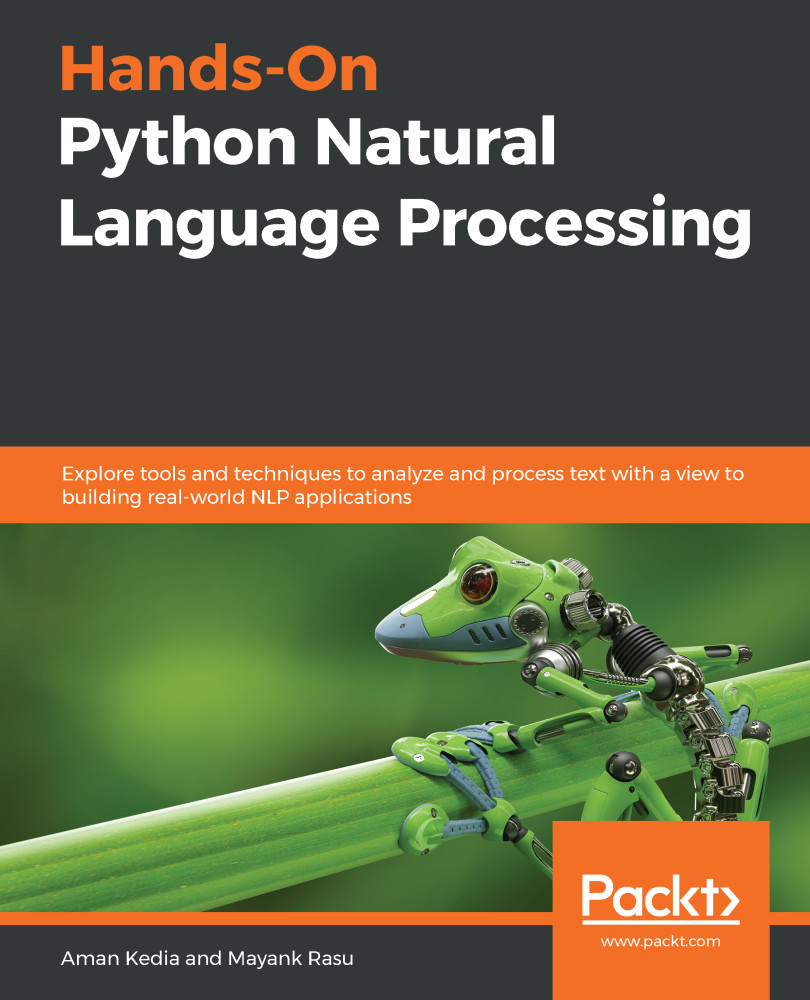
Natural Language Processing (NLP) is the subfield in computational linguistics that enables computers to understand, process, and analyze text. This book caters to the unmet demand for hands-on training of NLP concepts and provides exposure to real-world applications along with a solid theoretical grounding. This book starts by introducing you to the field of NLP and its applications, along with the modern Python libraries that you'll use to build your NLP-powered apps. With the help of practical examples, you’ll learn how to build reasonably sophisticated NLP applications, and cover various methodologies and challenges in deploying NLP applications in the real world. You'll cover key NLP tasks such as text classification, semantic embedding, sentiment analysis, machine translation, and developing a chatbot using machine learning and deep learning techniques. The book will also help you discover how machine learning techniques play a vital role in making your linguistic apps smart. Every chapter is accompanied by examples of real-world applications to help you build impressive NLP applications of your own. By the end of this NLP book, you’ll be able to work with language data, use machine learning to identify patterns in text, and get acquainted with the advancements in NLP.
Table of Contents (16 chapters)
close
close
1
Section 1: Introduction
4
Section 2: Natural Language Representation and Mathematics
9
Section 3: NLP and Learning
Identifying Patterns in Text Using Machine Learning

In the previous chapter, we learned about advanced vector representation methodologies such as Doc2Vec and Sent2Vec, which significantly improve text processing accuracy. In this chapter, we will explore the applications of Machine Learning (ML) algorithms in Natural Language Processing (NLP). We will start with a gentle introduction to ML and learn about some additional preprocessing steps required for ML model training. We will then gain a thorough understanding of Naive Bayes and Support Vector Machine (SVM) algorithms and build a sentiment analyzer using them. By the end of this chapter, you will have gained a sound understanding of the application of ML algorithms for text processing and will be able to build a production-ready ML-based sentiment analyzer.

The following topics will be covered in this chapter:

  • Introduction...
CONTINUE READING
83
Tech Concepts
36
Programming languages
73
Tech Tools
Icon Unlimited access to the largest independent learning library in tech of over 8,000 expert-authored tech books and videos.
Icon Innovative learning tools, including AI book assistants, code context explainers, and text-to-speech.
Icon 50+ new titles added per month and exclusive early access to books as they are being written.
Hands-On Python Natural Language Processing
notes
bookmark Notes and Bookmarks search Search in title playlist Add to playlist download Download options font-size Font size

Change the font size

margin-width Margin width

Change margin width

day-mode Day/Sepia/Night Modes

Change background colour

Close icon Search
Country selected

Close icon Your notes and bookmarks

Confirmation

Modal Close icon
claim successful

Buy this book with your credits?

Modal Close icon
Are you sure you want to buy this book with one of your credits?
Close
YES, BUY

Submit Your Feedback

Modal Close icon
Modal Close icon
Modal Close icon