Sign In Start Free Trial
Account

Add to playlist

Create a Playlist

Modal Close icon
You need to login to use this feature.
  • Book Overview & Buying Building Python Real time Applications with Storm
  • Table Of Contents Toc
  • Feedback & Rating feedback
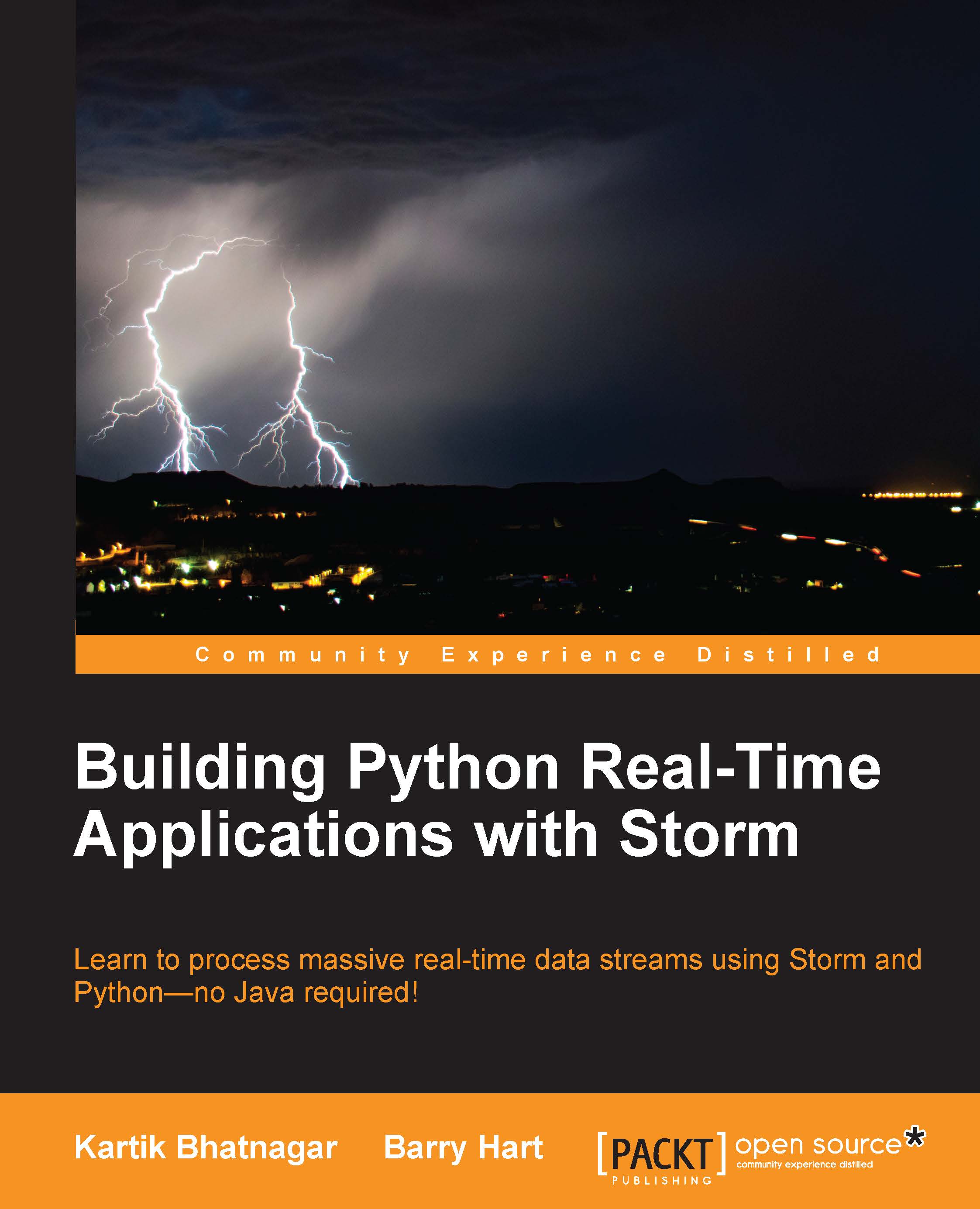
Building Python Real time Applications with Storm

Building Python Real time Applications with Storm

By : Bhatnagar, Hart
close
close
Building Python Real time Applications with Storm

Building Python Real time Applications with Storm

By: Bhatnagar, Hart

Overview of this book

Big data is a trending concept that everyone wants to learn about. With its ability to process all kinds of data in real time, Storm is an important addition to your big data “bag of tricks.” At the same time, Python is one of the fastest-growing programming languages today. It has become a top choice for both data science and everyday application development. Together, Storm and Python enable you to build and deploy real-time big data applications quickly and easily. You will begin with some basic command tutorials to set up storm and learn about its configurations in detail. You will then go through the requirement scenarios to create a Storm cluster. Next, you’ll be provided with an overview of Petrel, followed by an example of Twitter topology and persistence using Redis and MongoDB. Finally, you will build a production-quality Storm topology using development best practices.
Table of Contents (9 chapters)
close
close

Chapter 3. Introducing Petrel

As discussed in Chapter 1, Getting Acquainted with Storm, Storm is a platform for processing large amounts of data in real time. Storm applications are often written in Java, but Storm supports other languages as well, including Python. While the concepts are similar across languages, the details vary by language. In this chapter, we'll get our first hands-on experience using Storm with Python. First, you'll learn about a Python library called Petrel, which is necessary for creating topologies in Python. Next, we'll set up our Python/Storm development environment. Then, we'll take a close look at a working Storm topology written in Python. Finally, we'll run the topology and you will learn some key techniques to ease the process of developing and debugging topologies. After you complete this chapter, you'll have a good high-level understanding of developing basic Storm topologies. In this chapter, we will cover these...

Visually different images
CONTINUE READING
83
Tech Concepts
36
Programming languages
73
Tech Tools
Icon Unlimited access to the largest independent learning library in tech of over 8,000 expert-authored tech books and videos.
Icon Innovative learning tools, including AI book assistants, code context explainers, and text-to-speech.
Icon 50+ new titles added per month and exclusive early access to books as they are being written.
Building Python Real time Applications with Storm
notes
bookmark Notes and Bookmarks search Search in title playlist Add to playlist font-size Font size

Change the font size

margin-width Margin width

Change margin width

day-mode Day/Sepia/Night Modes

Change background colour

Close icon Search
Country selected

Close icon Your notes and bookmarks

Confirmation

Modal Close icon
claim successful

Buy this book with your credits?

Modal Close icon
Are you sure you want to buy this book with one of your credits?
Close
YES, BUY

Submit Your Feedback

Modal Close icon
Modal Close icon
Modal Close icon