Sign In Start Free Trial
Account

Add to playlist

Create a Playlist

Modal Close icon
You need to login to use this feature.
  • Book Overview & Buying Rspec Essentials
  • Table Of Contents Toc
  • Feedback & Rating feedback
Rspec Essentials

Rspec Essentials

By : Tadayon
3.3 (3)
close
close
Rspec Essentials

Rspec Essentials

3.3 (3)
By: Tadayon

Overview of this book

This book will teach you how to use RSpec to write high-value tests for real-world code. We start with the key concepts of the unit and testability, followed by hands-on exploration of key features. From the beginning, we learn how to integrate tests into the overall development process to help create high-quality code, avoiding the dangers of testing for its own sake. We build up sample applications and their corresponding tests step by step, from simple beginnings to more sophisticated versions that include databases and external web services. We devote three chapters to web applications with rich JavaScript user interfaces, building one from the ground up using behavior-driven development (BDD) and test-driven development (TDD). The code examples are detailed enough to be realistic while simple enough to be easily understood. Testing concepts, development methodologies, and engineering tradeoffs are discussed in detail as they arise. This approach is designed to foster the reader’s ability to make well-informed decisions on their own.
Table of Contents (12 chapters)
close
close
11
Index

Writing specs with RSpec

We have discussed a lot of theory; now, let's start applying it. We'll write a few specs for the AddressValidator module defined below:

module AddressValidator
  FIELD_NAMES = [:street, :city, :region, :postal_code, :country]
  VALID_VALUE = /^[A-Za-z0-9\.\# ]+$/
  class << self
    def valid?(o)
      normalized = parse(o)
      FIELD_NAMES.all? do |k|
        v = normalized[k]
        !v.nil? && v != "" && valid_part?(v)
      end
    end

    def missing_parts(o)
      normalized = parse(o)
      FIELD_NAMES - normalized.keys
    end

    private

    def parse(o)
      if (o.is_a?(String))
        values = o.split(",").map(&:strip)
        Hash[ FIELD_NAMES.zip(values) ]
      elseif (o.is_a?(Hash))
        o
      else
        raise "Don't know how to parse #{o.class}"
      end
    end

    def valid_part?(value)
      value =~ VALID_VALUE
    end
  end
end

We'll store the code above in a file called address_validator.rb. Let's start with a couple of simple tests in this chapter. In the next chapter, we'll explore a few different ways to expand and improve these tests, but for now we'll just focus on getting up and running with our first real RSpec tests.

We'll put the following code in a file called address_validator_spec.rb in the same folder as address_validator.rb:

require 'rspec'
require_relative 'address_validator'

describe AddressValidator do
  it "returns false for incomplete address" do
    address = { street: "123 Any Street", city: "Anytown" }
    expect(
      AddressValidator.valid?(address)
    ).to eq(false)
  end

  it "missing_parts returns an array of missing required parts" do
    address = { street: "123 Any Street", city: "Anytown" }
    expect(
      AddressValidator.missing_parts(address)
    ).to eq([:region, :postal_code, :country])
  end
end

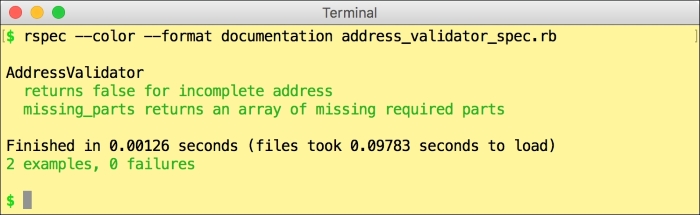
Now, let's run RSpec (make sure you have it installed already!) like this:

Writing specs with RSpec

That's it. We used a couple of options to format the output, which is self-explanatory. We'll dig deeper into how to run specs with various options in future chapters. For now, we've accomplished our goal of running RSpec for a couple of unit tests.

Now is a good time to reflect on the concepts of testability and the unit of code. How testable is our AddressValidator module? Do you see any potential problems? What about the units we've tested? Are they isolated and modular? Do you see any places where we could do better? Take some time to review the code and think about these questions before moving on to the next section.

Visually different images
CONTINUE READING
83
Tech Concepts
36
Programming languages
73
Tech Tools
Icon Unlimited access to the largest independent learning library in tech of over 8,000 expert-authored tech books and videos.
Icon Innovative learning tools, including AI book assistants, code context explainers, and text-to-speech.
Icon 50+ new titles added per month and exclusive early access to books as they are being written.
Rspec Essentials
notes
bookmark Notes and Bookmarks search Search in title playlist Add to playlist font-size Font size

Change the font size

margin-width Margin width

Change margin width

day-mode Day/Sepia/Night Modes

Change background colour

Close icon Search
Country selected

Close icon Your notes and bookmarks

Confirmation

Modal Close icon
claim successful

Buy this book with your credits?

Modal Close icon
Are you sure you want to buy this book with one of your credits?
Close
YES, BUY

Submit Your Feedback

Modal Close icon
Modal Close icon
Modal Close icon