Sign In Start Free Trial
Account

Add to playlist

Create a Playlist

Modal Close icon
You need to login to use this feature.
  • Book Overview & Buying Modular Programming with Python
  • Table Of Contents Toc
Modular Programming with Python

Modular Programming with Python

By : Westra
4 (3)
close
close
Modular Programming with Python

Modular Programming with Python

4 (3)
By: Westra

Overview of this book

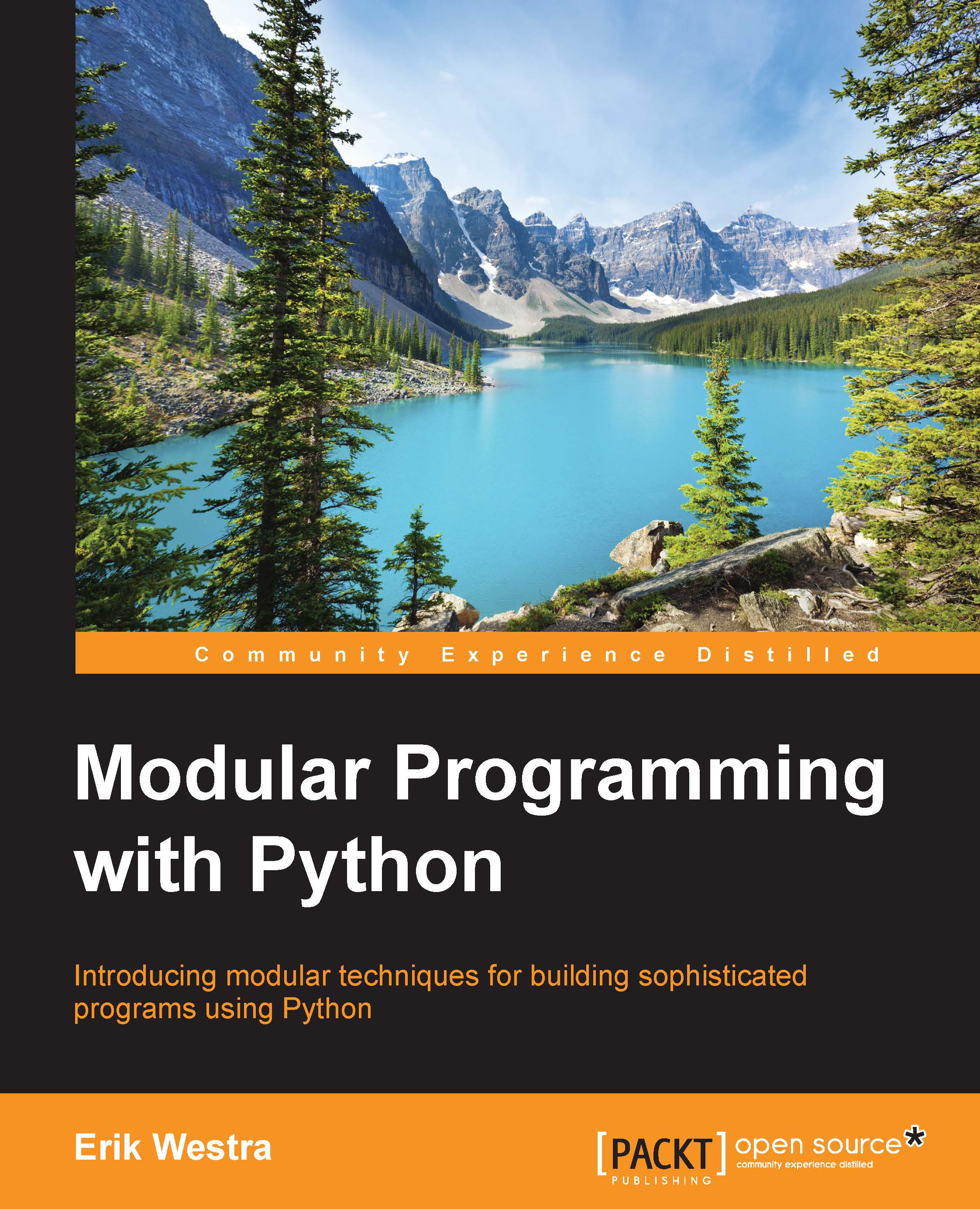
Python has evolved over the years and has become the primary choice of developers in various fields. The purpose of this book is to help readers develop readable, reliable, and maintainable programs in Python. Starting with an introduction to the concept of modules and packages, this book shows how you can use these building blocks to organize a complex program into logical parts and make sure those parts are working correctly together. Using clearly written, real-world examples, this book demonstrates how you can use modular techniques to build better programs. A number of common modular programming patterns are covered, including divide-and-conquer, abstraction, encapsulation, wrappers and extensibility. You will also learn how to test your modules and packages, how to prepare your code for sharing with other people, and how to publish your modules and packages on GitHub and the Python Package Index so that other people can use them. Finally, you will learn how to use modular design techniques to be a more effective programmer.
Table of Contents (11 chapters)
close
close
10
Index

Summary


In this chapter, we learned about the various ways in which you can test your Python modules and packages. We learned about unit testing and how the unittest package in the Python Standard Library makes it easier to write and use unit tests for the modules and packages that you develop. We saw how unit tests use the assert statement (or the various assertXXX() methods if you are using the unittest.TestCase class) to raise an AssertionError if a particular condition has not been met. By writing various unit tests, you can ensure that your modules and packages are working the way you expect them to.

We then looked at the process of preparing a module or package for publication, and saw how GitHub provides an excellent repository for storing and managing the source code for your modules and packages.

After creating our own test package, we worked through the process of submitting this package to the Python Package Index. Finally, we learned how to use pip, the Python Package Manager,...

CONTINUE READING
83
Tech Concepts
36
Programming languages
73
Tech Tools
Icon Unlimited access to the largest independent learning library in tech of over 8,000 expert-authored tech books and videos.
Icon Innovative learning tools, including AI book assistants, code context explainers, and text-to-speech.
Icon 50+ new titles added per month and exclusive early access to books as they are being written.
Modular Programming with Python
notes
bookmark Notes and Bookmarks search Search in title playlist Add to playlist download Download options font-size Font size

Change the font size

margin-width Margin width

Change margin width

day-mode Day/Sepia/Night Modes

Change background colour

Close icon Search
Country selected

Close icon Your notes and bookmarks

Confirmation

Modal Close icon
claim successful

Buy this book with your credits?

Modal Close icon
Are you sure you want to buy this book with one of your credits?
Close
YES, BUY

Submit Your Feedback

Modal Close icon
Modal Close icon
Modal Close icon