Sign In Start Free Trial
Account

Add to playlist

Create a Playlist

Modal Close icon
You need to login to use this feature.
  • Book Overview & Buying Node.js  Design Patterns
  • Table Of Contents Toc
  • Feedback & Rating feedback
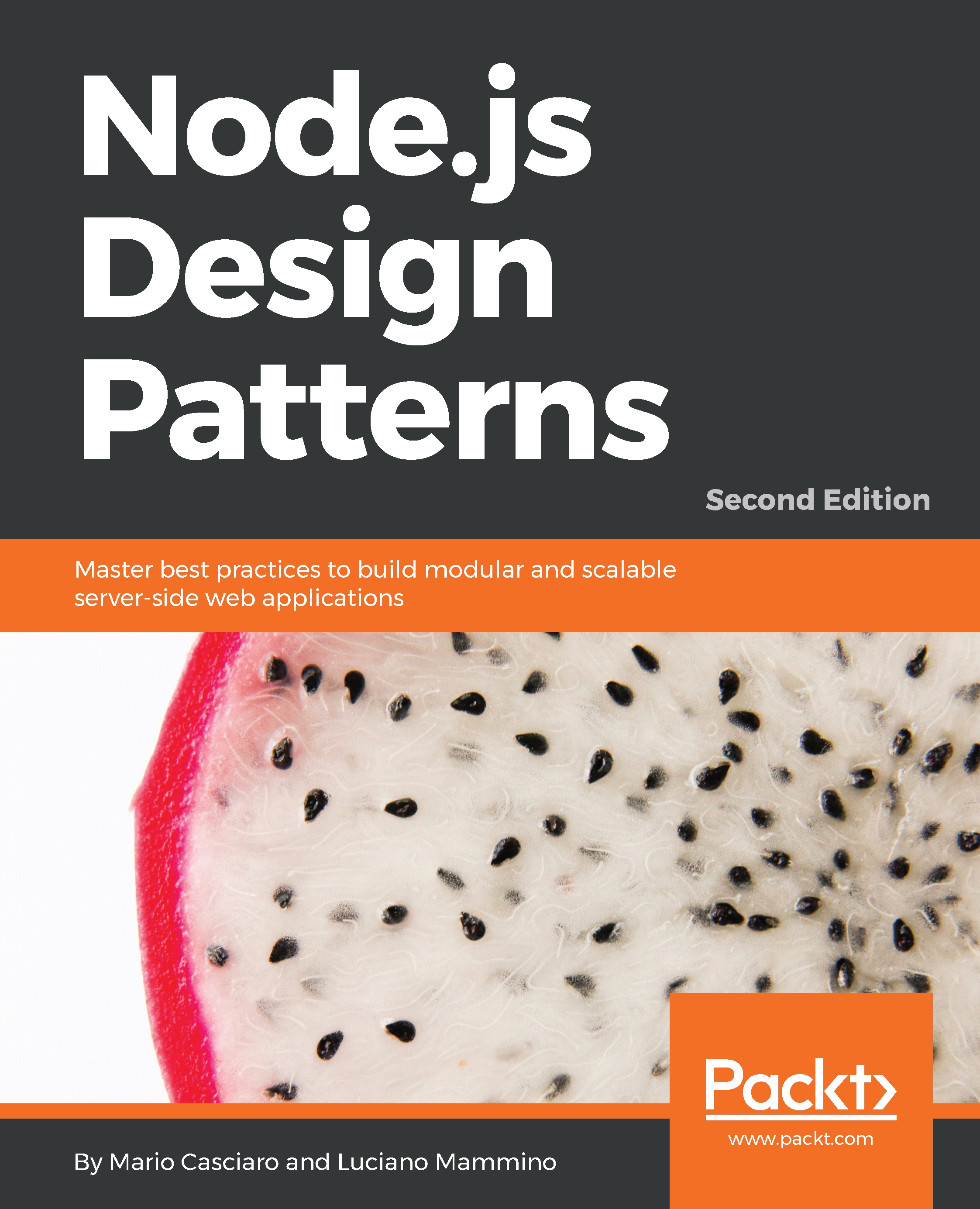
Node.js  Design Patterns

Node.js Design Patterns - Second Edition

By : Luciano Mammino, Purra, Mario Casciaro
4.6 (32)
close
close
Node.js  Design Patterns

Node.js Design Patterns

4.6 (32)
By: Luciano Mammino, Purra, Mario Casciaro

Overview of this book

Node.js is a massively popular software platform that lets you use JavaScript to easily create scalable server-side applications. It allows you to create efficient code, enabling a more sustainable way of writing software made of only one language across the full stack, along with extreme levels of reusability, pragmatism, simplicity, and collaboration. Node.js is revolutionizing the web and the way people and companies create their software. In this book, we will take you on a journey across various ideas and components, and the challenges you would commonly encounter while designing and developing software using the Node.js platform. You will also discover the "Node.js way" of dealing with design and coding decisions. The book kicks off by exploring the basics of Node.js describing it's asynchronous single-threaded architecture and the main design patterns. It then shows you how to master the asynchronous control flow patterns,and the stream component and it culminates into a detailed list of Node.js implementations of the most common design patterns as well as some specific design patterns that are exclusive to the Node.js world.Lastly, it dives into more advanced concepts such as Universal Javascript, and scalability' and it's meant to conclude the journey by giving the reader all the necessary concepts to be able to build an enterprise grade application using Node.js.
Table of Contents (12 chapters)
close
close

Preface

Node.js is considered by many as a game-changer—the biggest shift of the decade in web development. It is loved not just for its technical capabilities, but also for the paradigm shift that it introduced in web development.

First, Node.js applications are written in JavaScript, the language of the web, the only programming language supported natively by a majority of web browsers. This aspect enables scenarios such as single-language application stacks and sharing of code between the server and the client. Node.js itself is contributing to the rise and evolution of the JavaScript language. People realize that using JavaScript on the server is not as bad as it is in the browser, and they will soon start to love it for its pragmatism and for its hybrid nature, halfway between object-oriented and functional programming.

The second revolutionizing factor is its single-threaded, asynchronous architecture. Besides obvious advantages from a performance and scalability point of view, this characteristic changed the way developers approach concurrency and parallelism. Mutexes are replaced by queues, threads by callbacks and events, and synchronization by causality.

The last and most important aspect of Node.js lies in its ecosystem: the npm package manager, its constantly growing database of modules, its enthusiastic and helpful community, and most importantly, its very own culture based on simplicity, pragmatism, and extreme modularity.

However, because of these peculiarities, Node.js development gives you a very different feel compared to the other server-side platforms, and any developer new to this paradigm will often feel unsure about how to tackle even the most common design and coding problem effectively. Common questions include: "How do I organize my code?", "What's the best way to design this?", "How can I make my application more modular?", "How do I handle a set of asynchronous calls effectively?", "How can I make sure that my application will not collapse while it grows?", or more simply "What's the right way of doing this?" Fortunately, Node.js has become a mature enough platform and most of these questions can now be easily answered with a design pattern, a proven coding technique, or a recommended practice. The aim of this book is to guide you through this emerging world of patterns, techniques, and practices, showing you what the proven solutions to the common problems are and teaching you how to use them as the starting point to building the solution to your particular problem.

By reading this book, you will learn the following:

  • The "Node way":

    How to use the right point of view when approaching a Node.js design problem. You will learn, for example, how different traditional design patterns look in Node.js, or how to design modules that do only one thing.

  • A set of patterns to solve common Node.js design and coding problems:

    You will be presented with a "Swiss army knife" of patterns, ready-to-use in order to efficiently solve your everyday development and design problems.

  • How to write modular and efficient Node.js applications:

    You will gain an understanding of the basic building blocks and principles of writing large and well-organized Node.js applications and you will be able to apply these principles to novel problems that don't fall within the scope of existing patterns.

Throughout the book, you will be presented with several real-life libraries and technologies, such as LevelDb, Redis, RabbitMQ, ZMQ, Express, and many others. They will be used to demonstrate a pattern or technique, and besides making the example more useful, these will also give you great exposure to the Node.js ecosystem and its set of solutions.

Whether you use or plan to use Node.js for your work, your side project, or for an open source project, recognizing and using well-known patterns and techniques will allow you to use a common language when sharing your code and design, and on top of that, it will help you get a better understanding of the future of Node.js and how to make your own contributions a part of it.

Visually different images
CONTINUE READING
83
Tech Concepts
36
Programming languages
73
Tech Tools
Icon Unlimited access to the largest independent learning library in tech of over 8,000 expert-authored tech books and videos.
Icon Innovative learning tools, including AI book assistants, code context explainers, and text-to-speech.
Icon 50+ new titles added per month and exclusive early access to books as they are being written.
Node.js  Design Patterns
notes
bookmark Notes and Bookmarks search Search in title playlist Add to playlist font-size Font size

Change the font size

margin-width Margin width

Change margin width

day-mode Day/Sepia/Night Modes

Change background colour

Close icon Search
Country selected

Close icon Your notes and bookmarks

Confirmation

Modal Close icon
claim successful

Buy this book with your credits?

Modal Close icon
Are you sure you want to buy this book with one of your credits?
Close
YES, BUY

Submit Your Feedback

Modal Close icon
Modal Close icon
Modal Close icon