Sign In Start Free Trial
Account

Add to playlist

Create a Playlist

Modal Close icon
You need to login to use this feature.
  • Book Overview & Buying Tkinter GUI Application Development Blueprints
  • Table Of Contents Toc
  • Feedback & Rating feedback
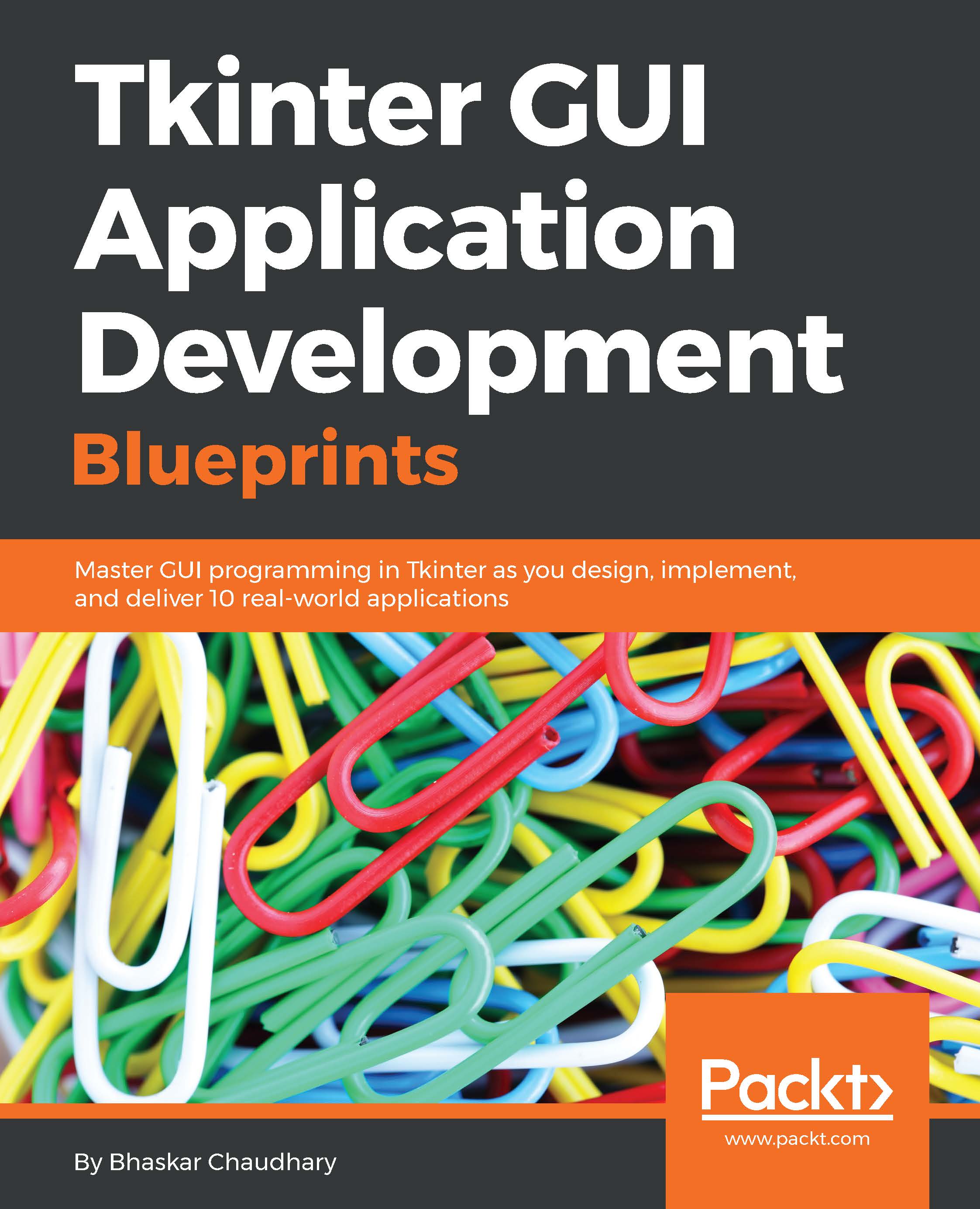
Tkinter GUI Application Development Blueprints

Tkinter GUI Application Development Blueprints

By : Bhaskar Chaudhary
4 (28)
close
close
Tkinter GUI Application Development Blueprints

Tkinter GUI Application Development Blueprints

4 (28)
By: Bhaskar Chaudhary

Overview of this book

Tkinter is the built-in GUI package that comes with standard Python distributions. It is a cross-platform package, which means you build once and deploy everywhere. It is simple to use and intuitive in nature, making it suitable for programmers and non-programmers alike. This book will help you master the art of GUI programming. It delivers the bigger picture of GUI programming by building real-world, productive, and fun applications such as a text editor, drum machine, game of chess, media player, drawing application, chat application, screen saver, port scanner, and many more. In every project, you will build on the skills acquired in the previous project and gain more expertise. You will learn to write multithreaded programs, network programs, database driven programs and more. You will also get to know the modern best practices involved in writing GUI apps. With its rich source of sample code, you can build upon the knowledge gained with this book and use it in your own projects in the discipline of your choice.
Table of Contents (10 chapters)
close
close
9
Index

Handling widget-specific variables

You need variables with a wide variety of widgets. You likely need a string variable to track what the user enters into the entry widget or text widget. You most probably need Boolean variables to track whether the user has checked off the Checkbox widget. You need integer variables to track the value entered in a Spinbox or Slider widget.

In order to respond to changes in widget-specific variables, Tkinter offers its own variable class. The variable that you can use to track widget-specific values must be subclassed from this Tkinter variable class. Tkinter offers some commonly used predefined variables. They are StringVar, IntVar, BooleanVar, and DoubleVar.

You can use these variables to capture and play with the changes in the values of variables from within your callback functions. You can also define your own variable type, if required.

Creating a Tkinter variable is simple. You simply have to call the constructor:

my_string = StringVar()
ticked_yes = BooleanVar()
group_choice = IntVar()
volume = DoubleVar()

Once the variable is created, you can use it as a widget option, as follows:

Entry(root, textvariable=my_string)
Checkbutton(root, text="Remember Me", variable=ticked_yes)
Radiobutton(root, text="Option1", variable=group_choice, value="option1") #radiobutton
Scale(root, label="Volume Control", variable=volume, from =0, to=10) # slider

Additionally, Tkinter provides access to the values of variables via the set() and get() methods, as follows:

my_var.set("FooBar") # setting value of variable
my_var.get() # Assessing the value of variable from say a callback

A demonstration of the Tkinter variable class is available in the 1.11.py code file. The code generates a window, as shown in the following screenshot:

Handling widget-specific variables

This concludes our brief discussion on events and callbacks. Here's a brief summary of the things that we discussed:

  • The command binding, which is used to bind simple widgets to certain functions
  • The use of the lambda function in case you need to process arguments
  • Event binding using the widget.bind(event, callback, add=None) method to bind keyboard and mouse events to your widgets and invoke callbacks when certain events occur
  • The passing of extra arguments to a callback
  • The binding of events to an entire application or to a particular class of widget by using bind_all() and bind_class()
  • Using the Tkinter variable class to set and get the values of widget-specific variables

In short, you now know how to make your GUI program responsive to end-user requests!

Visually different images
CONTINUE READING
83
Tech Concepts
36
Programming languages
73
Tech Tools
Icon Unlimited access to the largest independent learning library in tech of over 8,000 expert-authored tech books and videos.
Icon Innovative learning tools, including AI book assistants, code context explainers, and text-to-speech.
Icon 50+ new titles added per month and exclusive early access to books as they are being written.
Tkinter GUI Application Development Blueprints
notes
bookmark Notes and Bookmarks search Search in title playlist Add to playlist font-size Font size

Change the font size

margin-width Margin width

Change margin width

day-mode Day/Sepia/Night Modes

Change background colour

Close icon Search
Country selected

Close icon Your notes and bookmarks

Confirmation

Modal Close icon
claim successful

Buy this book with your credits?

Modal Close icon
Are you sure you want to buy this book with one of your credits?
Close
YES, BUY

Submit Your Feedback

Modal Close icon
Modal Close icon
Modal Close icon