


-
Book Overview & Buying
-
Table Of Contents

-
Feedback & Rating

Mastering QGIS - Second Edition
By :


Mastering QGIS
By:
Overview of this book
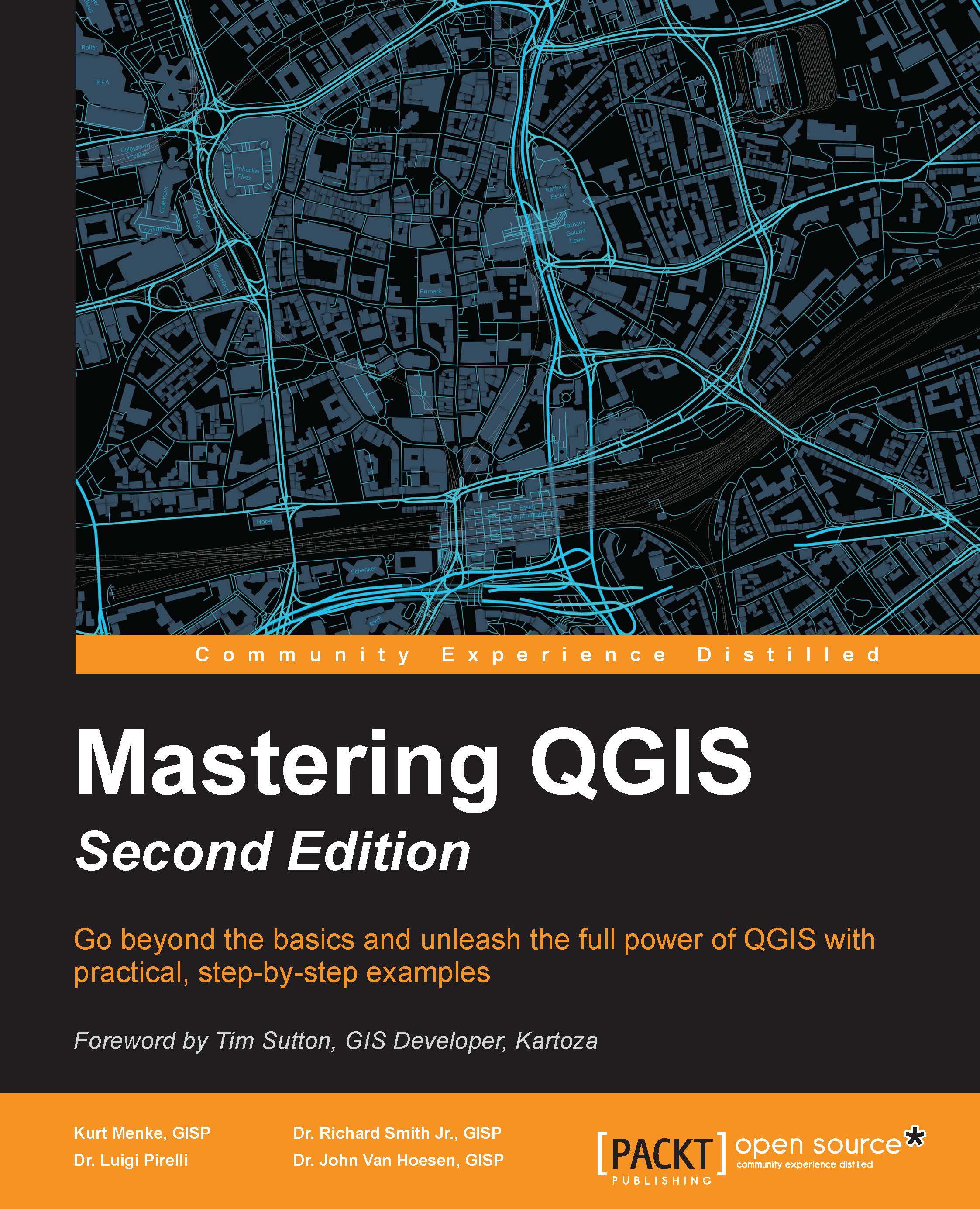
QGIS is an open source solution to GIS. It is widely used by GIS professionals all over the world. It is the leading alternative to the proprietary GIS software. Although QGIS is described as intuitive, it is also by default complex. Knowing which tools to use and how to apply them is essential to producing valuable deliverables on time.
Starting with a refresher on the QGIS basics, this book will take you all the way through to creating your first custom QGIS plugin. From the refresher, we will recap how to create, populate, and manage a spatial database. You’ll also walk through styling GIS data, from creating custom symbols and color ramps to using blending modes. In the next section, you will discover how to prepare vector, heat maps, and create live layer effects, labeling, and raster data for processing. You’ll also discover advanced data creation and editing techniques.
The last third of the book covers the more technical aspects of QGIS such as using LAStools and GRASS GIS’s integration with the Processing Toolbox, how to automate workflows with batch processing, and how to create graphical models. Finally, you will see how to create and run Python data processing scripts and write your own QGIS plugin with pyqgis.
By the end of the book, you will understand how to work with all the aspects of QGIS, and will be ready to use it for any type of GIS work.
Table of Contents (13 chapters)
Preface


 Free Chapter
1. A Refreshing Look at QGIS
2. Creating Spatial Databases
3. Styling Raster and Vector Data
4. Preparing Vector Data for Processing
5. Preparing Raster Data for Processing
6. Advanced Data Creation and Editing
7. Advanced Data Visualization
8. The Processing Toolbox
9. Automating Workflows with the Graphical Modeler
10. Creating QGIS Plugins with PyQGIS and Problem Solving
11. PyQGIS Scripting

Index
Customer Reviews



