
Sign In Start Free Trial
Account

Add to playlist

Create a Playlist

Modal Close icon
You need to login to use this feature.
  • Book Overview & Buying Mastering Geospatial Analysis with Python
  • Table Of Contents Toc
  • Feedback & Rating feedback
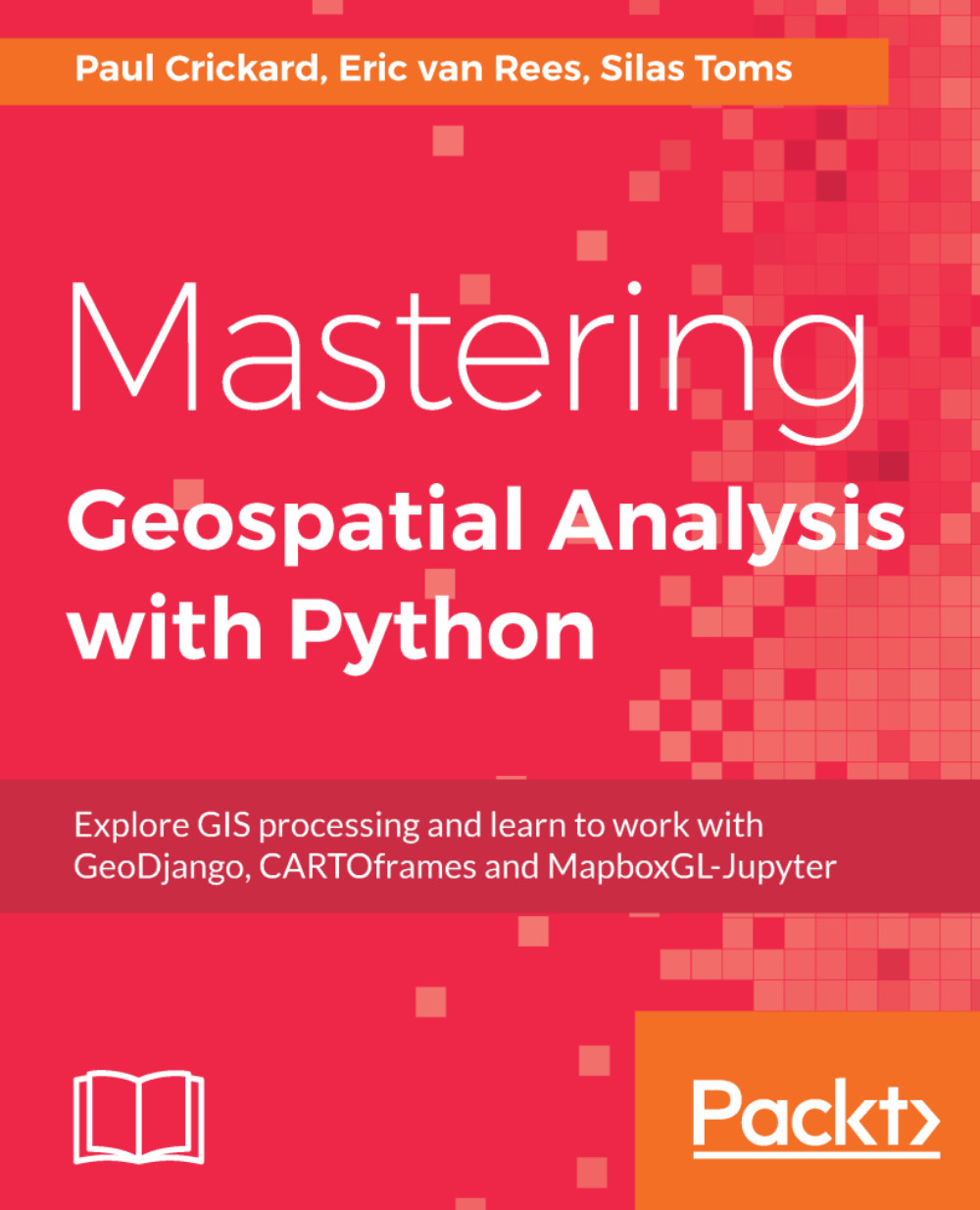
Mastering Geospatial Analysis with Python

Mastering Geospatial Analysis with Python

By : Toms, Paul Crickard, Eric van Rees
3 (4)
close
close
Mastering Geospatial Analysis with Python

Mastering Geospatial Analysis with Python

3 (4)
By: Toms, Paul Crickard, Eric van Rees

Overview of this book

Python comes with a host of open source libraries and tools that help you work on professional geoprocessing tasks without investing in expensive tools. This book will introduce Python developers, both new and experienced, to a variety of new code libraries that have been developed to perform geospatial analysis, statistical analysis, and data management. This book will use examples and code snippets that will help explain how Python 3 differs from Python 2, and how these new code libraries can be used to solve age-old problems in geospatial analysis. You will begin by understanding what geoprocessing is and explore the tools and libraries that Python 3 offers. You will then learn to use Python code libraries to read and write geospatial data. You will then learn to perform geospatial queries within databases and learn PyQGIS to automate analysis within the QGIS mapping suite. Moving forward, you will explore the newly released ArcGIS API for Python and ArcGIS Online to perform geospatial analysis and create ArcGIS Online web maps. Further, you will deep dive into Python Geospatial web frameworks and learn to create a geospatial REST API.
Table of Contents (18 chapters)
close
close
7
Geoprocessing with Geodatabases

Geospatial Data Abstraction Library (GDAL) and the OGR Simple Features Library

The Geospatial Data Abstraction Library (GDAL)/OGR Simple Features Library combines two separate libraries that are generally downloaded together as a GDAL. This means that installing the GDAL package also gives access to OGR functionality, which is why they're covered together here. The reason GDAL is covered first is that other packages were written after GDAL, so chronologically, it comes first. As you will notice, some of the packages covered in this chapter extend GDAL's functionality or use it under the hood.

GDAL was created in the 1990s by Frank Warmerdam and saw its first release in June 2000. Later, the development of GDAL was transferred to the Open Source Geospatial Foundation (OSGeo). Technically, GDAL is a little different than your average Python package as the GDAL...

Visually different images
CONTINUE READING
83
Tech Concepts
36
Programming languages
73
Tech Tools
Icon Unlimited access to the largest independent learning library in tech of over 8,000 expert-authored tech books and videos.
Icon Innovative learning tools, including AI book assistants, code context explainers, and text-to-speech.
Icon 50+ new titles added per month and exclusive early access to books as they are being written.
Mastering Geospatial Analysis with Python
notes
bookmark Notes and Bookmarks search Search in title playlist Add to playlist download Download options font-size Font size

Change the font size

margin-width Margin width

Change margin width

day-mode Day/Sepia/Night Modes

Change background colour

Close icon Search
Country selected

Close icon Your notes and bookmarks

Confirmation

Modal Close icon
claim successful

Buy this book with your credits?

Modal Close icon
Are you sure you want to buy this book with one of your credits?
Close
YES, BUY

Submit Your Feedback

Modal Close icon
Modal Close icon
Modal Close icon