
Sign In Start Free Trial
Account

Add to playlist

Create a Playlist

Modal Close icon
You need to login to use this feature.
  • Book Overview & Buying Rust Programming By Example
  • Table Of Contents Toc
  • Feedback & Rating feedback
Rust Programming By Example

Rust Programming By Example

By : Gomez, Antoni Boucher
3.5 (4)
close
close
Rust Programming By Example

Rust Programming By Example

3.5 (4)
By: Gomez, Antoni Boucher

Overview of this book

Rust is an open source, safe, concurrent, practical language created by Mozilla. It runs blazingly fast, prevents segfaults, and guarantees safety. This book gets you started with essential software development by guiding you through the different aspects of Rust programming. With this approach, you can bridge the gap between learning and implementing immediately. Beginning with an introduction to Rust, you’ll learn the basic aspects such as its syntax, data types, functions, generics, control flows, and more. After this, you’ll jump straight into building your first project, a Tetris game. Next you’ll build a graphical music player and work with fast, reliable networking software using Tokio, the scalable and productive asynchronous IO Rust library. Over the course of this book, you’ll explore various features of Rust Programming including its SDL features, event loop, File I/O, and the famous GTK+ widget toolkit. Through these projects, you’ll see how well Rust performs in terms of concurrency—including parallelism, reliability, improved performance, generics, macros, and thread safety. We’ll also cover some asynchronous and reactive programming aspects of Rust. By the end of the book, you’ll be comfortable building various real-world applications in Rust.
Table of Contents (13 chapters)
close
close
3
Events and Basic Game Mechanisms

Pattern matching

So how can we know which variant is in a variable whose type is an enumeration and how to get the values out of it? For that, we need to use pattern matching. The match expression is one way to do pattern matching. Let's see how to use it to compute the result of an expression:

fn print_expr(expr: Expr) {
    match expr {
        Expr::Null => println!("No value"),
        Expr::Add(x, y) => println!("{}", x + y),
        Expr::Sub(x, y) => println!("{}", x - y),
        Expr::Mul(x, y) => println!("{}", x * y),
        Expr::Div { dividend: x, divisor: 0 } => println!("Divisor 
is zero"
), Expr::Div { dividend: x, divisor: y } => println!("{}",
x/y), Expr::Val(x) => println!("{}", x), } }

A match expression is a way to check whether a value follows a certain pattern and executes different codes for different patterns. In this case, we match over an enumerated type, so we check for each variant. If the expression is Expr::Add, the code on the right of => is executed: println!("{}", x + y). By writing variable names inside the parentheses next to Expr::Add, we specify that the actual values of this variant are bound to these names. By doing so, we can use these variable names on the right side of =>.

Figure 1.1 is a diagram showing how pattern matching works:
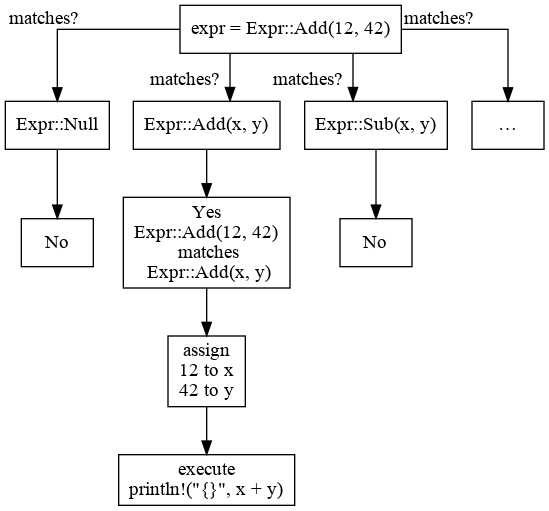
Figure 1.1

A match can also be used to check whether a number is within a range. This function converts an ASCII character (represented by u8 in Rust) to uppercase:

fn uppercase(c: u8) -> u8 {
    match c {
        b'a'...b'z' => c - 32,
        _ => c,
    }
}

Here, the ... syntax represents an inclusive range. And the underscore (_) is used to mean literally everything else, this is very useful in Rust because match needs to be exhaustive.

You can convert u8 to char using the as syntax, as shown earlier:

println!("{}", uppercase(b'a') as char);

It is also possible to match against different patterns in a match by using the | operator:

fn is_alphanumeric(c: char) -> bool {
    match c {
        'a'...'z' | 'A'...'Z' | '0'...'9' => true,
        _ => false,
    }
}

There are alternative syntaxes to do pattern matching. One of them is the if let construct. Let's rewrite our uppercase function using if let:

fn uppercase(c: u8) -> u8 {
    if let b'a'...b'z' = c {
        c - 32
    } else {
        c
    }
}

Unlike a match, if let does not need to be exhaustive. It does not even require an else branch, the rules used for the normal if expression also applies to if let. This construct can be more appropriate than match when you only want to match against one or two patterns.

Irrefutable patterns

Another form of pattern matching is irrefutable patterns. A pattern is irrefutable when there's only one way to match it and it always succeeds. For instance, another way to get the elements of a tuple is with an irrefutable pattern:

let tuple = (24, 42);
let (a, b) = tuple;
println!("{}, {}", a, b);

In the second line, we assign the first element of the tuple to a and the second to b.

Visually different images
CONTINUE READING
83
Tech Concepts
36
Programming languages
73
Tech Tools
Icon Unlimited access to the largest independent learning library in tech of over 8,000 expert-authored tech books and videos.
Icon Innovative learning tools, including AI book assistants, code context explainers, and text-to-speech.
Icon 50+ new titles added per month and exclusive early access to books as they are being written.
Rust Programming By Example
notes
bookmark Notes and Bookmarks search Search in title playlist Add to playlist download Download options font-size Font size

Change the font size

margin-width Margin width

Change margin width

day-mode Day/Sepia/Night Modes

Change background colour

Close icon Search
Country selected

Close icon Your notes and bookmarks

Confirmation

Modal Close icon
claim successful

Buy this book with your credits?

Modal Close icon
Are you sure you want to buy this book with one of your credits?
Close
YES, BUY

Submit Your Feedback

Modal Close icon
Modal Close icon
Modal Close icon