Sign In Start Free Trial
Account

Add to playlist

Create a Playlist

Modal Close icon
You need to login to use this feature.
  • Book Overview & Buying Learning JavaScript Data  Structures and Algorithms
  • Table Of Contents Toc
  • Feedback & Rating feedback
Learning JavaScript Data  Structures and Algorithms

Learning JavaScript Data Structures and Algorithms - Third Edition

By : Loiane Avancini
3.1 (9)
close
close
Learning JavaScript Data  Structures and Algorithms

Learning JavaScript Data Structures and Algorithms

3.1 (9)
By: Loiane Avancini

Overview of this book

A data structure is a particular way of organizing data in a computer to utilize resources efficiently. Data structures and algorithms are the base of every solution to any programming problem. With this book, you will learn to write complex and powerful code using the latest ES 2017 features. Learning JavaScript Data Structures and Algorithms begins by covering the basics of JavaScript and introduces you to ECMAScript 2017, before gradually moving on to the most important data structures such as arrays, queues, stacks, and linked lists. You will gain in-depth knowledge of how hash tables and set data structures function as well as how trees and hash maps can be used to search files in an HD or represent a database. This book serves as a route to take you deeper into JavaScript. You’ll also get a greater understanding of why and how graphs, one of the most complex data structures, are largely used in GPS navigation systems in social networks. Toward the end of the book, you’ll discover how all the theories presented in this book can be applied to solve real-world problems while working on your own computer networks and Facebook searches.
Table of Contents (17 chapters)
close
close

Self-balancing trees


Now that you have learned how to work with BST, you can dive into the study of trees if you want to.

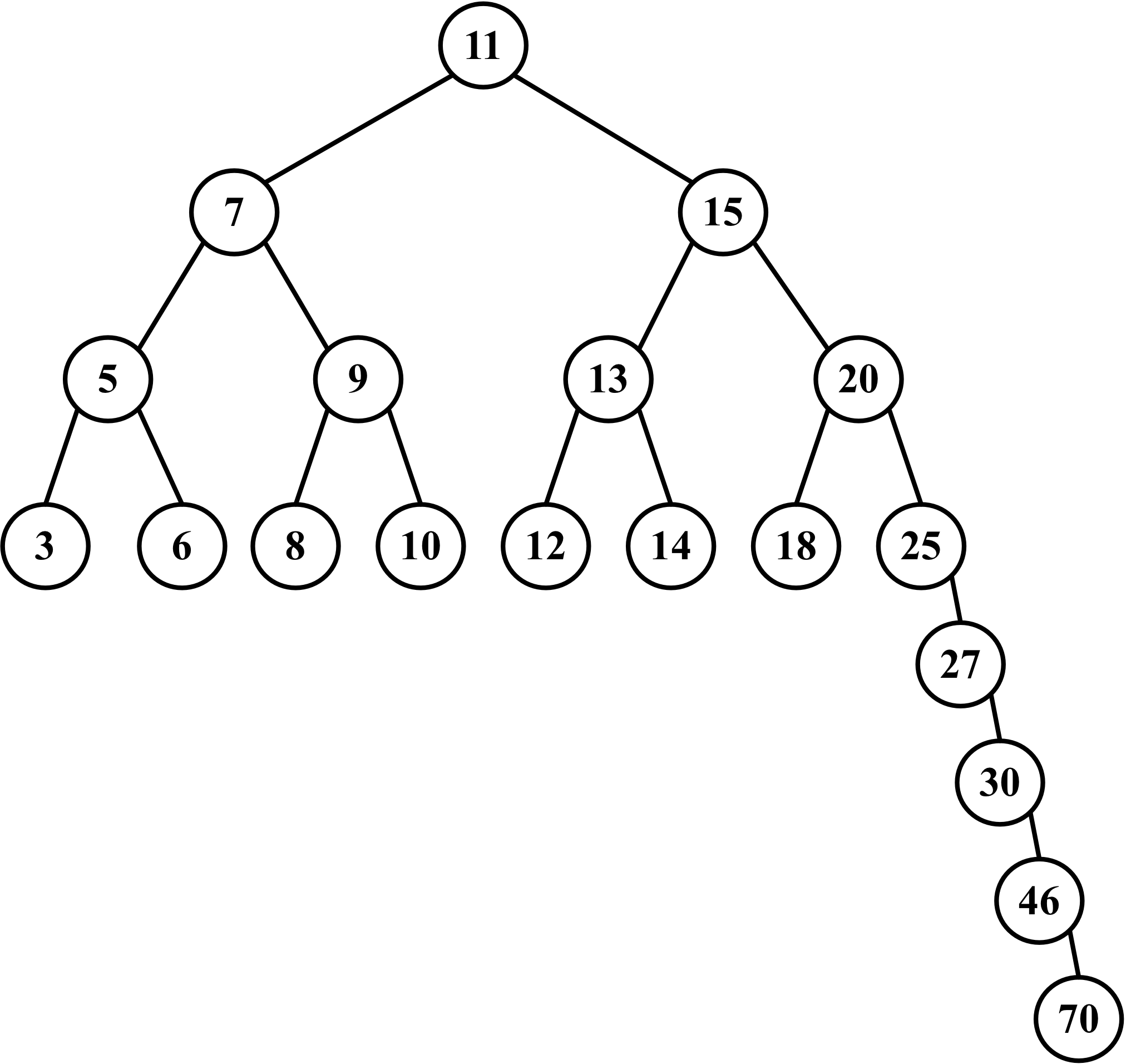
BST has a problem: depending on how many nodes you add, one of the edges of the tree can be very deep, meaning a branch of the tree can have a high level and another branch can have a low level, as shown in the following diagram:

This can cause performance issues when adding, removing, and searching for a node on a particular edge of the tree. For this reason, there is a tree called the Adelson-Velskii and Landi's tree (AVL tree). The AVL tree is a self-balancing BST, which means the height of both the left and right subtrees of any node differ by 1 at most. You will learn more about the AVL tree in the following topic.

Adelson-Velskii and Landi’s tree (AVL tree)

The AVL tree is a self-balancing tree, meaning the tree tries to self-balance whenever a node is added to it or removed from it. The height of the left or right subtree of any node (and any level) differs by 1 at...

Visually different images
CONTINUE READING
83
Tech Concepts
36
Programming languages
73
Tech Tools
Icon Unlimited access to the largest independent learning library in tech of over 8,000 expert-authored tech books and videos.
Icon Innovative learning tools, including AI book assistants, code context explainers, and text-to-speech.
Icon 50+ new titles added per month and exclusive early access to books as they are being written.
Learning JavaScript Data  Structures and Algorithms
notes
bookmark Notes and Bookmarks search Search in title playlist Add to playlist download Download options font-size Font size

Change the font size

margin-width Margin width

Change margin width

day-mode Day/Sepia/Night Modes

Change background colour

Close icon Search
Country selected

Close icon Your notes and bookmarks

Confirmation

Modal Close icon
claim successful

Buy this book with your credits?

Modal Close icon
Are you sure you want to buy this book with one of your credits?
Close
YES, BUY

Submit Your Feedback

Modal Close icon
Modal Close icon
Modal Close icon