Sign In Start Free Trial
Account

Add to playlist

Create a Playlist

Modal Close icon
You need to login to use this feature.
  • Book Overview & Buying Software Architecture with Spring 5.0
  • Table Of Contents Toc
  • Feedback & Rating feedback
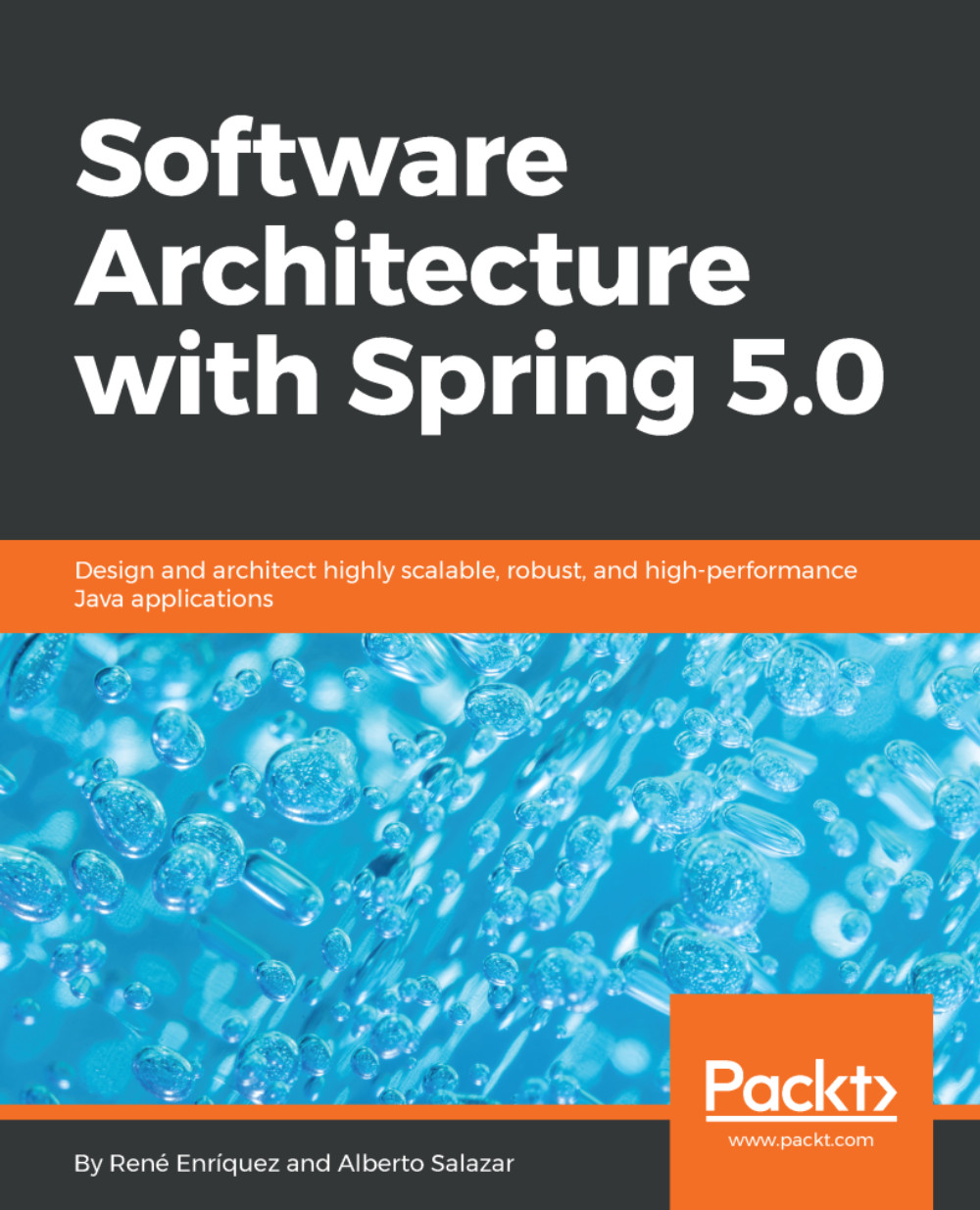
Software Architecture with Spring 5.0

Software Architecture with Spring 5.0

By : Enríquez, Salazar
3.4 (5)
close
close
Software Architecture with Spring 5.0

Software Architecture with Spring 5.0

3.4 (5)
By: Enríquez, Salazar

Overview of this book

Spring 5 and its ecosystem can be used to build robust architectures effectively. Software architecture is the underlying piece that helps us accomplish our business goals whilst supporting the features that a product demands. This book explains in detail how to choose the right architecture and apply best practices during your software development cycle to avoid technical debt and support every business requirement. Choosing the right architecture model to support your business requirements is one of the key decisions you need to take when a new product is being created from scratch or is being refactored to support new business demands. This book gives you insights into the most common architectural models and guides you when and where they can be used. During this journey, you’ll see cutting-edge technologies surrounding the Spring products, and understand how to use agile techniques such as DevOps and continuous delivery to take your software to production effectively. By the end of this book, you’ll not only know the ins and outs of Spring, but also be able to make critical design decisions that surpass your clients’ expectations.
Table of Contents (16 chapters)
close
close

Containers


Containers provide a lightweight approach to virtualization that consists of providing the bare minimum that an application requires in order to work. In the old days, VMs used to be the main choice for provisioning environments and running applications. However, they require a complete OS in order to work. Containers, on the other hand, reuse the host OS to run and provision the required environments. Let's learn more about this concept by looking at the following diagram:

Virtual machines and containers

In the preceding diagram, we can see the Virtual Machines (VMs) on the left side and the containers on the right side. Let's start by learning how a Vm works.

VMs require their own OS using the hardware assigned to the VM, which is supported by the hypervisor. The preceding diagram shows three VMs, which means that we need to have installed three OSes, one per VM. When you're running applications within VMs, you have to consider the resources that will be consumed by the application...

Visually different images
CONTINUE READING
83
Tech Concepts
36
Programming languages
73
Tech Tools
Icon Unlimited access to the largest independent learning library in tech of over 8,000 expert-authored tech books and videos.
Icon Innovative learning tools, including AI book assistants, code context explainers, and text-to-speech.
Icon 50+ new titles added per month and exclusive early access to books as they are being written.
Software Architecture with Spring 5.0
notes
bookmark Notes and Bookmarks search Search in title playlist Add to playlist download Download options font-size Font size

Change the font size

margin-width Margin width

Change margin width

day-mode Day/Sepia/Night Modes

Change background colour

Close icon Search
Country selected

Close icon Your notes and bookmarks

Confirmation

Modal Close icon
claim successful

Buy this book with your credits?

Modal Close icon
Are you sure you want to buy this book with one of your credits?
Close
YES, BUY

Submit Your Feedback

Modal Close icon
Modal Close icon
Modal Close icon