
Sign In Start Free Trial
Account

Add to playlist

Create a Playlist

Modal Close icon
You need to login to use this feature.
  • Book Overview & Buying Hands-On Data Structures and Algorithms with Python
  • Table Of Contents Toc
  • Feedback & Rating feedback
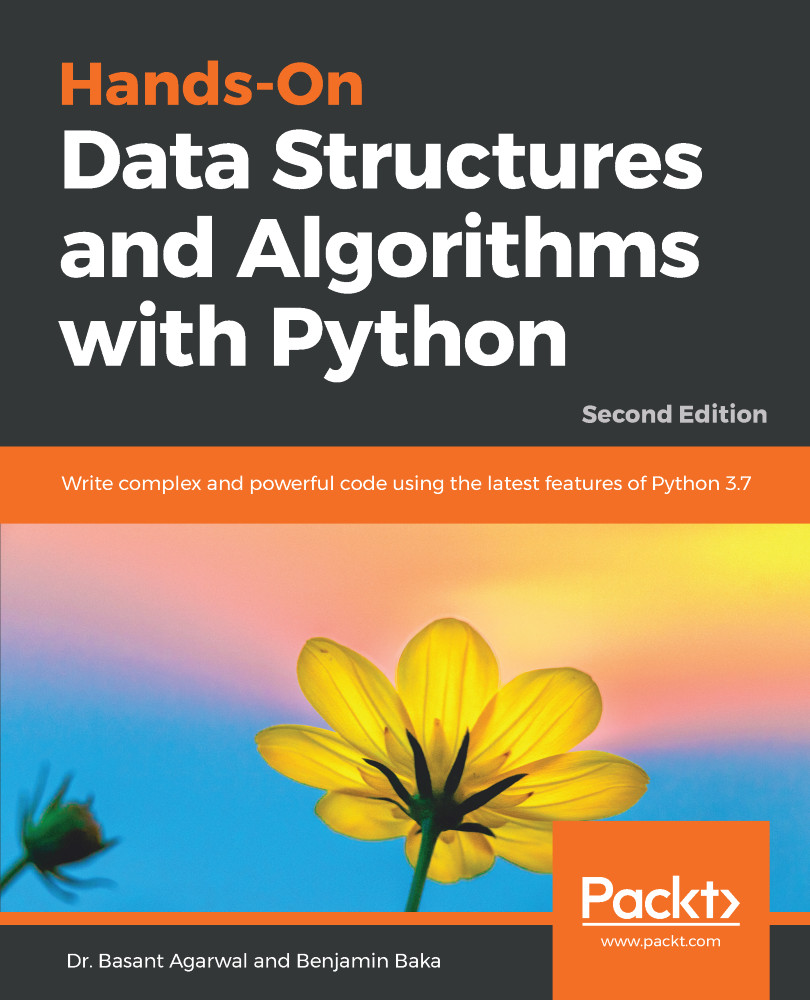
Hands-On Data Structures and Algorithms with Python

Hands-On Data Structures and Algorithms with Python - Second Edition

By : Dr. Basant Agarwal, Benjamin Baka, David Julian
3 (13)
close
close
Hands-On Data Structures and Algorithms with Python

Hands-On Data Structures and Algorithms with Python

3 (13)
By: Dr. Basant Agarwal, Benjamin Baka, David Julian

Overview of this book

Data structures allow you to store and organize data efficiently. They are critical to any problem, provide a complete solution, and act like reusable code. Hands-On Data Structures and Algorithms with Python teaches you the essential Python data structures and the most common algorithms for building easy and maintainable applications. This book helps you to understand the power of linked lists, double linked lists, and circular linked lists. You will learn to create complex data structures, such as graphs, stacks, and queues. As you make your way through the chapters, you will explore the application of binary searches and binary search trees, along with learning common techniques and structures used in tasks such as preprocessing, modeling, and transforming data. In the concluding chapters, you will get to grips with organizing your code in a manageable, consistent, and extendable way. You will also study how to bubble sort, selection sort, insertion sort, and merge sort algorithms in detail. By the end of the book, you will have learned how to build components that are easy to understand, debug, and use in different applications. You will get insights into Python implementation of all the important and relevant algorithms.
Table of Contents (16 chapters)
close
close

Selection sort algorithms

Another popular sorting algorithm is the selection sort. The selection sorting algorithm begins by finding the smallest element in the list, and interchanges it with the data stored at the first position in the list. Thus, it makes the sub-list sorted up to the first element. Next, the second smallest element, which is the smallest element in the remaining list, is identified and interchanged with the second position in the list. This makes the initial two elements sorted. The process is repeated, and the smallest element remaining in the list should be swapped with the element in the third index on the list. This means that the first three elements are now sorted. This process is repeated for (n-1) times to sort n items.

Let's look at an example to understand how the algorithm works. We'll sort the following list of 4 elements using the selection...

Visually different images
CONTINUE READING
83
Tech Concepts
36
Programming languages
73
Tech Tools
Icon Unlimited access to the largest independent learning library in tech of over 8,000 expert-authored tech books and videos.
Icon Innovative learning tools, including AI book assistants, code context explainers, and text-to-speech.
Icon 50+ new titles added per month and exclusive early access to books as they are being written.
Hands-On Data Structures and Algorithms with Python
notes
bookmark Notes and Bookmarks search Search in title playlist Add to playlist download Download options font-size Font size

Change the font size

margin-width Margin width

Change margin width

day-mode Day/Sepia/Night Modes

Change background colour

Close icon Search
Country selected

Close icon Your notes and bookmarks

Confirmation

Modal Close icon
claim successful

Buy this book with your credits?

Modal Close icon
Are you sure you want to buy this book with one of your credits?
Close
YES, BUY

Submit Your Feedback

Modal Close icon
Modal Close icon
Modal Close icon