Sign In Start Free Trial
Account

Add to playlist

Create a Playlist

Modal Close icon
You need to login to use this feature.
  • Book Overview & Buying Julia 1.0 Programming
  • Table Of Contents Toc
  • Feedback & Rating feedback
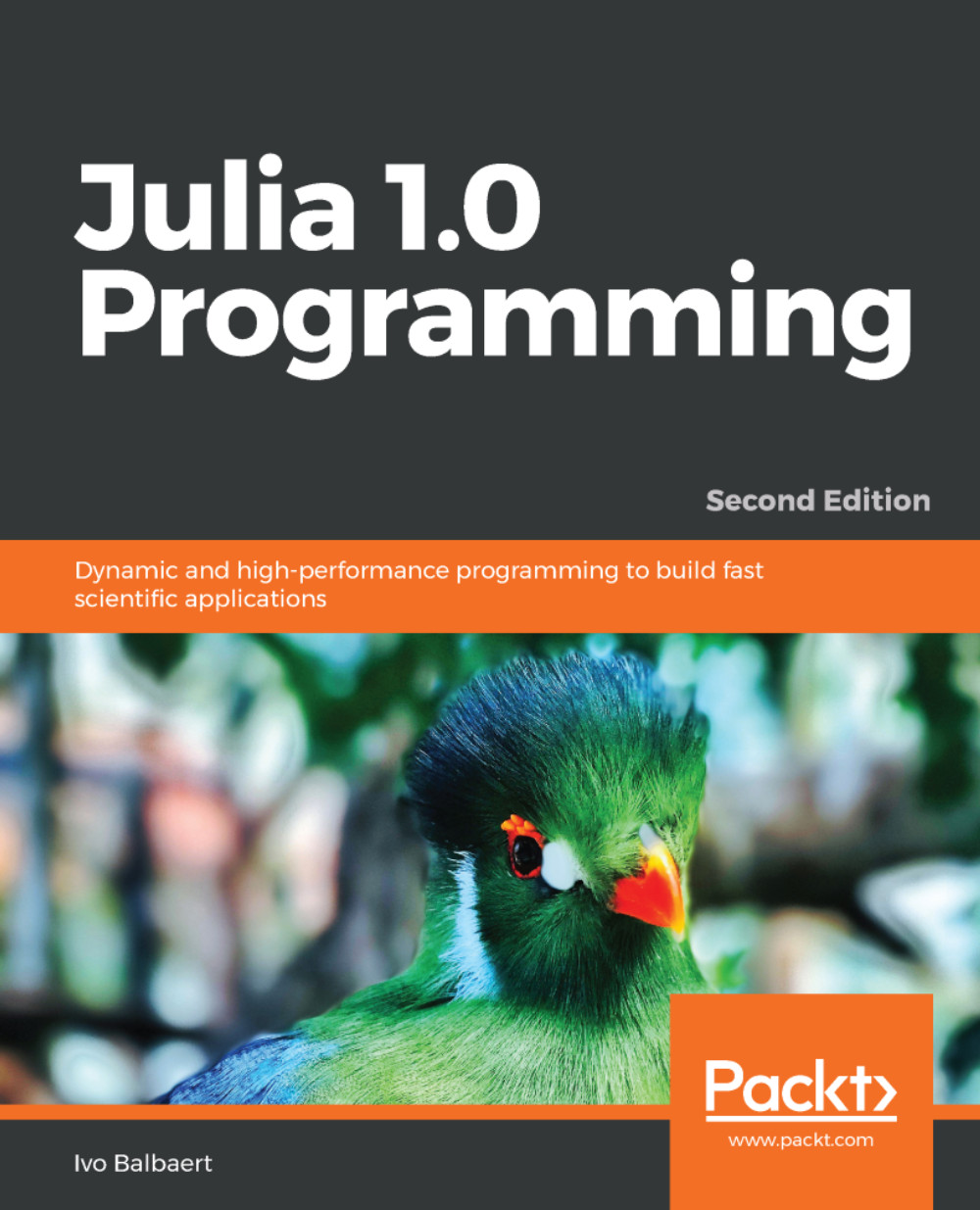
Julia 1.0 Programming

Julia 1.0 Programming - Second Edition

By : Ivo Balbaert
3.5 (2)
close
close
Julia 1.0 Programming

Julia 1.0 Programming

3.5 (2)
By: Ivo Balbaert

Overview of this book

The release of Julia 1.0 is now ready to change the technical world by combining the high productivity and ease of use of Python and R with the lightning-fast speed of C++. Julia 1.0 programming gives you a head start in tackling your numerical and data problems. You will begin by learning how to set up a running Julia platform, before exploring its various built-in types. With the help of practical examples, this book walks you through two important collection types: arrays and matrices. In addition to this, you will be taken through how type conversions and promotions work. In the course of the book, you will be introduced to the homo-iconicity and metaprogramming concepts in Julia. You will understand how Julia provides different ways to interact with an operating system, as well as other languages, and then you'll discover what macros are. Once you have grasped the basics, you’ll study what makes Julia suitable for numerical and scientific computing, and learn about the features provided by Julia. By the end of this book, you will also have learned how to run external programs. This book covers all you need to know about Julia in order to leverage its high speed and efficiency for your applications.
Table of Contents (12 chapters)
close
close

Calling C and Fortran


While Julia can rightfully claim to obviate the need to write some C or Fortran code, it is possible that you will need to interact with the existing C or Fortran shared libraries. Functions in such a library can be called directly by Julia, with no glue code, boilerplate code, or compilation needed. Because Julia's LLVM compiler generates native code, calling a C function from Julia has exactly the same overhead as calling the same function from C code itself. However, first, we need to know a few more things:

  • For calling out to C, we need to work with pointer types; a native pointer Ptr{T} is nothing more than the memory address for a variable of type T. You can use Cstring if the value is null-terminated.
  • At this lower level, the term primitive is also used. primitive is a concrete type whose data consists of bits, such as Int8, UInt8, Int32, Float64, Bool, and Char.
  • To pass a string to C, it is converted to a contiguous byte array representation with the function unsafe_string...
Visually different images
CONTINUE READING
83
Tech Concepts
36
Programming languages
73
Tech Tools
Icon Unlimited access to the largest independent learning library in tech of over 8,000 expert-authored tech books and videos.
Icon Innovative learning tools, including AI book assistants, code context explainers, and text-to-speech.
Icon 50+ new titles added per month and exclusive early access to books as they are being written.
Julia 1.0 Programming
notes
bookmark Notes and Bookmarks search Search in title playlist Add to playlist font-size Font size

Change the font size

margin-width Margin width

Change margin width

day-mode Day/Sepia/Night Modes

Change background colour

Close icon Search
Country selected

Close icon Your notes and bookmarks

Confirmation

Modal Close icon
claim successful

Buy this book with your credits?

Modal Close icon
Are you sure you want to buy this book with one of your credits?
Close
YES, BUY

Submit Your Feedback

Modal Close icon
Modal Close icon
Modal Close icon