
Sign In Start Free Trial
Account

Add to playlist

Create a Playlist

Modal Close icon
You need to login to use this feature.
  • Book Overview & Buying Learn Red ? Fundamentals of Red
  • Table Of Contents Toc
  • Feedback & Rating feedback
Learn Red ? Fundamentals of Red

Learn Red ? Fundamentals of Red

By : Ivo Balbaert
4 (2)
close
close
Learn Red ? Fundamentals of Red

Learn Red ? Fundamentals of Red

4 (2)
By: Ivo Balbaert

Overview of this book

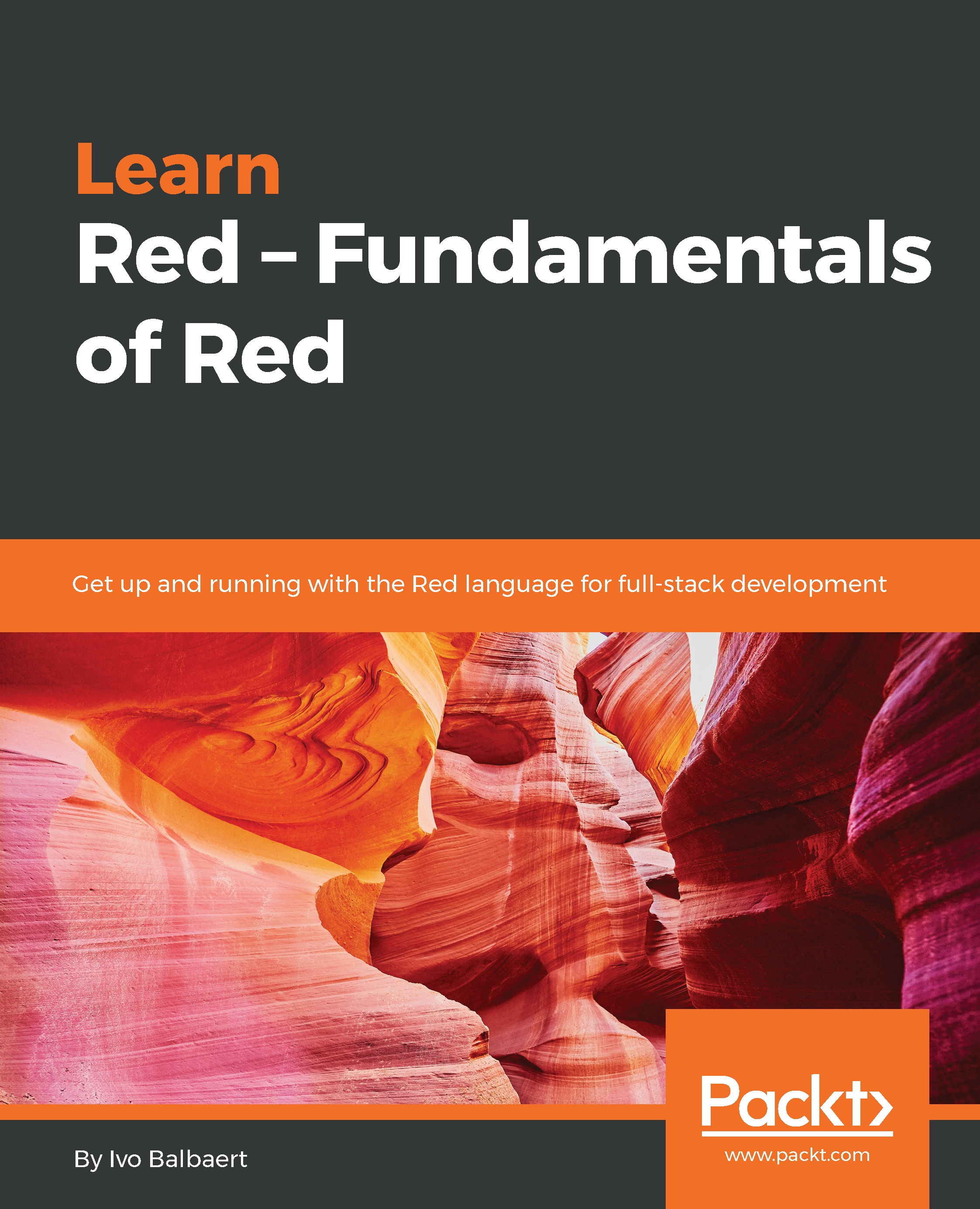
A key problem of software development today is software bloat, where huge toolchains and development environments are needed in software coding and deployment. Red significantly reduces this bloat by offering a minimalist but complete toolchain. This is the first introductory book about it, and it will get you up and running with Red as quickly as possible. This book shows you how to write effective functions, reduce code redundancies, and improve code reuse. It will be helpful for new programmers who are starting out with Red to explore its wide and ever-growing package ecosystem and also for experienced developers who want to add Red to their skill set. The book presents the fundamentals of programming in Red and in-depth informative examples using a step-by-step approach. You will be taken through concepts and examples such as doing simple metaprogramming, functions, collections, GUI applications, and more. By the end of the book, you will be fully equipped to start your own projects in Red.
Table of Contents (13 chapters)
close
close
11
Assessments

Questions

  1. What's wrong with the following line of code? Correct it:
      name: John
  1. Examine the system word in the console with ? system.
  2. Give the values of i1 and i2 after evaluating i2: 1 + i1: 1.
  3. To better see the difference between them, use print and probe on [10 * 5].
  4. Coming from other languages, it is common to type the mistake to_float 42; what happens then? Explain this.
  5. See whether you can find the results of the following expressions for yourself (see Chapter03/evaluation.red):

        print (6 < 13) and (42 < 33)
print (43 < 42) xor (44 < 43)
print complement 3

  1. From the following code snippet evaluate the last three lines and explain the results:
        a: "red" ;== "red"
b: copy a ;== "red"
a = b
a == b
a =? b
  1. What's the output of print [3 = 2 tab 5 = 5 tab...
Visually different images
CONTINUE READING
83
Tech Concepts
36
Programming languages
73
Tech Tools
Icon Unlimited access to the largest independent learning library in tech of over 8,000 expert-authored tech books and videos.
Icon Innovative learning tools, including AI book assistants, code context explainers, and text-to-speech.
Icon 50+ new titles added per month and exclusive early access to books as they are being written.
Learn Red ? Fundamentals of Red
notes
bookmark Notes and Bookmarks search Search in title playlist Add to playlist download Download options font-size Font size

Change the font size

margin-width Margin width

Change margin width

day-mode Day/Sepia/Night Modes

Change background colour

Close icon Search
Country selected

Close icon Your notes and bookmarks

Confirmation

Modal Close icon
claim successful

Buy this book with your credits?

Modal Close icon
Are you sure you want to buy this book with one of your credits?
Close
YES, BUY

Submit Your Feedback

Modal Close icon
Modal Close icon
Modal Close icon