
Sign In Start Free Trial
Account

Add to playlist

Create a Playlist

Modal Close icon
You need to login to use this feature.
  • Book Overview & Buying Learn C Programming
  • Table Of Contents Toc
Learn C Programming

Learn C Programming

By : Jeff Szuhay
4.2 (16)
close
close
Learn C Programming

Learn C Programming

4.2 (16)
By: Jeff Szuhay

Overview of this book

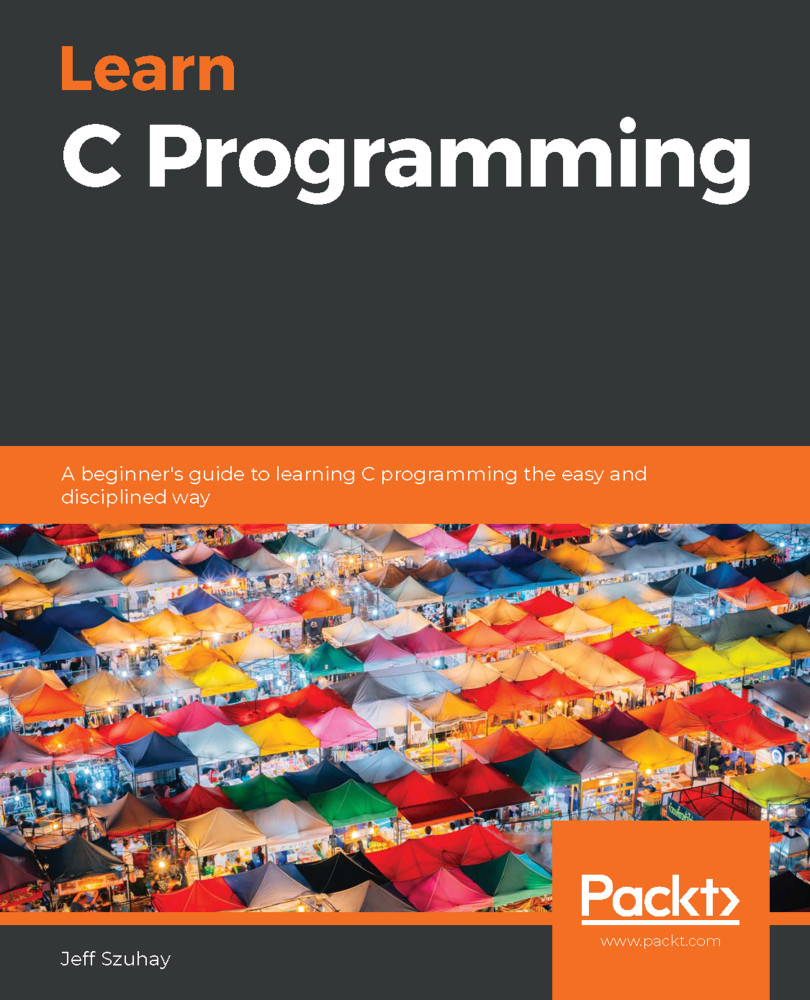
C is a powerful general-purpose programming language that is excellent for beginners to learn. This book will introduce you to computer programming and software development using C. If you're an experienced developer, this book will help you to become familiar with the C programming language. This C programming book takes you through basic programming concepts and shows you how to implement them in C. Throughout the book, you'll create and run programs that make use of one or more C concepts, such as program structure with functions, data types, and conditional statements. You'll also see how to use looping and iteration, arrays, pointers, and strings. As you make progress, you'll cover code documentation, testing and validation methods, basic input/output, and how to write complete programs in C. By the end of the book, you'll have developed basic programming skills in C, that you can apply to other programming languages and will develop a solid foundation for you to advance as a programmer.
Table of Contents (33 chapters)
close
close
1
Section 1: C Fundamentals
10
Section 2: Complex Data Types
19
Section 3: Memory Manipulation
22
Section 4: Input and Output
28
Section 5: Building Blocks for Larger Programs

Understanding memory and memory addressing

First, it is essential to understand that everything that runs on a computer is in memory. When we run a program, it is read from the disk, loaded into memory, and becomes the execution stream. When we read from a file on a disk, CD, or flash drive, it is firstread into memory and accessed from there, not from its original location (this is an oversimplification since there is a bit more that goes on). All of the functions we call and execute are in memory. All of the variables, structures, and arrays we declare are given their own locations in memory. Finally, all of the parts of the computer that we can read from or write to are accessible through some predefined memory location. How the OS handles all of the system devices, system resources (memory), and the filesystem is beyond the scope of this book.

Second, once we understand that everything is in memory, we must know that each byte of memory is addressable. The memory address...

CONTINUE READING
83
Tech Concepts
36
Programming languages
73
Tech Tools
Icon Unlimited access to the largest independent learning library in tech of over 8,000 expert-authored tech books and videos.
Icon Innovative learning tools, including AI book assistants, code context explainers, and text-to-speech.
Icon 50+ new titles added per month and exclusive early access to books as they are being written.
Learn C Programming
notes
bookmark Notes and Bookmarks search Search in title playlist Add to playlist download Download options font-size Font size

Change the font size

margin-width Margin width

Change margin width

day-mode Day/Sepia/Night Modes

Change background colour

Close icon Search
Country selected

Close icon Your notes and bookmarks

Confirmation

Modal Close icon
claim successful

Buy this book with your credits?

Modal Close icon
Are you sure you want to buy this book with one of your credits?
Close
YES, BUY

Submit Your Feedback

Modal Close icon
Modal Close icon
Modal Close icon