
Sign In Start Free Trial
Account

Add to playlist

Create a Playlist

Modal Close icon
You need to login to use this feature.
  • Book Overview & Buying Programming in C#: Exam 70-483 (MCSD) Guide
  • Table Of Contents Toc
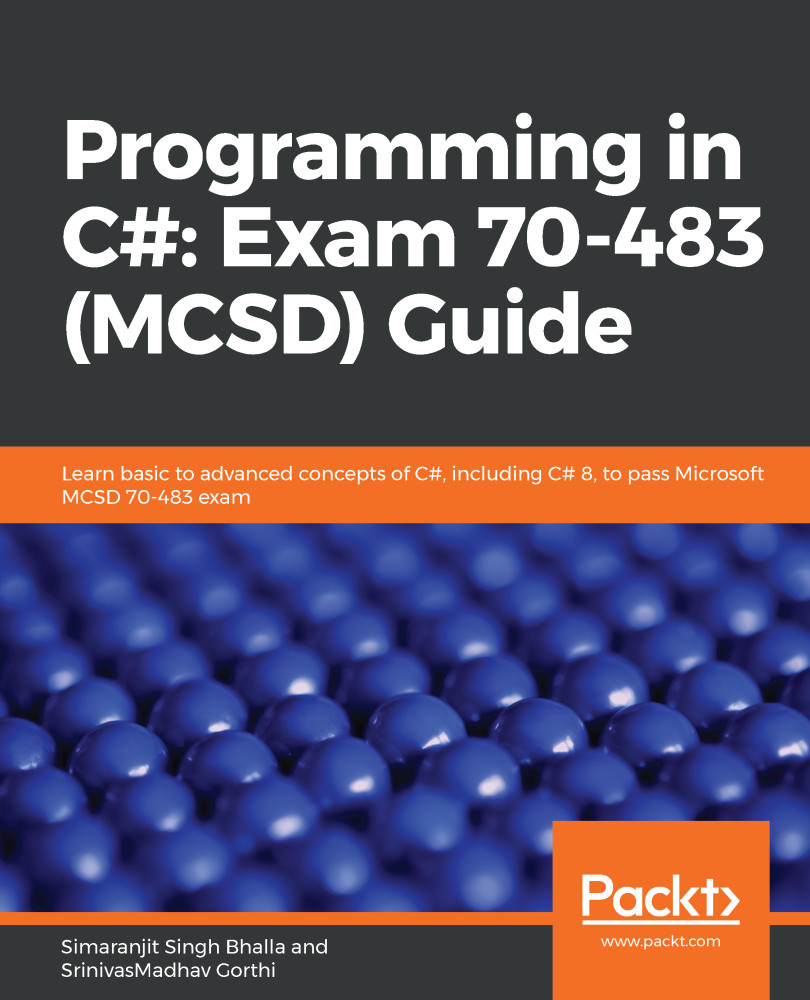
Programming in C#: Exam 70-483 (MCSD) Guide

Programming in C#: Exam 70-483 (MCSD) Guide

By : Bhalla, Gorthi
3 (1)
close
close
Programming in C#: Exam 70-483 (MCSD) Guide

Programming in C#: Exam 70-483 (MCSD) Guide

3 (1)
By: Bhalla, Gorthi

Overview of this book

Programming in C# is a certification from Microsoft that measures the ability of developers to use the power of C# in decision making and creating business logic. This book is a certification guide that equips you with the skills that you need to crack this exam and promote your problem-solving acumen with C#. The book has been designed as preparation material for the Microsoft specialization exam in C#. It contains examples spanning the main focus areas of the certification exam, such as debugging and securing applications, and managing an application's code base, among others. This book will be full of scenarios that demand decision-making skills and require a thorough knowledge of C# concepts. You will learn how to develop business logic for your application types in C#. This book is exam-oriented, considering all the patterns for Microsoft certifications and practical solutions to challenges from Microsoft-certified authors. By the time you've finished this book, you will have had sufficient practice solving real-world application development problems with C# and will be able to carry your newly-learned skills to crack the Microsoft certification exam to level up your career.
Table of Contents (22 chapters)
close
close
17
Mock Test 1
18
Mock Test 2
19
Mock Test 3

Learning the Basics of C#

In simple terms, programming is the art of writing a set of commands that instruct a computer to execute a particular task. In the early days, programming capabilities were limited due to memory and speed restrictions. Due to this, programmers wrote crude and simple tasks that did elementary jobs. With time and with more enhancements, people started writing programs in procedural languages such as COBOL.

Although the languages did the work, the programs had some limitations. There was not much scope for writing reusable components or design patterns that could be used in different places in the application. Hence, the applications were difficult to maintain and scalability was a challenge.

As a result, efforts were made to develop high-level programming languages that could overcome all such challenges faced by procedural languages. With time, many different programming languages were devised. C was developed between 1972 and 1973. At the time, it was a low-level procedural language that depended upon the underlying platform, such as Linux or Windows. C also did not fully utilize the concept of object-oriented programming (which we will go through in Chapter 3, Understanding Object-Oriented Programming).

C++ was introduced in 1998, and provided programmers with the ability to effectively use the concepts of object-oriented programming while still retaining the machine-level programming features provided by C. In this book, we will go through the different aspects of programming in C#. While retaining the OOP capabilities of C++, C# allows us to write programs independent of the underlying hardware implementation.

In this chapter, we will go over the basics of C#. We will review its underlying fundamentals and dive deep into the .NET Framework architecture. We will learn how common language runtime works to translate the application code to machine-level code. We will learn how C# is both different and similar to other languages, such as C and C++. We will then learn about the different components in a C# program, such as classes, namespaces, and assemblies. And, as a common tradition for any new language, we will look at the implementation of a Hello World program.

This chapter consists of the following topics:

  • Comparing C# with C and C++
  • .NET Framework
  • .NET Framework release versions
  • Visual Studio for C#
  • Basic structure of C#
  • Creating a basic program in C#
Visually different images
CONTINUE READING
83
Tech Concepts
36
Programming languages
73
Tech Tools
Icon Unlimited access to the largest independent learning library in tech of over 8,000 expert-authored tech books and videos.
Icon Innovative learning tools, including AI book assistants, code context explainers, and text-to-speech.
Icon 50+ new titles added per month and exclusive early access to books as they are being written.
Programming in C#: Exam 70-483 (MCSD) Guide
notes
bookmark Notes and Bookmarks search Search in title playlist Add to playlist download Download options font-size Font size

Change the font size

margin-width Margin width

Change margin width

day-mode Day/Sepia/Night Modes

Change background colour

Close icon Search
Country selected

Close icon Your notes and bookmarks

Confirmation

Modal Close icon
claim successful

Buy this book with your credits?

Modal Close icon
Are you sure you want to buy this book with one of your credits?
Close
YES, BUY

Submit Your Feedback

Modal Close icon
Modal Close icon
Modal Close icon