Sign In Start Free Trial
Account

Add to playlist

Create a Playlist

Modal Close icon
You need to login to use this feature.
  • Book Overview & Buying Java Fundamentals
  • Table Of Contents Toc
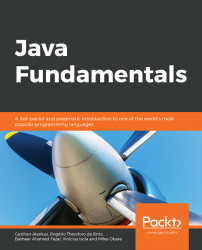
Java Fundamentals

Java Fundamentals

By : Gazihan Alankus , Rogério Theodoro de Brito , Basheer Ahamed Fazal , Isola, Miles Obare
1 (1)
close
close
Java Fundamentals

Java Fundamentals

1 (1)
By: Gazihan Alankus , Rogério Theodoro de Brito , Basheer Ahamed Fazal , Isola, Miles Obare

Overview of this book

Since its inception, Java has stormed the programming world. Its features and functionalities provide developers with the tools needed to write robust cross-platform applications. Java Fundamentals introduces you to these tools and functionalities that will enable you to create Java programs. The book begins with an introduction to the language, its philosophy, and evolution over time, until the latest release. You'll learn how the javac/java tools work and what Java packages are - the way a Java program is usually organized. Once you are comfortable with this, you'll be introduced to advanced concepts of the language, such as control flow keywords. You'll explore object-oriented programming and the part it plays in making Java what it is. In the concluding chapters, you'll get to grips with classes, typecasting, and interfaces, and understand the use of data structures, arrays, strings, handling exceptions, and creating generics. By the end of this book, you will have learned to write programs, automate tasks, and follow advanced courses on algorithms and data structures or explore more advanced Java courses.
Table of Contents (12 chapters)
close
close
Java Fundamentals
Preface

Autoboxing and Unboxing


Sometimes, we need to deal with primitive types in methods that only accept objects. A good example of this is when we want to store integers in an ArrayList (which we will discuss later). This class, ArrayList, only accepts objects, and not primitives. Fortunately, Java provides all primitive types as classes. Wrapper classes can hold primitive values and we can manipulate them as if they were normal classes.

An example of the Integer class, which can hold an int is as follows:

Integer a = new Integer(1);

We can also skip the new keyword and the compiler will implicitly wrap it for us:

Integer a = 1;

We can then use the object as if it was any other object. We can upcast it to Object and then downcast it back to an Integer.

This operation of converting a primitive type into an object (reference type) is referred to as autoboxing.

We can also convert the object back into a primitive type:

Integer a = 1;
int b = a;

Here, the b primitive is assigned the value of a, which is...

CONTINUE READING
83
Tech Concepts
36
Programming languages
73
Tech Tools
Icon Unlimited access to the largest independent learning library in tech of over 8,000 expert-authored tech books and videos.
Icon Innovative learning tools, including AI book assistants, code context explainers, and text-to-speech.
Icon 50+ new titles added per month and exclusive early access to books as they are being written.
Java Fundamentals
notes
bookmark Notes and Bookmarks search Search in title playlist Add to playlist font-size Font size

Change the font size

margin-width Margin width

Change margin width

day-mode Day/Sepia/Night Modes

Change background colour

Close icon Search
Country selected

Close icon Your notes and bookmarks

Confirmation

Modal Close icon
claim successful

Buy this book with your credits?

Modal Close icon
Are you sure you want to buy this book with one of your credits?
Close
YES, BUY

Submit Your Feedback

Modal Close icon
Modal Close icon
Modal Close icon