Sign In Start Free Trial
Account

Add to playlist

Create a Playlist

Modal Close icon
You need to login to use this feature.
  • Book Overview & Buying Modern C++ Programming Cookbook
  • Table Of Contents Toc
Modern C++ Programming Cookbook

Modern C++ Programming Cookbook - Second Edition

By : Marius Bancila
4.7 (12)
close
close
Modern C++ Programming Cookbook

Modern C++ Programming Cookbook

4.7 (12)
By: Marius Bancila

Overview of this book

C++ has come a long way to be one of the most widely used general-purpose languages that is fast, efficient, and high-performance at its core. The updated second edition of Modern C++ Programming Cookbook addresses the latest features of C++20, such as modules, concepts, coroutines, and the many additions to the standard library, including ranges and text formatting. The book is organized in the form of practical recipes covering a wide range of problems faced by modern developers. The book also delves into the details of all the core concepts in modern C++ programming, such as functions and classes, iterators and algorithms, streams and the file system, threading and concurrency, smart pointers and move semantics, and many others. It goes into the performance aspects of programming in depth, teaching developers how to write fast and lean code with the help of best practices. Furthermore, the book explores useful patterns and delves into the implementation of many idioms, including pimpl, named parameter, and attorney-client, teaching techniques such as avoiding repetition with the factory pattern. There is also a chapter dedicated to unit testing, where you are introduced to three of the most widely used libraries for C++: Boost.Test, Google Test, and Catch2. By the end of the book, you will be able to effectively leverage the features and techniques of C++11/14/17/20 programming to enhance the performance, scalability, and efficiency of your applications.
Table of Contents (16 chapters)
close
close
13
Bibliography
14
Other Books You May Enjoy
15
Index

Generating pseudo-random numbers

Generating random numbers is necessary for a large variety of applications, from games to cryptography, from sampling to forecasting. However, the term random numbers is not actually correct, as the generation of numbers through mathematical formulas is deterministic and does not produce true random numbers, but numbers that look random and are called pseudo-random. True randomness can only be achieved through hardware devices, based on physical processes, and even that can be challenged as we may consider even the universe to be actually deterministic. Modern C++ provides support for generating pseudo-random numbers through a pseudo-random number library containing number generators and distributions. Theoretically, it can also produce true random numbers, but in practice, those could actually be only pseudo-random.

Getting ready

In this recipe, we'll discuss the standard support for generating pseudo-random numbers. Understanding the difference between random and pseudo-random numbers is key. True random numbers are numbers that cannot be predicted better than by random chance, and are produced with the help of hardware random number generators. Pseudo-random numbers are numbers produced with the help of algorithms that generate sequences with properties that approximate the ones of true random numbers.

Furthermore, being familiar with various statistical distributions is a plus. It is mandatory, though, that you know what a uniform distribution is, because all engines in the library produce numbers that are uniformly distributed. Without going into any details, we will just mention that uniform distribution is a probability distribution that is concerned with events that are equally likely to occur (within certain bounds).

How to do it...

To generate pseudo-random numbers in your application, you should perform the following steps:

  1. Include the header <random>:
    #include <random>
    
  2. Use an std::random_device generator for seeding a pseudo-random engine:
    std::random_device rd{};
    
  3. Use one of the available engines for generating numbers and initialize it with a random seed:
    auto mtgen = std::mt19937{ rd() };
    
  4. Use one of the available distributions for converting the output of the engine to one of the desired statistical distributions:
    auto ud = std::uniform_int_distribution<>{ 1, 6 };
    
  5. Generate the pseudo-random numbers:
    for(auto i = 0; i < 20; ++i)
      auto number = ud(mtgen);
    

How it works...

The pseudo-random number library contains two types of components:

  • Engines, which are generators of random numbers; these can produce either pseudo-random numbers with a uniform distribution or, if available, actual random numbers.
  • Distributions that convert the output of an engine to a statistical distribution.

All engines (except for random_device) produce integer numbers in a uniform distribution, and all engines implement the following methods:

  • min(): This is a static method that returns the minimum value that can be produced by the generator.
  • max(): This is a static method that returns the maximum value that can be produced by the generator.
  • seed(): This initializes the algorithm with a start value (except for random_device, which cannot be seeded).
  • operator(): This generates a new number uniformly distributed between min() and max().
  • discard(): This generates and discards a given number of pseudo-random numbers.

The following engines are available:

  • linear_congruential_engine: This is a linear congruential generator that produces numbers using the following formula:

    x(i) = (A * x(i – 1) + C) mod M

  • mersenne_twister_engine: This is a Mersenne twister generator that keeps a value on W * (N – 1) * R bits. Each time a number needs to be generated, it extracts W bits. When all the bits have been used, it twists the large value by shifting and mixing the bits so that it has a new set of bits to extract from.
  • subtract_with_carry_engine: This is a generator that implements a subtract with carry algorithm based on the following formula:

    x(i) = (x(iR) – x(iS) – cy(i – 1)) mod M

    In the preceding formula, cy is defined as:

In addition, the library provides engine adapters that are also engines wrapping another engine and producing numbers based on the output of the base engine. Engine adapters implement the same methods mentioned earlier for the base engines. The following engine adapters are available:

  • discard_block_engine: A generator that, from every block of P numbers generated by the base engine, keeps only R numbers, discarding the rest.
  • independent_bits_engine: A generator that produces numbers with a different number of bits than the base engine.
  • shuffle_order_engine: A generator that keeps a shuffled table of K numbers produced by the base engine and returns numbers from this table, replacing them with numbers generated by the base engine.

Choosing a pseudo-random number generator should be done based on the specific requirements of your application. The linear congruential engine is medium fast but has very small storage requirements for its internal state. The subtract with carry engine is very fast, including on machines that don't have a processor with advanced arithmetic instructions set. However, it requires larger storage for its internal state and the sequence of generated numbers has fewer desirable characteristics. The Mersenne twister is the slowest of these engines and has the greatest storage durations, but produces the longest non-repeating sequences of pseudo-numbers.

All these engines and engine adaptors produce pseudo-random numbers. The library, however, provides another engine called random_device that is supposed to produce non-deterministic numbers, but this is not an actual constraint as physical sources of random entropy might not be available. Therefore, implementations of random_device could actually be based on a pseudo-random engine. The random_device class cannot be seeded like the other engines and has an additional method called entropy() that returns the random device entropy, which is 0 for a deterministic generator and nonzero for a non-deterministic generator.

However, this is not a reliable method for determining whether the device is actually deterministic or non-deterministic. For instance, both GNU libstdc++ and LLVM libc++ implement a non-deterministic device, but return 0 for entropy. On the other hand, VC++ and boost.random return 32 and 10, respectively, for entropy.

All these generators produce integers in a uniform distribution. This is, however, only one of the many possible statistical distributions where random numbers are needed in most applications. To be able to produce numbers (either integer or real) in other distributions, the library provides several classes called distributions. These convert the output of an engine according to the statistical distribution it implements. The following distributions are available:

Type

Class name

Numbers

Statistical distribution

Uniform

uniform_int_distribution

Integer

Uniform

uniform_real_distribution

Real

Uniform

Bernoulli

bernoulli_distribution

Boolean

Bernoulli

binomial_distribution

Integer

Binomial

negative_binomial_distribution

Integer

Negative binomial

geometric_distribution

Integer

Geometric

Poisson

poisson_distribution

Integer

Poisson

exponential_distribution

Real

Exponential

gamma_distribution

Real

Gamma

weibull_distribution

Real

Weibull

extreme_value_distribution

Real

Extreme value

Normal

normal_distribution

Real

Standard normal (Gaussian)

lognormal_distribution

Real

Lognormal

chi_squared_distribution

Real

Chi-squared

cauchy_distribution

Real

Cauchy

fisher_f_distribution

Real

Fisher's F-distribution

student_t_distribution

Real

Student's t-distribution

Sampling

discrete_distribution

Integer

Discrete

piecewise_constant_distribution

Real

Values distributed on constant subintervals

piecewise_linear_distribution

Real

Values distributed on defined subintervals

Each of the engines provided by the library has advantages and disadvantages, as it was mentioned earlier. The Mersenne twister, although the slowest and one that has the largest internal state, when initialized appropriately, can produce the longest non-repeating sequence of numbers. In the following examples, we will use std::mt19937, a 32-bit Mersenne twister with 19,937 bits of internal state.

The simplest way to generate random numbers looks like this:

auto mtgen = std::mt19937 {};
for (auto i = 0; i < 10; ++i)
  std::cout << mtgen() << '\n';

In this example, mtgen is std::mt19937 for the Mersenne twister. To generate numbers, you only need to use the call operator that advances the internal state and returns the next pseudo-random number. However, this code is flawed, as the engine is not seeded. As a result, it always produces the same sequence of numbers, which is probably not what you want in most cases.

There are different approaches for initializing the engine. One approach, common with the C random library, is to use the current time. In modern C++, it should look like this:

auto seed = std::chrono::high_resolution_clock::now()
            .time_since_epoch()
            .count();
auto mtgen = std::mt19937{ static_cast<unsigned int>(seed) };

In this example, seed is a number representing the number of ticks since the clock's epoch until the present moment. This number is then used to seed the engine. The problem with this approach is that the value of that seed is actually deterministic, and in some classes of applications, it could be prone to attacks. A more reliable approach is to seed the generator with actual random numbers.

The std::random_device class is an engine that is supposed to return true random numbers, though implementations could actually be based on a pseudo-random generator:

std::random_device rd;
auto mtgen = std::mt19937 {rd()};

Numbers produced by all engines follow a uniform distribution. To convert the result to another statistical distribution, we have to use a distribution class. To show how generated numbers are distributed according to the selected distribution, we will use the following function. This function generates a specified number of pseudo-random numbers and counts their repetition in a map. The values from the map are then used to produce a bar-like diagram showing how often each number occurred:

void generate_and_print(std::function<int(void)> gen,
                        int const iterations = 10000)
{
  // map to store the numbers and their repetition
  auto data = std::map<int, int>{};
  // generate random numbers
  for (auto n = 0; n < iterations; ++n)
    ++data[gen()];
  // find the element with the most repetitions
  auto max = std::max_element(
             std::begin(data), std::end(data),
             [](auto kvp1, auto kvp2) {
    return kvp1.second < kvp2.second; });
  // print the bars
  for (auto i = max->second / 200; i > 0; --i)
  {
    for (auto kvp : data)
    {
      std::cout
        << std::fixed << std::setprecision(1) << std::setw(3)
        << (kvp.second / 200 >= i ? (char)219 : ' ');
    }
    std::cout << '\n';
  }
  // print the numbers
  for (auto kvp : data)
  {
    std::cout
      << std::fixed << std::setprecision(1) << std::setw(3)
      << kvp.first;
  }
  std::cout << '\n';
}

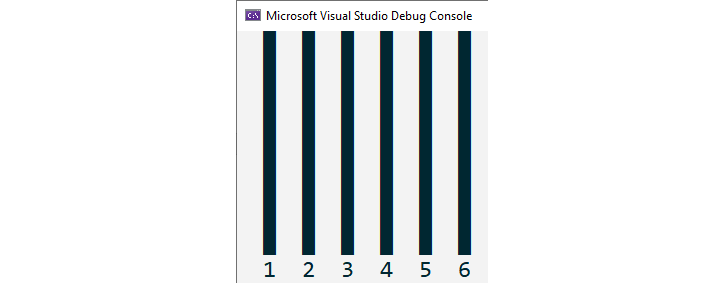
The following code generates random numbers using the std::mt19937 engine with a uniform distribution in the range [1, 6]; this is basically what you get when you throw a dice:

std::random_device rd{};
auto mtgen = std::mt19937{ rd() };
auto ud = std::uniform_int_distribution<>{ 1, 6 };
generate_and_print([&mtgen, &ud]() {return ud(mtgen); });

The output of the program looks like this:

Figure 2.1: Uniform distribution of the range [1,6]

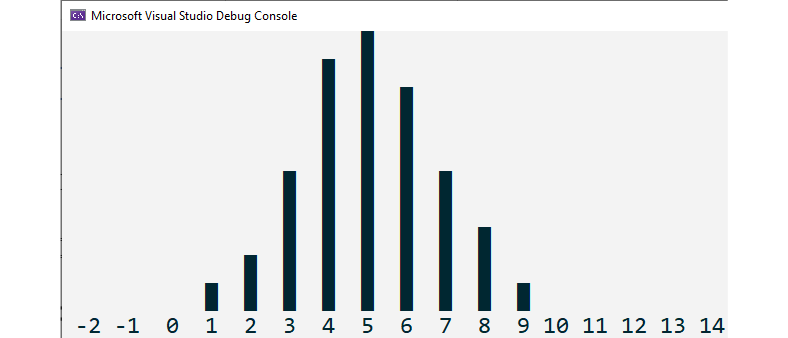
In the next and final example, we're changing the distribution to a normal distribution with a mean of 5 and a standard deviation of 2. This distribution produces real numbers; therefore, in order to use the previous generate_and_print() function, the numbers must be rounded to integers:

std::random_device rd{};
auto mtgen = std::mt19937{ rd() };
auto nd = std::normal_distribution<>{ 5, 2 };
generate_and_print(
  [&mtgen, &nd]() {
    return static_cast<int>(std::round(nd(mtgen))); });

The following will be the output of the preceding code:

Figure 2.2: Normal distribution with mean 5 and standard variance 2

Here, we can see that, based on the graphical representation, the distribution has changed from a uniform one to a normal one with the mean at value 5.

See also

  • Initializing all bits of internal state of a pseudo-random number generator to learn how to properly initialize random number engines
CONTINUE READING
83
Tech Concepts
36
Programming languages
73
Tech Tools
Icon Unlimited access to the largest independent learning library in tech of over 8,000 expert-authored tech books and videos.
Icon Innovative learning tools, including AI book assistants, code context explainers, and text-to-speech.
Icon 50+ new titles added per month and exclusive early access to books as they are being written.
Modern C++ Programming Cookbook
notes
bookmark Notes and Bookmarks search Search in title playlist Add to playlist download Download options font-size Font size

Change the font size

margin-width Margin width

Change margin width

day-mode Day/Sepia/Night Modes

Change background colour

Close icon Search
Country selected

Close icon Your notes and bookmarks

Confirmation

Modal Close icon
claim successful

Buy this book with your credits?

Modal Close icon
Are you sure you want to buy this book with one of your credits?
Close
YES, BUY

Submit Your Feedback

Modal Close icon
Modal Close icon
Modal Close icon