Sign In Start Free Trial
Account

Add to playlist

Create a Playlist

Modal Close icon
You need to login to use this feature.
  • Book Overview & Buying Hands-On Data Structures and Algorithms with Python – Third Edition
  • Table Of Contents Toc
Hands-On Data Structures and Algorithms with Python – Third Edition

Hands-On Data Structures and Algorithms with Python – Third Edition - Third Edition

By : Dr. Basant Agarwal
4.8 (26)
close
close
Hands-On Data Structures and Algorithms with Python – Third Edition

Hands-On Data Structures and Algorithms with Python – Third Edition

4.8 (26)
By: Dr. Basant Agarwal

Overview of this book

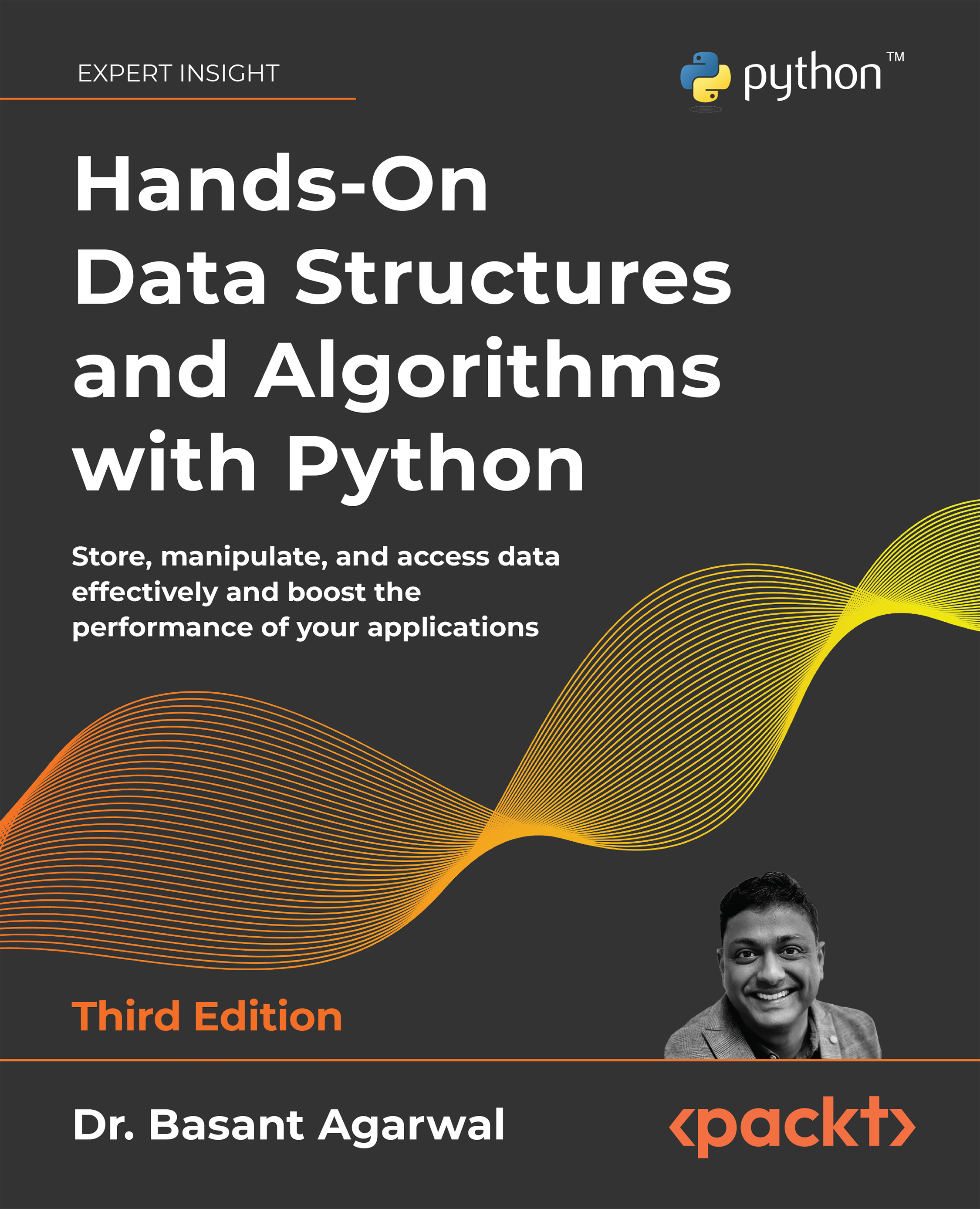
Choosing the right data structure is pivotal to optimizing the performance and scalability of applications. This new edition of Hands-On Data Structures and Algorithms with Python will expand your understanding of key structures, including stacks, queues, and lists, and also show you how to apply priority queues and heaps in applications. You’ll learn how to analyze and compare Python algorithms, and understand which algorithms should be used for a problem based on running time and computational complexity. You will also become confident organizing your code in a manageable, consistent, and scalable way, which will boost your productivity as a Python developer. By the end of this Python book, you’ll be able to manipulate the most important data structures and algorithms to more efficiently store, organize, and access data in your applications.
Table of Contents (17 chapters)
close
close
14
Other Books You May Enjoy
15
Index

Heaps

A heap data structure is a specialization of a tree in which the nodes are ordered in a specific way. A heap is a data structure where each data elements satisfies a heap property, and the heap property states that there must be a certain relationship between a parent node and its child nodes. According to this certain relationship in the tree, the heaps can be of two types, in other words, max heaps and min heaps. In a max heap, each parent node value must always be greater than or equal to all its children. In this kind of tree, the root node must be the greatest value in the tree. For example, see Figure 7.1 showing the max heap in which all the nodes have greater values compared to their children:

Figure 7.1: An example of a max heap

In a min heap, the relationship between parent and children is that the value of the parent node must always be less than or equal to its children. This rule should be followed by all the nodes in the tree. In the min heap, the...

CONTINUE READING
83
Tech Concepts
36
Programming languages
73
Tech Tools
Icon Unlimited access to the largest independent learning library in tech of over 8,000 expert-authored tech books and videos.
Icon Innovative learning tools, including AI book assistants, code context explainers, and text-to-speech.
Icon 50+ new titles added per month and exclusive early access to books as they are being written.
Hands-On Data Structures and Algorithms with Python – Third Edition
notes
bookmark Notes and Bookmarks search Search in title playlist Add to playlist download Download options font-size Font size

Change the font size

margin-width Margin width

Change margin width

day-mode Day/Sepia/Night Modes

Change background colour

Close icon Search
Country selected

Close icon Your notes and bookmarks

Confirmation

Modal Close icon
claim successful

Buy this book with your credits?

Modal Close icon
Are you sure you want to buy this book with one of your credits?
Close
YES, BUY

Submit Your Feedback

Modal Close icon
Modal Close icon
Modal Close icon