Sign In Start Free Trial
Account

Add to playlist

Create a Playlist

Modal Close icon
You need to login to use this feature.
  • Book Overview & Buying Quantum Chemistry and Computing for the Curious
  • Table Of Contents Toc
  • Feedback & Rating feedback
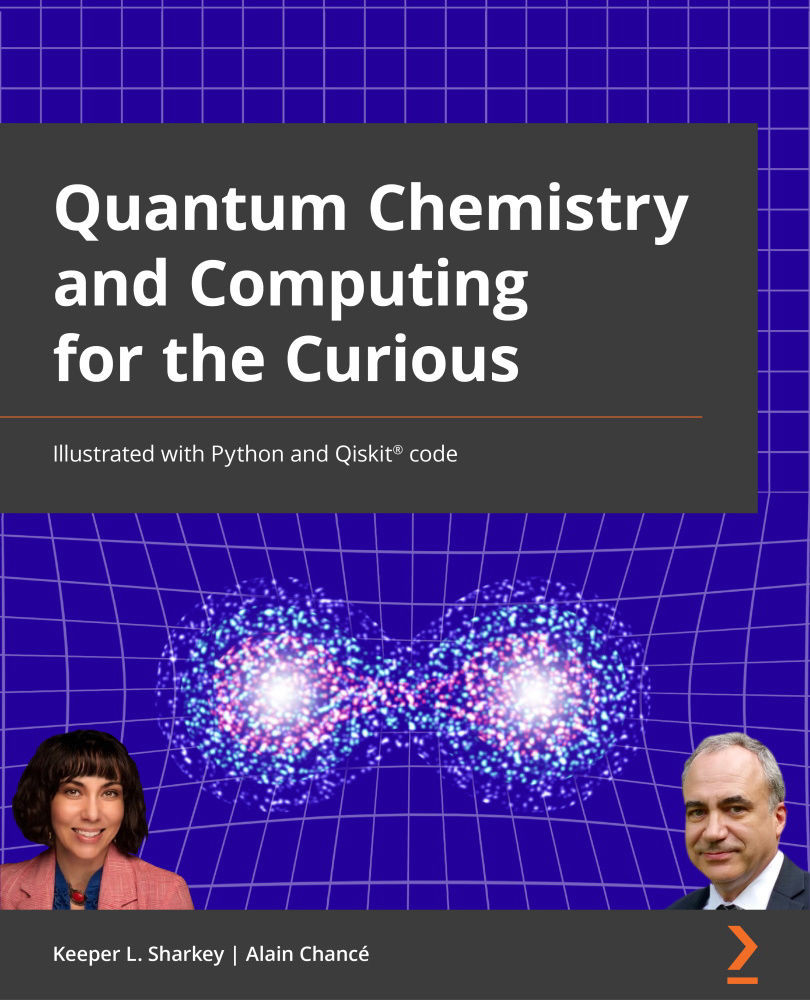
Quantum Chemistry and Computing for the Curious

Quantum Chemistry and Computing for the Curious

By : Keeper Layne Sharkey, Alex Khan, Chancé
4.8 (15)
close
close
Quantum Chemistry and Computing for the Curious

Quantum Chemistry and Computing for the Curious

4.8 (15)
By: Keeper Layne Sharkey, Alex Khan, Chancé

Overview of this book

Explore quantum chemical concepts and the postulates of quantum mechanics in a modern fashion, with the intent to see how chemistry and computing intertwine. Along the way you’ll relate these concepts to quantum information theory and computation. We build a framework of computational tools that lead you through traditional computational methods and straight to the forefront of exciting opportunities. These opportunities will rely on achieving next-generation accuracy by going further than the standard approximations such as beyond Born-Oppenheimer calculations. Discover how leveraging quantum chemistry and computing is a key enabler for overcoming major challenges in the broader chemical industry. The skills that you will learn can be utilized to solve new-age business needs that specifically hinge on quantum chemistry
Table of Contents (14 chapters)
close
close
8
Chapter 8: References
9
Chapter 9:Glossary
2
Appendix B: Leveraging Jupyter Notebooks on the Cloud
3
Appendix C: Trademarks

Chapter 3: Quantum Circuit Model of Computation

"As we scale towards a million [qubits], I think we've got some fundamental issues in error correction, control, and maybe quantum physics that can rear their heads," he said, adding that even those problems are "solvable."

– Arvind Krishna, IBM chairman and CEO

Figure 3.1 – Scaling of the quantum computer [authors]

There are fundamental differences between classical computing and quantum computing; classical computing is deterministic with 1s and 0s, and quantum is probabilistic with a twist. Quantum computers work with probability amplitudes, which is a postulate of quantum mechanics (see Section 2.2, Postulate 2 – Probability amplitudes). The probabilistic amplitudes of quantum computing behave differently from classical probabilities in that these values can cancel each other out, which is known as destructive interference.

Destructive interference...

Visually different images
CONTINUE READING
83
Tech Concepts
36
Programming languages
73
Tech Tools
Icon Unlimited access to the largest independent learning library in tech of over 8,000 expert-authored tech books and videos.
Icon Innovative learning tools, including AI book assistants, code context explainers, and text-to-speech.
Icon 50+ new titles added per month and exclusive early access to books as they are being written.
Quantum Chemistry and Computing for the Curious
notes
bookmark Notes and Bookmarks search Search in title playlist Add to playlist download Download options font-size Font size

Change the font size

margin-width Margin width

Change margin width

day-mode Day/Sepia/Night Modes

Change background colour

Close icon Search
Country selected

Close icon Your notes and bookmarks

Confirmation

Modal Close icon
claim successful

Buy this book with your credits?

Modal Close icon
Are you sure you want to buy this book with one of your credits?
Close
YES, BUY

Submit Your Feedback

Modal Close icon
Modal Close icon
Modal Close icon