Sign In Start Free Trial
Account

Add to playlist

Create a Playlist

Modal Close icon
You need to login to use this feature.
  • Book Overview & Buying C++20 STL Cookbook
  • Table Of Contents Toc
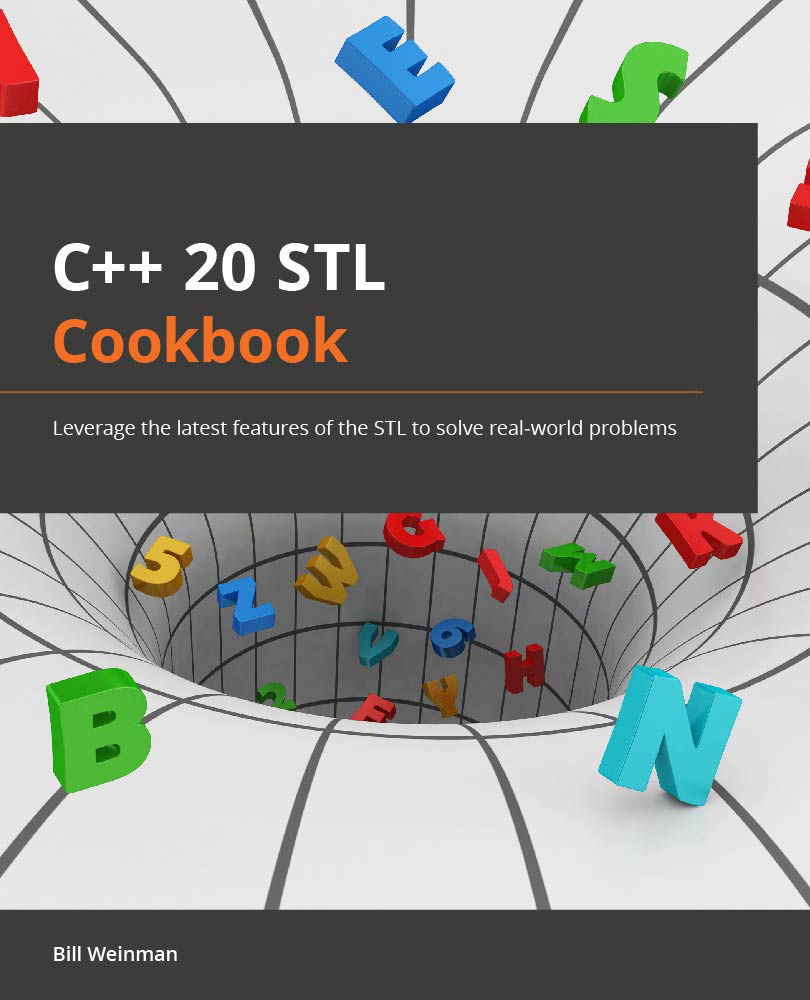
C++20 STL Cookbook

C++20 STL Cookbook

By : Bill Weinman
4.5 (10)
close
close
C++20 STL Cookbook

C++20 STL Cookbook

4.5 (10)
By: Bill Weinman

Overview of this book

Fast, efficient, and flexible, the C++ programming language has come a long way and is used in every area of the industry to solve many problems. The latest version C++20 will see programmers change the way they code as it brings a whole array of features enabling the quick deployment of applications. This book will get you up and running with using the STL in the best way possible. Beginning with new language features in C++20, this book will help you understand the language's mechanics and library features and offer insights into how they work. Unlike other books, the C++20 STL Cookbook takes an implementation-specific, problem-solution approach that will help you overcome hurdles quickly. You'll learn core STL concepts, such as containers, algorithms, utility classes, lambda expressions, iterators, and more, while working on real-world recipes. This book is a reference guide for using the C++ STL with its latest capabilities and exploring the cutting-edge features in functional programming and lambda expressions. By the end of the book C++20 book, you'll be able to leverage the latest C++ features and save time and effort while solving tasks elegantly using the STL.
Table of Contents (13 chapters)
close
close

A quick overview of the STL container types

The STL provides a comprehensive set of container types, including sequential containers, associative containers, and container adapters. Here's a brief overview:

Sequential containers

The sequential containers provide an interface where the elements are arranged in sequence. While you may use the elements sequentially, some of these containers use contiguous storage, and others do not. The STL includes these sequential containers:

  • The array is a fixed-size sequence that holds a specific number of elements in contiguous storage. Once allocated, it cannot change size. This is the simplest and fastest contiguous storage container.
  • The vector is like an array that can shrink and grow. Its elements are stored contiguously, so changing size may involve the expense of allocating memory and moving data. A vector may keep extra space in reserve to mitigate that cost. Inserting and deleting elements from anywhere other than...
CONTINUE READING
83
Tech Concepts
36
Programming languages
73
Tech Tools
Icon Unlimited access to the largest independent learning library in tech of over 8,000 expert-authored tech books and videos.
Icon Innovative learning tools, including AI book assistants, code context explainers, and text-to-speech.
Icon 50+ new titles added per month and exclusive early access to books as they are being written.
C++20 STL Cookbook
notes
bookmark Notes and Bookmarks search Search in title playlist Add to playlist download Download options font-size Font size

Change the font size

margin-width Margin width

Change margin width

day-mode Day/Sepia/Night Modes

Change background colour

Close icon Search
Country selected

Close icon Your notes and bookmarks

Confirmation

Modal Close icon
claim successful

Buy this book with your credits?

Modal Close icon
Are you sure you want to buy this book with one of your credits?
Close
YES, BUY

Submit Your Feedback

Modal Close icon
Modal Close icon
Modal Close icon