Sign In Start Free Trial
Account

Add to playlist

Create a Playlist

Modal Close icon
You need to login to use this feature.
  • Book Overview & Buying Practical Business Process Modeling and Analysis
  • Table Of Contents Toc
  • Feedback & Rating feedback
Practical Business Process Modeling and Analysis

Practical Business Process Modeling and Analysis

By : Jim Sinur, Zbigniew Misiak, BJ Biernatowski
close
close
Practical Business Process Modeling and Analysis

Practical Business Process Modeling and Analysis

By: Jim Sinur, Zbigniew Misiak, BJ Biernatowski

Overview of this book

Every business transformation begins with one question, “How can we do this better?” Whether it’s eliminating inefficiencies, optimizing business operations, or reimagining entire workflows with the help of AI, success depends on understanding and optimizing business processes. However, finding the right approach can be challenging with shifting market demands and evolving technologies. In this book, three seasoned experts in BPM, automation, and AI-driven process optimization guide you through frameworks, techniques, and tools that drive digital transformation by helping you explore business process modelling, before and after process execution. You'll visualize complex workflows, establish scalable process architectures that drive digital transformation, and integrate automation for efficiency. With insights into BPMN, business value analysis, and field-tested consulting guidance, you'll see how process-led design and data-driven decisions can lead to smarter, more agile operations. Through real-world examples, you’ll grasp how leading organizations have optimized their processes and how you can apply the same principles in your digital change program. By the end of this book, you’ll be able to identify, design, analyze, and transform business processes for measurable impact, as well as master the synergy of technology, process, and strategy to build systems that drive sustainable growth.
Table of Contents (14 chapters)
close
close
10
Measuring the Business Value of Process Transformation
13
Other Books You May Enjoy

How does process modeling contribute to digital transformation?

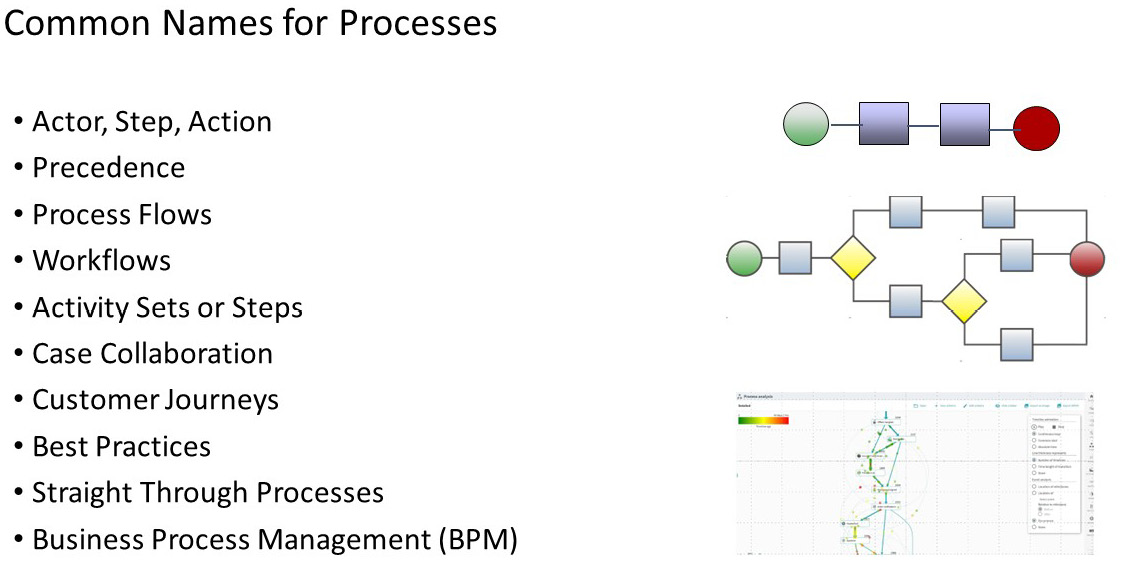
Processes are everywhere in an organization; therefore, the process models are essential for digital transformation to progress. While only 20–30% of the most high-volume processes of an organization are automated in some way, there are ample opportunities for digital transformation. The easy step is to look at those processes, but sometimes the most essential and costly processes are outside the normal high-volume processes and looking for automation opportunities. For organizations to execute flawlessly, all processes are candidates for digital attention. Organizations can also benefit by finding procedural processes that can prevent risk, compete for skills more effectively, and stay compliant in a changing business environment. Finding these golden nuggets will require some digging. See Figure 1.1 for the common names for processes typically found in organizations. Industry groups and competitive benchmarks can point to the kinds of processes to transform over and above the typical high-volume processes.

Figure 1.1 – Common names for processes

Figure 1.1 – Common names for processes

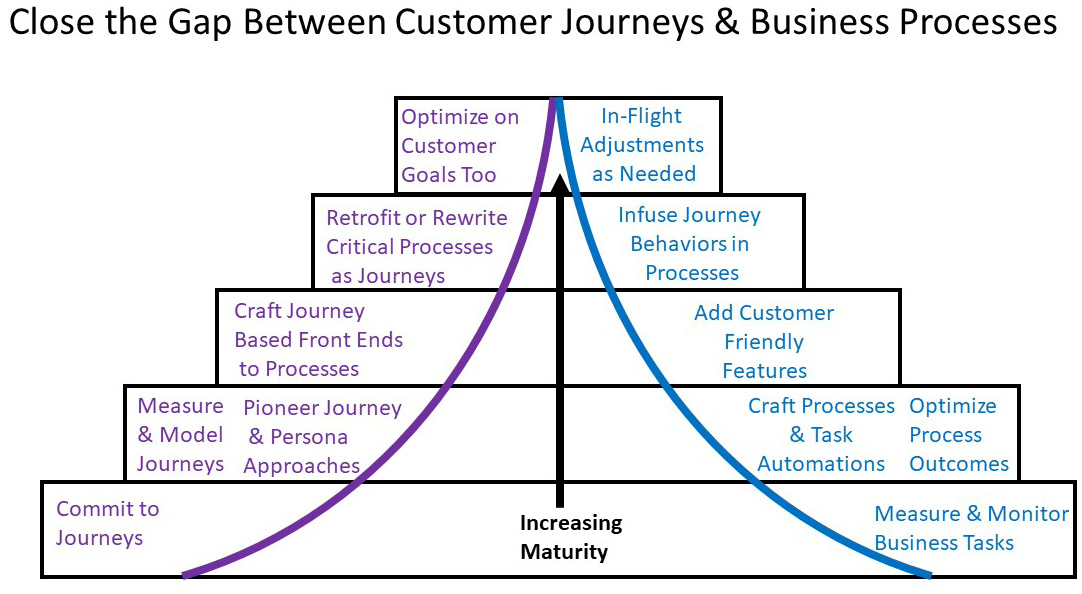
Often, organizations improve typical high-volume core processes by improving the customer experience and start to converge highly automated and internally focused processes to include the goals of the customer, making these processes more outside-in, AKA customer-centric over time. Most often, systems concentrate on internal organizational goals that are aimed at efficiency only. The primary goal of many organizational processes revolves around the cost and speed of transactional completion in a compliant manner, but not necessarily in favor of customer goals. Digital transformation is an opportunity to balance customer goals with internal organizational goals focusing primarily on profit. See Figure 1.2 for ideas on closing the gap between the customer experience and business processes. Many organizations believe they do not inflict pain on their customers when interacting with their core processes. These organizations need to classify the pain they cause and what characteristics cause the pain for customers. See Figure 1.3 for an example customer pain index.

Figure 1.2 – Close the gap between customer journeys and business processes

Figure 1.2 – Close the gap between customer journeys and business processes

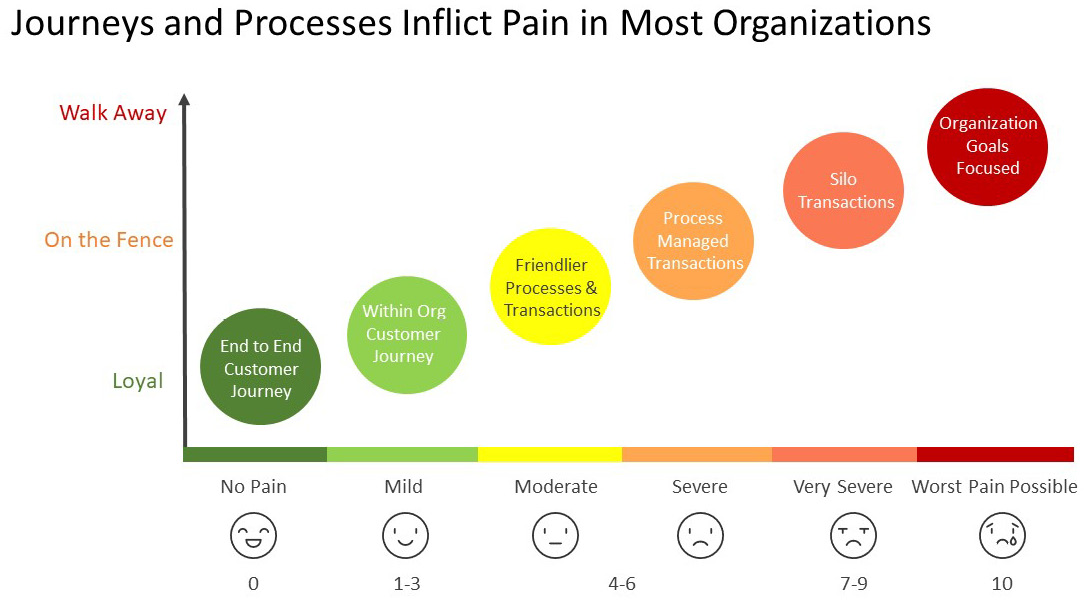
Many organizations believe they do not inflict pain on their customers when interacting with their core processes. These organizations need to classify the pain they cause and what characteristics cause that pain for customers. See Figure 1.3 for an example customer pain index:

Figure 1.3 – Customer pain index

Figure 1.3 – Customer pain index

More than likely, there is an opportunity for more automation in those core processes. Emerging digital technologies combined with traditional technologies used in a new way or in different contexts hold potential benefits for organizations and their constituents. Examples under the watchful umbrella of modern cybersecurity include the following:

  • AI / generative / decisioning / learning
  • Analytics / poly analytics / mining
  • Business Process Management (BPM) / development / automation
  • Collaboration / content
  • Business application / models / templates / components
  • Cloud / integration / data fabrics / blockchain data
  • IoT / edge hardware / digital twins

Making the existing processes friendlier and more intelligent is an excellent first step. Consider adding more robust assistance/intelligence to the participants (AKA resources) involved in process completion. Typical process resources include the following in the context of location and state:

  • Managers
  • Knowledge workers
  • Skilled workers
  • APIs, data meshes, and data and knowledge sources
  • System components, bots, and algorithms
  • Sensors, chips, controllers, and edge firmware
  • Robots, drones, cameras, and so on

No matter the process that an organization chooses, a process model will point the way to the improvement opportunities for digital transformation efforts, especially when combined with AI, business analytics, process/data mining, and non-self-serving surveys of customers, employees, partners, contractors, and communities.

Visually different images
CONTINUE READING
83
Tech Concepts
36
Programming languages
73
Tech Tools
Icon Unlimited access to the largest independent learning library in tech of over 8,000 expert-authored tech books and videos.
Icon Innovative learning tools, including AI book assistants, code context explainers, and text-to-speech.
Icon 50+ new titles added per month and exclusive early access to books as they are being written.
Practical Business Process Modeling and Analysis
notes
bookmark Notes and Bookmarks search Search in title playlist Add to playlist download Download options font-size Font size

Change the font size

margin-width Margin width

Change margin width

day-mode Day/Sepia/Night Modes

Change background colour

Close icon Search
Country selected

Close icon Your notes and bookmarks

Confirmation

Modal Close icon
claim successful

Buy this book with your credits?

Modal Close icon
Are you sure you want to buy this book with one of your credits?
Close
YES, BUY

Submit Your Feedback

Modal Close icon
Modal Close icon
Modal Close icon