Sign In Start Free Trial
Account

Add to playlist

Create a Playlist

Modal Close icon
You need to login to use this feature.
  • Book Overview & Buying The Go Workshop
  • Table Of Contents Toc
  • Feedback & Rating feedback
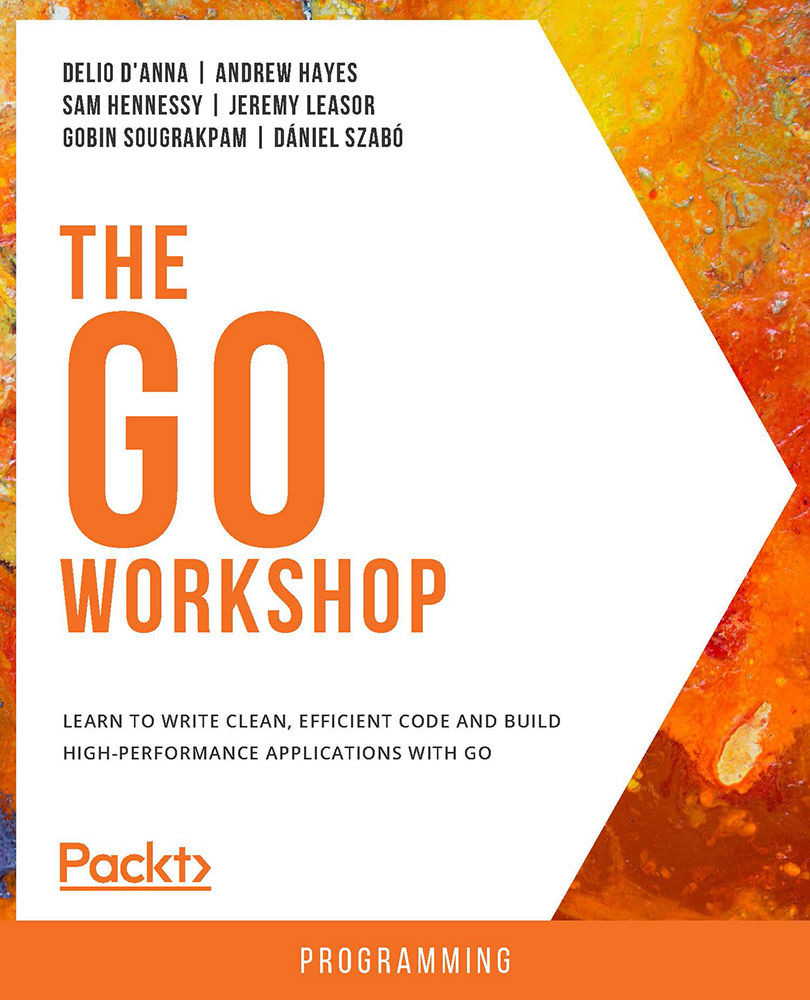
The Go Workshop

The Go Workshop

By : Delio D'Anna , Andrew Hayes , Sam Hennessy , Jeremy Leasor , Gobin Sougrakpam , Dániel Szabó
4.8 (20)
close
close
The Go Workshop

The Go Workshop

4.8 (20)
By: Delio D'Anna , Andrew Hayes , Sam Hennessy , Jeremy Leasor , Gobin Sougrakpam , Dániel Szabó

Overview of this book

The Go Workshop will take the pain out of learning the Go programming language (also known as Golang). It is designed to teach you to be productive in building real-world software. Presented in an engaging, hands-on way, this book focuses on the features of Go that are used by professionals in their everyday work. Each concept is broken down, clearly explained, and followed up with activities to test your knowledge and build your practical skills. Your first steps will involve mastering Go syntax, working with variables and operators, and using core and complex types to hold data. Moving ahead, you will build your understanding of programming logic and implement Go algorithms to construct useful functions. As you progress, you'll discover how to handle errors, debug code to troubleshoot your applications, and implement polymorphism using interfaces. The later chapters will then teach you how to manage files, connect to a database, work with HTTP servers and REST APIs, and make use of concurrent programming. Throughout this Workshop, you'll work on a series of mini projects, including a shopping cart, a loan calculator, a working hours tracker, a web page counter, a code checker, and a user authentication system. By the end of this book, you'll have the knowledge and confidence to tackle your own ambitious projects with Go.
Table of Contents (21 chapters)
close
close
Lock Free Chapter
1
1. Variables and Operators
2
2. Logic and Loops

Invisible Concurrency

We've seen in the previous exercise, the effects of concurrency through race conditions, but we want to see them in practice. It is easy to understand that concurrency problems are difficult to visualize as they do not manifest in the same way every time we run a program. That's why we are focusing on finding ways to synchronize concurrent work. One easy way to visualize it, however, but that is difficult to use in tests, is to print out each concurrent routine and see the order in which these routines are called. In the previous exercise, for example, we could have sent another parameter with a name and printed the name of the function at each iteration in the for loop.

If we want to see the effects of concurrency and still be able to test it, we could use the atomic package again, this time with strings so that we can build a string containing a message from each Goroutine. For this scenario, we will use the sync package again, but we will not make...

Visually different images
CONTINUE READING
83
Tech Concepts
36
Programming languages
73
Tech Tools
Icon Unlimited access to the largest independent learning library in tech of over 8,000 expert-authored tech books and videos.
Icon Innovative learning tools, including AI book assistants, code context explainers, and text-to-speech.
Icon 50+ new titles added per month and exclusive early access to books as they are being written.
The Go Workshop
notes
bookmark Notes and Bookmarks search Search in title playlist Add to playlist download Download options font-size Font size

Change the font size

margin-width Margin width

Change margin width

day-mode Day/Sepia/Night Modes

Change background colour

Close icon Search
Country selected

Close icon Your notes and bookmarks

Confirmation

Modal Close icon
claim successful

Buy this book with your credits?

Modal Close icon
Are you sure you want to buy this book with one of your credits?
Close
YES, BUY

Submit Your Feedback

Modal Close icon
Modal Close icon
Modal Close icon