Sign In Start Free Trial
Account

Add to playlist

Create a Playlist

Modal Close icon
You need to login to use this feature.
  • Book Overview & Buying OpenCL Programming by Example
  • Table Of Contents Toc
  • Feedback & Rating feedback
OpenCL Programming by Example

OpenCL Programming by Example

By : Banger, Koushik Bhattacharyya
3.3 (7)
close
close
OpenCL Programming by Example

OpenCL Programming by Example

3.3 (7)
By: Banger, Koushik Bhattacharyya

Overview of this book

Research in parallel programming has been a mainstream topic for a decade, and will continue to be so for many decades to come. Many parallel programming standards and frameworks exist, but only take into account one type of hardware architecture. Today computing platforms come with many heterogeneous devices. OpenCL provides royalty free standard to program heterogeneous hardware. This guide offers you a compact coverage of all the major topics of OpenCL programming. It explains optimization techniques and strategies in-depth, using illustrative examples and also provides case studies from diverse fields. Beginners and advanced application developers will find this book very useful. Beginning with the discussion of the OpenCL models, this book explores their architectural view, programming interfaces and primitives. It slowly demystifies the process of identifying the data and task parallelism in diverse algorithms. It presents examples from different domains to show how the problems within different domains can be solved more efficiently using OpenCL. You will learn about parallel sorting, histogram generation, JPEG compression, linear and parabolic regression and k-nearest neighborhood, a clustering algorithm in pattern recognition. Following on from this, optimization strategies are explained with matrix multiplication examples. You will also learn how to do an interoperation of OpenGL and OpenCL. "OpenCL Programming by Example" explains OpenCL in the simplest possible language, which beginners will find it easy to understand. Developers and programmers from different domains who want to achieve acceleration for their applications will find this book very useful.
Table of Contents (13 chapters)
close
close
12
Index

Advances in computer architecture

All over the 20th century computer architectures have advanced by multiple folds. The trend is continuing in the 21st century and will remain for a long time to come. Some of these trends in architecture follow Moore's Law. "Moore's law is the observation that, over the history of computing hardware, the number of transistors on integrated circuits doubles approximately every two years". Many devices in the computer industry are linked to Moore's law, whether they are DSPs, memory devices, or digital cameras. All the hardware advances would be of no use if there weren't any software advances. Algorithms and software applications grow in complexity, as more and more user interaction comes into play. An algorithm can be highly sequential or it may be parallelized, by using any parallel computing framework. Amdahl's Law is used to predict the speedup for an algorithm, which can be obtained given n threads. This speedup is dependent on the value of the amount of strictly serial or non-parallelizable code (B). The time T(n) an algorithm takes to finish when being executed on n thread(s) of execution corresponds to:

T(n) = T(1) (B + (1-B)/n)

Therefore the theoretical speedup which can be obtained for a given algorithm is given by :

Speedup(n) = 1/(B + (1-B)/n)

Amdahl's Law has a limitation, that it does not fully exploit the computing power that becomes available as the number of processing core increase.

Gustafson's Law takes into account the scaling of the platform by adding more processing elements in the platform. This law assumes that the total amount of work that can be done in parallel, varies linearly with the increase in number of processing elements. Let an algorithm be decomposed into (a+b). The variable a is the serial execution time and variable b is the parallel execution time. Then the corresponding speedup for P parallel elements is given by:

(a + P*b)

Speedup = (a + P*b) / (a + b)

Now defining α as a/(a+b), the sequential execution component, as follows, gives the speedup for P processing elements:

Speedup(P) = P – α *(P - 1)

Given a problem which can be solved using OpenCL, the same problem can also be solved on a different hardware with different capabilities. Gustafson's law suggests that with more number of computing units, the data set should also increase that is, "fixed work per processor". Whereas Amdahl's law suggests the speedup which can be obtained for the existing data set if more computing units are added, that is, "Fixed work for all processors". Let's take the following example:

Let the serial component and parallel component of execution be of one unit each.

In Amdahl's Law the strictly serial component of code is B (equals 0.5). For two processors, the speedup T(2) is given by:

T(2) = 1 / (0.5 + (1 – 0.5) / 2) = 1.33

Similarly for four and eight processors, the speedup is given by:

T(4) = 1.6 and T(8) = 1.77

Adding more processors, for example when n tends to infinity, the speedup obtained at max is only 2. On the other hand in Gustafson's law, Alpha = 1(1+1) = 0.5 (which is also the serial component of code). The speedup for two processors is given by:

Speedup(2) = 2 – 0.5(2 - 1) = 1.5

Similarly for four and eight processors, the speedup is given by:

Speedup(4) = 2.5 and Speedup(8) = 4.5

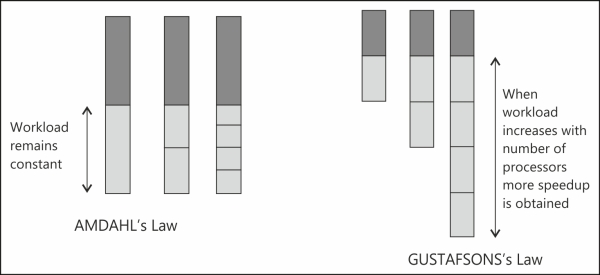
The following figure shows the work load scaling factor of Gustafson's law, when compared to Amdahl's law with a constant workload:

Advances in computer architecture

Comparison of Amdahl's and Gustafson's Law

OpenCL is all about parallel programming, and Gustafson's law very well fits into this book as we will be dealing with OpenCL for data parallel applications. Workloads which are data parallel in nature can easily increase the data set and take advantage of the scalable platforms by adding more compute units. For example, more pixels can be computed as more compute units are added.

Visually different images
CONTINUE READING
83
Tech Concepts
36
Programming languages
73
Tech Tools
Icon Unlimited access to the largest independent learning library in tech of over 8,000 expert-authored tech books and videos.
Icon Innovative learning tools, including AI book assistants, code context explainers, and text-to-speech.
Icon 50+ new titles added per month and exclusive early access to books as they are being written.
OpenCL Programming by Example
notes
bookmark Notes and Bookmarks search Search in title playlist Add to playlist font-size Font size

Change the font size

margin-width Margin width

Change margin width

day-mode Day/Sepia/Night Modes

Change background colour

Close icon Search
Country selected

Close icon Your notes and bookmarks

Confirmation

Modal Close icon
claim successful

Buy this book with your credits?

Modal Close icon
Are you sure you want to buy this book with one of your credits?
Close
YES, BUY

Submit Your Feedback

Modal Close icon
Modal Close icon
Modal Close icon