Sign In Start Free Trial
Account

Add to playlist

Create a Playlist

Modal Close icon
You need to login to use this feature.
  • Book Overview & Buying Penetration Testing with Raspberry Pi
  • Table Of Contents Toc
Penetration Testing with Raspberry Pi

Penetration Testing with Raspberry Pi - Second Edition

By : Jason Beltrame, McPhee
4.3 (4)
close
close
Penetration Testing with Raspberry Pi

Penetration Testing with Raspberry Pi

4.3 (4)
By: Jason Beltrame, McPhee

Overview of this book

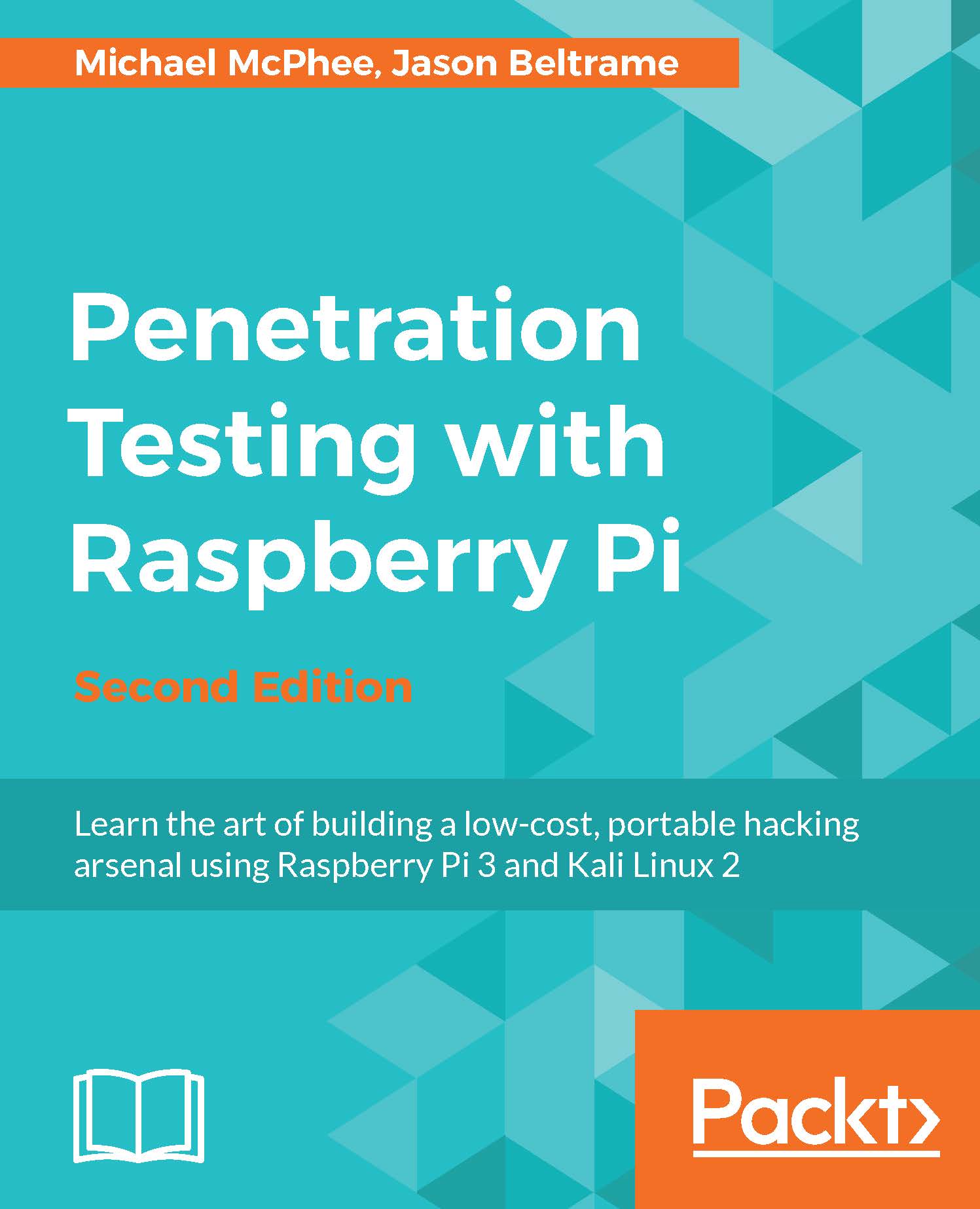
This book will show you how to utilize the latest credit card sized Raspberry Pi 3 and create a portable, low-cost hacking tool using Kali Linux 2. You’ll begin by installing and tuning Kali Linux 2 on Raspberry Pi 3 and then get started with penetration testing. You will be exposed to various network security scenarios such as wireless security, scanning network packets in order to detect any issues in the network, and capturing sensitive data. You will also learn how to plan and perform various attacks such as man-in-the-middle, password cracking, bypassing SSL encryption, compromising systems using various toolkits, and many more. Finally, you’ll see how to bypass security defenses and avoid detection, turn your Pi 3 into a honeypot, and develop a command and control system to manage a remotely-placed Raspberry Pi 3. By the end of this book you will be able to turn Raspberry Pi 3 into a hacking arsenal to leverage the most popular open source toolkit, Kali Linux 2.0.
Table of Contents (8 chapters)
close
close

Chapter 2.  Preparing for Battle

Despite the massive improvements the Raspberry Pi 3 makes over its predecessors, it should still be considered an underpowered platform for security assessments. That being said, it is designed as a low-cost, ultra-portable computer primarily targeting educators and hobbyists. That gives it an advantage in covert, on-site penetration testing and other discreet engagements. Our focus for this chapter will be on how to prepare a Raspberry Pi (or other platforms) running Kali Linux for the management access and connectivity it will need during all phases of a penetration test.

We'll cover the following topics in this chapter:

  • Using a Command and Control server
  • Preparing for a penetration test
  • Setting up the SSH service
  • SSH default keys and management
  • Reverse shell through SSH
  • Using stunnel and other tunneling protocols
  • Setting up Remote GUI Access
  • Overclocking
  • Setting up the wireless interface
  • Setting up the Bluetooth interface
  • Setting up a 3G USB modem...
CONTINUE READING
83
Tech Concepts
36
Programming languages
73
Tech Tools
Icon Unlimited access to the largest independent learning library in tech of over 8,000 expert-authored tech books and videos.
Icon Innovative learning tools, including AI book assistants, code context explainers, and text-to-speech.
Icon 50+ new titles added per month and exclusive early access to books as they are being written.
Penetration Testing with Raspberry Pi
notes
bookmark Notes and Bookmarks search Search in title playlist Add to playlist font-size Font size

Change the font size

margin-width Margin width

Change margin width

day-mode Day/Sepia/Night Modes

Change background colour

Close icon Search
Country selected

Close icon Your notes and bookmarks

Confirmation

Modal Close icon
claim successful

Buy this book with your credits?

Modal Close icon
Are you sure you want to buy this book with one of your credits?
Close
YES, BUY

Submit Your Feedback

Modal Close icon
Modal Close icon
Modal Close icon