


-
Book Overview & Buying
-
Table Of Contents

Hands-On RTOS with Microcontrollers - Second Edition
By :


Hands-On RTOS with Microcontrollers
By:
Overview of this book
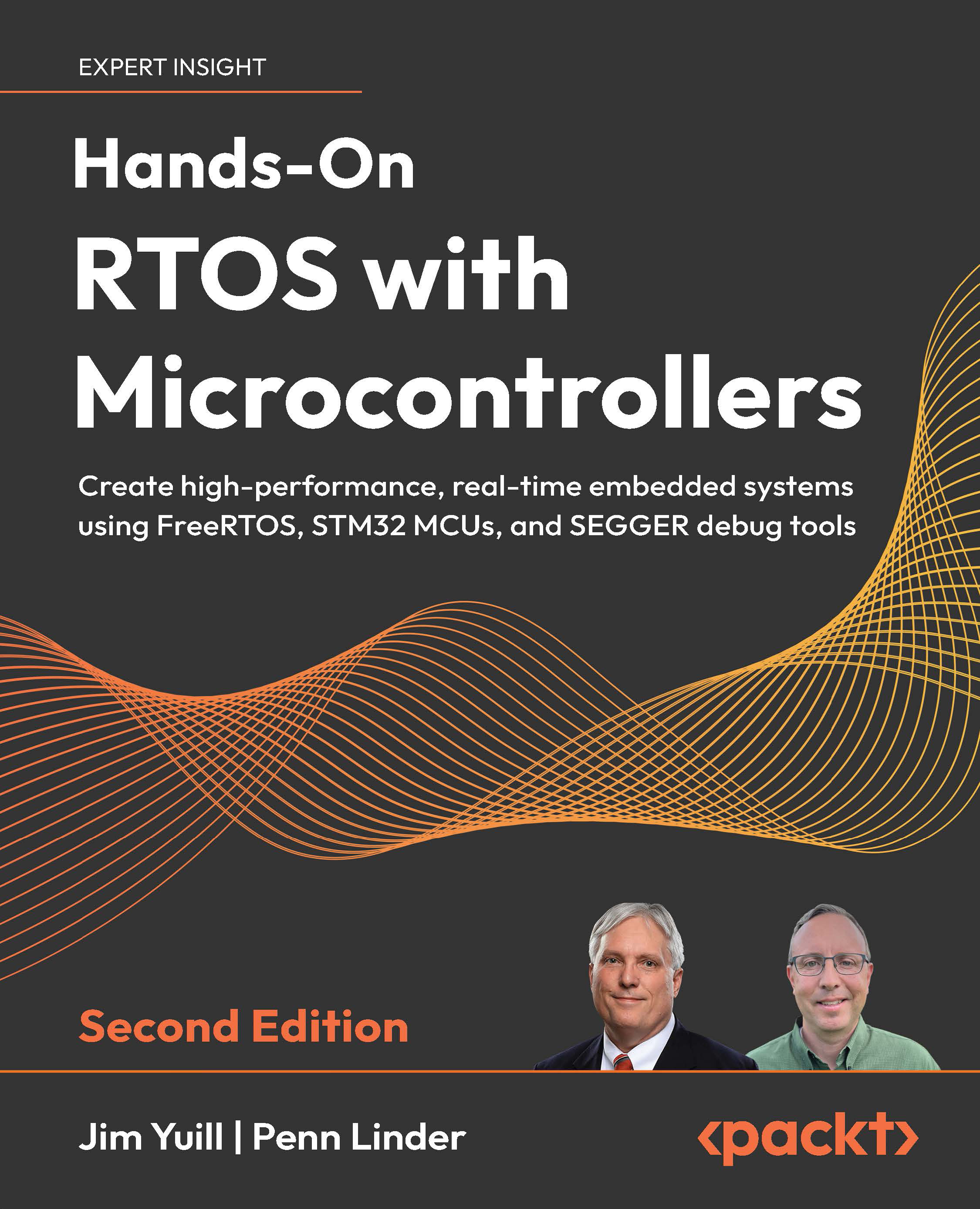
This updated edition of Hands-On RTOS with Microcontrollers is packed with cutting-edge content to help you expand your skills and stay ahead of the curve with embedded systems development. Written by senior engineers with decades of experience in embedded systems and related technologies, it covers the role of real-time OSs in today’s time-critical applications, and it covers FreeRTOS, including its key capabilities and APIs. You’ll find detailed descriptions of system design, hands-on system use, the hardware platform (dev-board, MCU, and debug-probe), and the development tools (IDE, build system, and debugging tools).
This second edition teaches you how to implement over 20 real-world embedded applications, using FreeRTOS's primary features. The chapters include example programs on GitHub, with detailed instructions. You’ll create and install your own FreeRTOS system on the dev-board (purchased separately), and set up an IDE project with debugging tools.
An ST dev-board is used with the book, and it is purchased separately (STM32 Nucleo-F767ZI - the dev-board is not required to read and understand the book).
By the end of this book, you’ll have the hands-on skills to start designing, building, and optimizing embedded applications, using FreeRTOS, development boards, and debugging tools.
Table of Contents (27 chapters)
Preface


Part 1: Introduction to RTOSes, the Dev-Board, and Tools
 Free Chapter
Introducing Real-Time Systems
Introducing the Development Board
Introducing the Development-Tools
Understanding Super-Loops
Implementing the Super-Loop
Part 2: The FreeRTOS Scheduler, Tasks, and Primary APIs
Understanding RTOS Tasks
Running the FreeRTOS Scheduler
Protecting Data and Synchronizing Tasks
Intertask Communication
Part 3: Using FreeRTOS to Build Systems
Drivers and ISRs
More Efficient Drivers and ISRs
Sharing Hardware Peripherals among Tasks
Creating Loose Coupling with Queues
Part 4: System Design and Troubleshooting
FreeRTOS Memory Management

Multi-Processor and Multi-Core Systems
Troubleshooting Tips and Next Steps
Part 5: Reference Information and FreeRTOS Installation
Other Books You May Enjoy
Index
Appendix A: Tools Quick-Reference
Appendix B: Reference Information
Appendix C: Creating FreeRTOS Projects, and Installing FreeRTOS


