Sign In Start Free Trial
Account

Add to playlist

Create a Playlist

Modal Close icon
You need to login to use this feature.
  • Book Overview & Buying The Vulnerability Researcher's Handbook
  • Table Of Contents Toc
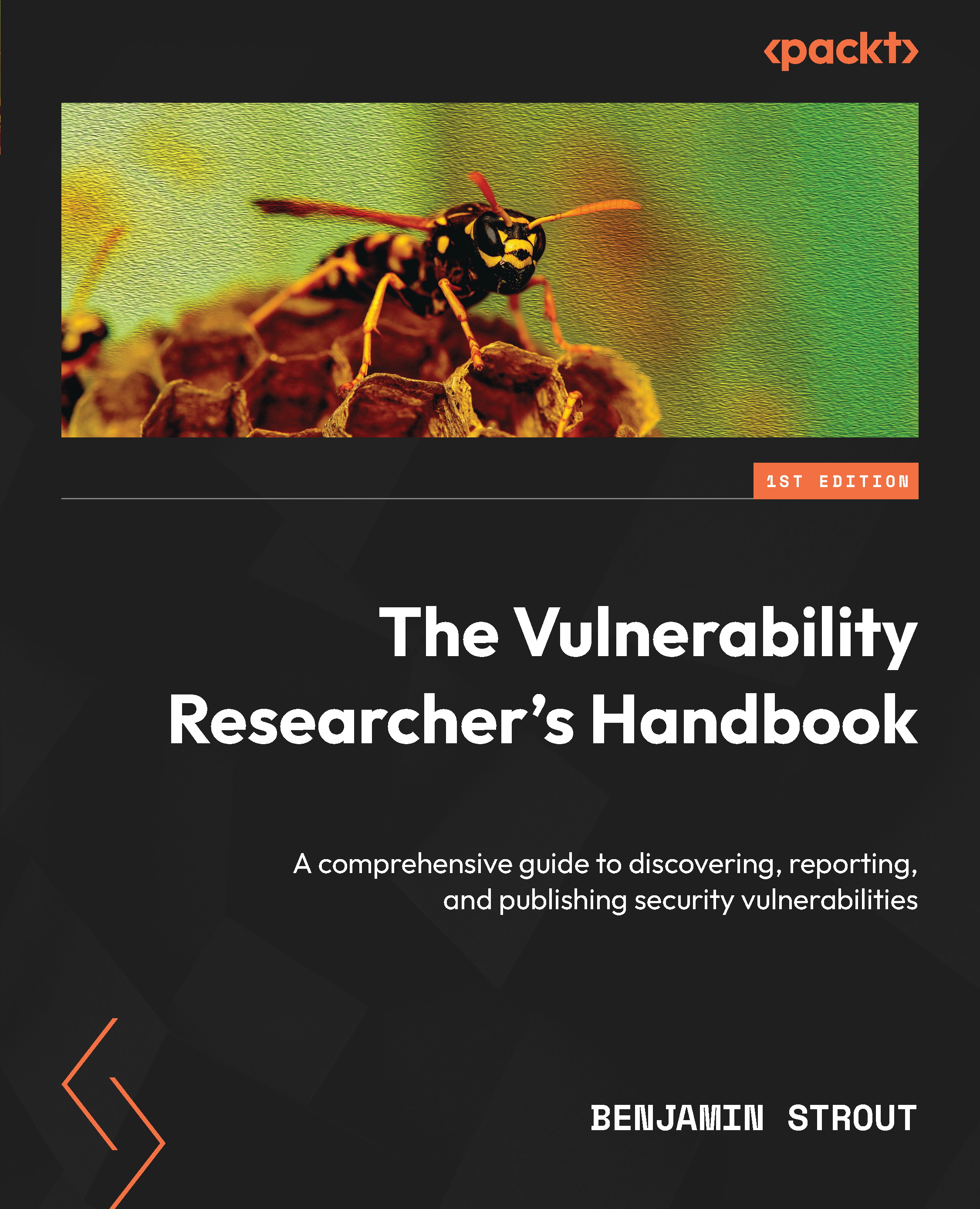
The Vulnerability Researcher's Handbook

The Vulnerability Researcher's Handbook

By : Benjamin Strout
5 (1)
close
close
The Vulnerability Researcher's Handbook

The Vulnerability Researcher's Handbook

5 (1)
By: Benjamin Strout

Overview of this book

Vulnerability researchers are in increasingly high demand as the number of security incidents related to crime continues to rise with the adoption and use of technology. To begin your journey of becoming a security researcher, you need more than just the technical skills to find vulnerabilities; you’ll need to learn how to adopt research strategies and navigate the complex and frustrating process of sharing your findings. This book provides an easy-to-follow approach that will help you understand the process of discovering, disclosing, and publishing your first zero-day vulnerability through a collection of examples and an in-depth review of the process. You’ll begin by learning the fundamentals of vulnerabilities, exploits, and what makes something a zero-day vulnerability. Then, you'll take a deep dive into the details of planning winning research strategies, navigating the complexities of vulnerability disclosure, and publishing your research with sometimes-less-than-receptive vendors. By the end of the book, you'll be well versed in how researchers discover, disclose, and publish vulnerabilities, navigate complex vendor relationships, receive credit for their work, and ultimately protect users from exploitation. With this knowledge, you’ll be prepared to conduct your own research and publish vulnerabilities.
Table of Contents (16 chapters)
close
close
1
Part 1– Vulnerability Research Fundamentals
5
Part 2 – Vulnerability Disclosure, Publishing, and Reporting
10
Part 3 – Case Studies, Researcher Resources, and Vendor Resources

An Introduction to Vulnerabilities

A vulnerability is a characteristic of something that makes that thing susceptible to hazards or damage. Technology is certainly not immune to vulnerabilities. For example, during the 1960s in the United States, AT&T observed one of the first widespread exploitations of vulnerabilities in technology. People found they could subvert telephone systems and avoid paying for services if they played certain tones into telephone receivers. These technology hackers learned that if they understood how the systems worked and what flaws might be present in these systems, they could take advantage of weaknesses in ways that could directly benefit them. Today, the same spirit and enterprising ways of challenging technology by using it in unintended ways are present and thriving.

Throughout our world, people are discovering and exploiting vulnerabilities found in software. Software drives the modern world in almost everything we do. Security researchers can find software and subsequent vulnerabilities in the simple applications you use on your phone, business applications that drive commerce, devices used in hospitals to save lives, and industrial controls that help ensure societal needs. These vulnerabilities can be used for cybercrime, to violate your privacy, disrupt infrastructure, and create national security risks. Unfortunately, the exploitation of these security vulnerabilities can be difficult to detect, especially in undisclosed vulnerabilities.

Despite the growing number of reported and unreported vulnerabilities, people continue to be victimized by these threats, which incur increasingly high financial and privacy costs.. So, what is being done about this? In this chapter, we’ll explore how these threats are addressed by covering some fundamental concepts.

We’ll go over the following:

  • Software vulnerabilities and the CIA Triad
  • How software vulnerabilities are classified and organized
  • The vulnerability scanners that professionals often use to detect and fix flaws in software
  • Some common security vulnerability types usually found in software
  • The vulnerability life cycle and its impact on software

By the end of this chapter, you should understand what vulnerabilities are, how they get introduced to software, how vulnerabilities are organized and ranked, how to search for vulnerable software components, and the software vulnerability life cycle. Let’s get started.

CONTINUE READING
83
Tech Concepts
36
Programming languages
73
Tech Tools
Icon Unlimited access to the largest independent learning library in tech of over 8,000 expert-authored tech books and videos.
Icon Innovative learning tools, including AI book assistants, code context explainers, and text-to-speech.
Icon 50+ new titles added per month and exclusive early access to books as they are being written.
The Vulnerability Researcher's Handbook
notes
bookmark Notes and Bookmarks search Search in title playlist Add to playlist font-size Font size

Change the font size

margin-width Margin width

Change margin width

day-mode Day/Sepia/Night Modes

Change background colour

Close icon Search
Country selected

Close icon Your notes and bookmarks

Confirmation

Modal Close icon
claim successful

Buy this book with your credits?

Modal Close icon
Are you sure you want to buy this book with one of your credits?
Close
YES, BUY

Submit Your Feedback

Modal Close icon
Modal Close icon
Modal Close icon