Sign In Start Free Trial
Account

Add to playlist

Create a Playlist

Modal Close icon
You need to login to use this feature.
  • Book Overview & Buying Incident Response for Windows
  • Table Of Contents Toc
  • Feedback & Rating feedback
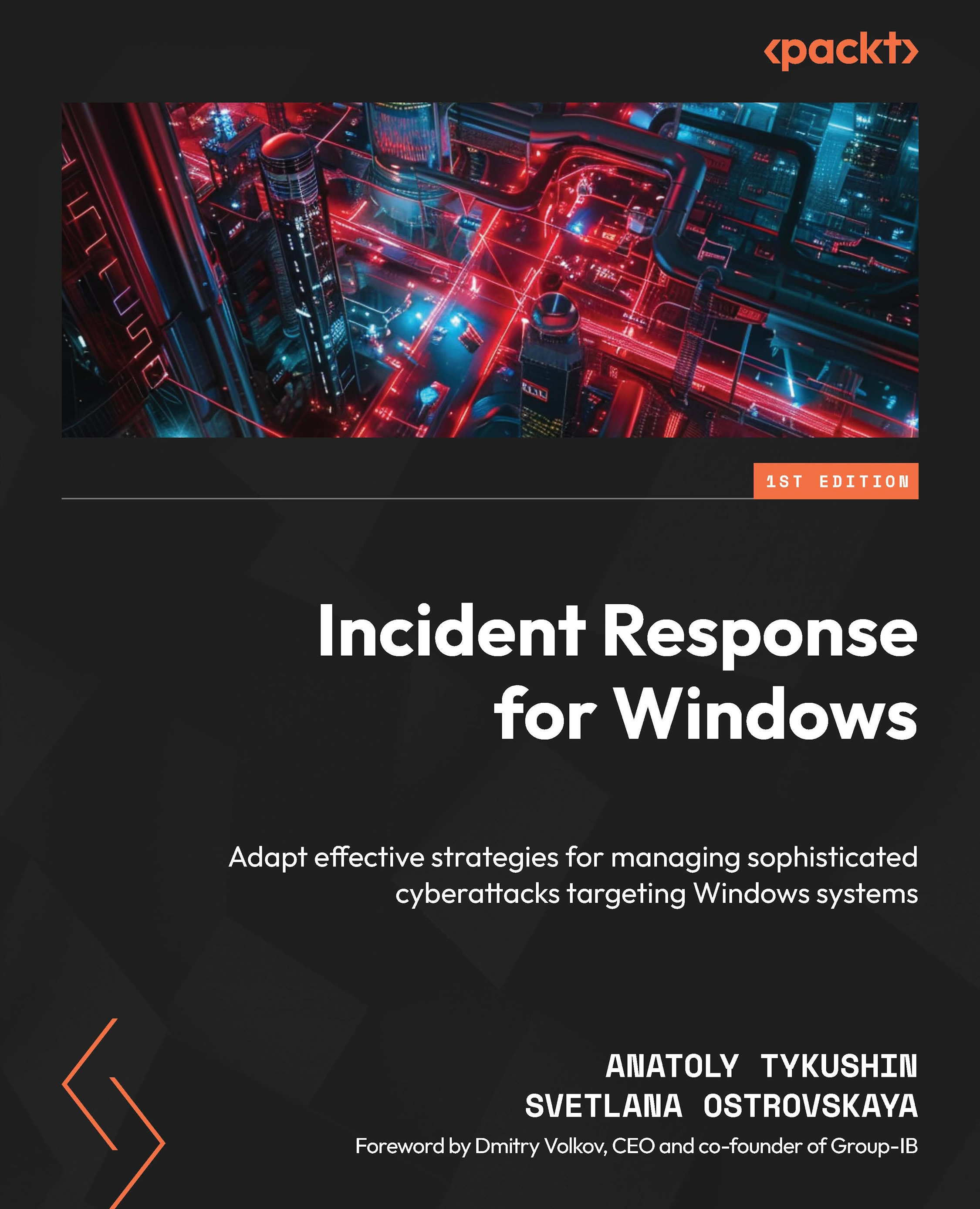
Incident Response for Windows

Incident Response for Windows

By : Anatoly Tykushin, Ostrovskaya
4.8 (9)
close
close
Incident Response for Windows

Incident Response for Windows

4.8 (9)
By: Anatoly Tykushin, Ostrovskaya

Overview of this book

Cybersecurity threats are constantly evolving, posing serious risks to organizations. Incident Response for Windows, by cybersecurity experts Anatoly Tykushin and Svetlana Ostrovskaya, provides a practical hands-on guide to mitigating threats in Windows environments, drawing from their real-world experience in incident response and digital forensics. Designed for cybersecurity professionals, IT administrators, and digital forensics practitioners, the book covers the stages of modern cyberattacks, including reconnaissance, infiltration, network propagation, and data exfiltration. It takes a step-by-step approach to incident response, from preparation and detection to containment, eradication, and recovery. You will also explore Windows endpoint forensic evidence and essential tools for gaining visibility into Windows infrastructure. The final chapters focus on threat hunting and proactive strategies to identify cyber incidents before they escalate. By the end of this book, you will gain expertise in forensic evidence collection, threat hunting, containment, eradication, and recovery, equipping them to detect, analyze, and respond to cyber threats while strengthening your organization's security posture
Table of Contents (20 chapters)
close
close
1
Part 1: Understanding the Threat Landscape and Attack Life Cycle
4
Part 2: Incident Response Procedures and Endpoint Forensic Evidence Collection
7
Part 3: Incident Analysis and Threat Hunting on Windows Systems
15
Part 4: Incident Investigation Management and Reporting

Introduction to the Threat Landscape

Most of the attacks (more than 90% according to GROUP-IB’s global experience) targeting organizations’ networks are run against Windows environments. It derives from the market dominance of the Microsoft Windows operating system, familiarity for most users in the world, software diversity in terms of it supporting a vast range of applications, backward compatibility, which makes it tough to eliminate several severe cybersecurity issues that were discovered in the past, and a bunch of legacy systems that don’t support the latest versions of these operating systems.

We (the authors) have been involved in hundreds of incident response engagements in many organizations on many continents of all sizes in a variety of industries, including government, the financial sector (banks, brokers, and cryptocurrency exchange), pharmacies and healthcare, critical industries, retail, construction, IT, and more, with different levels of cybersecurity maturity: where there were no cybersecurity teams to companies with huge security operations center (SOC) teams with dedicated roles covered by professionals with 10+ years of experience, automations and worked out like a Swiss watch. There is no silver bullet but there are some best practices that can be implemented to reduce – but not eliminate – cybersecurity risks.

This chapter explores the intricate web of threat intelligence levels, which can help organizations identify and categorize potential cyber threats targeting their Windows systems. In terms of all threat intelligence levels, we will discuss how they contribute to an organization’s overall cybersecurity posture.

We will also examine the main types of threat actors, their motivations, and the tactics they employ when targeting organizations with Windows environments.

Additionally, we will present real-world use cases that highlight the importance of understanding the cyber threat landscape, illustrating how organizations can proactively identify vulnerabilities, prioritize risks, and prepare for developing effective countermeasures for their Windows systems.

This chapter will cover the following topics:

  • Getting familiar with the cyber threat landscape
  • Types of threat actors and their motivations, including advanced persistent threats (APTs), cybercriminals, hacktivists, competitors, insider threats, terrorist groups, and script kiddies
  • Building a cyber threat landscape

Let’s take a look!

Visually different images
CONTINUE READING
83
Tech Concepts
36
Programming languages
73
Tech Tools
Icon Unlimited access to the largest independent learning library in tech of over 8,000 expert-authored tech books and videos.
Icon Innovative learning tools, including AI book assistants, code context explainers, and text-to-speech.
Icon 50+ new titles added per month and exclusive early access to books as they are being written.
Incident Response for Windows
notes
bookmark Notes and Bookmarks search Search in title playlist Add to playlist font-size Font size

Change the font size

margin-width Margin width

Change margin width

day-mode Day/Sepia/Night Modes

Change background colour

Close icon Search
Country selected

Close icon Your notes and bookmarks

Confirmation

Modal Close icon
claim successful

Buy this book with your credits?

Modal Close icon
Are you sure you want to buy this book with one of your credits?
Close
YES, BUY

Submit Your Feedback

Modal Close icon
Modal Close icon
Modal Close icon