Sign In Start Free Trial
Account

Add to playlist

Create a Playlist

Modal Close icon
You need to login to use this feature.
  • Book Overview & Buying CompTIA CySA+ (CS0-003) Certification Guide
  • Table Of Contents Toc
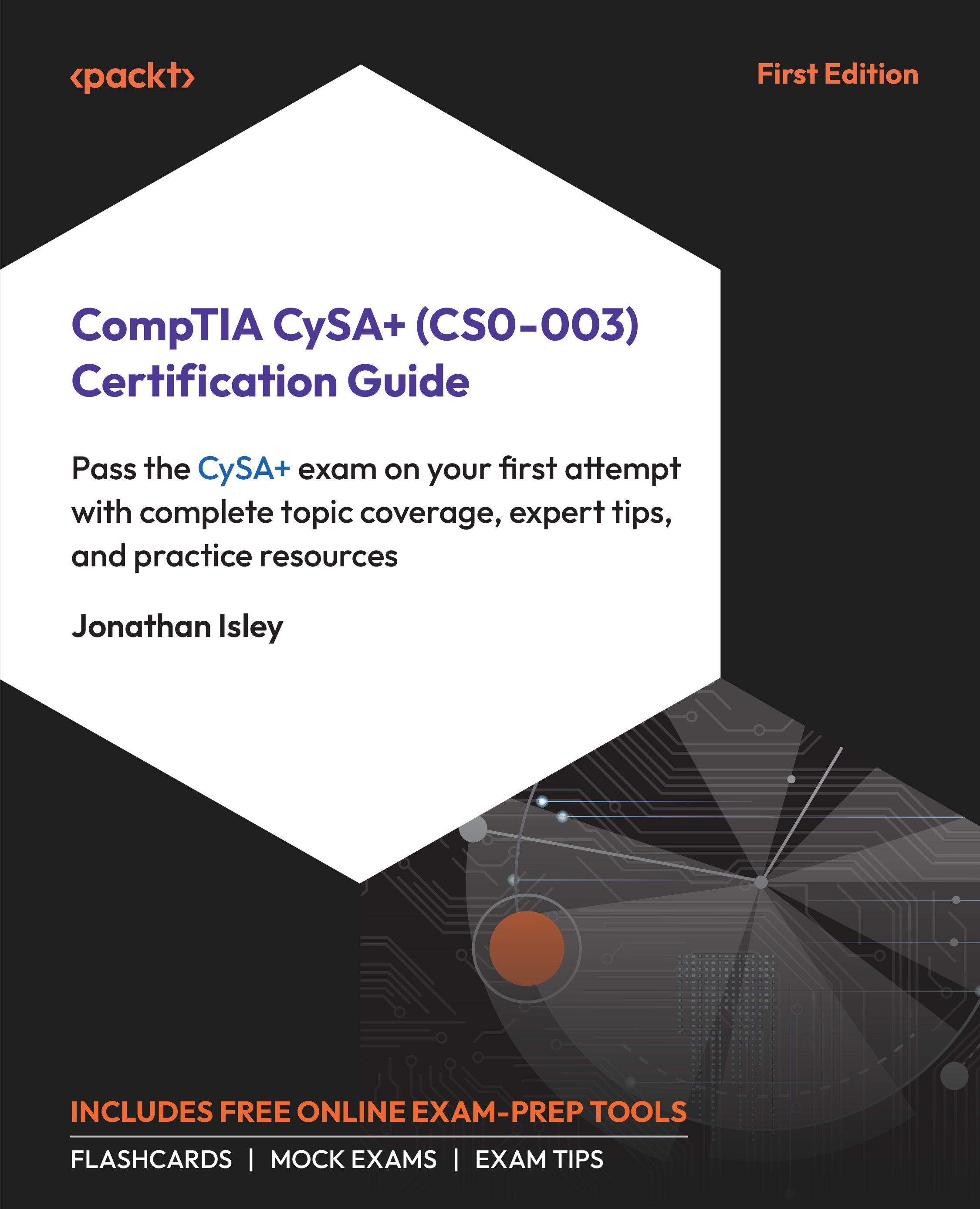
CompTIA CySA+ (CS0-003) Certification Guide

CompTIA CySA+ (CS0-003) Certification Guide

By : Jonathan Isley
close
close
CompTIA CySA+ (CS0-003) Certification Guide

CompTIA CySA+ (CS0-003) Certification Guide

By: Jonathan Isley

Overview of this book

The CompTIA CySA+ (CS0-003) Certification Guide is your complete resource for passing the latest CySA+ exam and developing real-world cybersecurity skills. Covering all four exam domains—security operations, vulnerability management, incident response, and reporting and communication—this guide provides clear explanations, hands-on examples, and practical guidance drawn from real-world scenarios. You’ll learn how to identify and analyze signs of malicious activity, apply threat hunting and intelligence concepts, and leverage tools to manage, assess, and respond to vulnerabilities and attacks. The book walks you through the incident response lifecycle and shows you how to report and communicate findings during both proactive and reactive cybersecurity efforts. To solidify your understanding, each chapter includes review questions and interactive exercises. You’ll also get access to over 250 flashcards and two full-length practice exams that mirror the real test—helping you gauge your readiness and boost your confidence. Whether you're starting your career in cybersecurity or advancing from an entry-level role, this guide equips you with the knowledge and skills you need to pass the CS0-003 exam and thrive as a cybersecurity analyst.
Table of Contents (19 chapters)
close
close

IAM, Logging, and Security Architecture

Identity and access management (IAM), logging, and security are the three major concepts that serve as the main building blocks of an organization’s security. In today’s ever-evolving security landscape, these concepts (if properly implemented) can secure the base of an organization’s environment. If absent or improperly implemented, it can expose an organization to many IAM issues, such as unauthorized access due to inadequate role-based permissions, potentially allowing access to sensitive data, and ineffective or missing multi-factor authentication (MFA) implementation, which may increase the risk of account compromise and unauthorized access. It can also cause logging issues such as insufficient logging details, causing incomplete records of security events and making it difficult to investigate and respond to incidents effectively, and lack of centralized log management, which can complicate incident investigation and response, making it slower and less effective. There is also the risk of security architecture issues such as inadequate network segmentation arising, which can expose lateral movement threats within the network and increased risk of a wider impact and poorly configured firewalls and access controls, potentially leaving open vulnerabilities that attackers could exploit to gain unauthorized access to the system.

Design and planning are the key first steps to creating a secure environment. First, a cybersecurity analyst must choose between infrastructure models, such as virtualization, containerization, on-premises, cloud, or hybrid. During this process, you must be aware of and understand common operating system (OS) concepts, including system hardening, filesystems, system processes, logging, and underlying hardware architecture. You must then include network design concepts to integrate these systems while continuing to keep security in mind. After the systems and networks are designed, you must be able to use and manage them securely. This is where access concepts and technologies will be integrated into the design to further facilitate an overall secure organization.

This chapter will discuss the CIA triad, teaching about infrastructure concepts, such as virtualization and containerization, alongside operating system concepts and network architecture. You will learn about the logging setup and its importance as related to system security and health. IAM criticality and concepts will be examined. The chapter will end by discussing encryption and sensitive data protection.

This chapter covers Domain 1.0: Security Operations, objective 1.1 Explain the importance of system and network architecture concepts in security operations in the CompTIA CySA+ CS0-003 exam.

The exam topics covered are as follows:

  • Infrastructure concepts
  • Operating system concepts
  • Log ingestion
  • Network architecture concepts
  • IAM
  • Encryption and data protection
Visually different images
CONTINUE READING
83
Tech Concepts
36
Programming languages
73
Tech Tools
Icon Unlimited access to the largest independent learning library in tech of over 8,000 expert-authored tech books and videos.
Icon Innovative learning tools, including AI book assistants, code context explainers, and text-to-speech.
Icon 50+ new titles added per month and exclusive early access to books as they are being written.
CompTIA CySA+ (CS0-003) Certification Guide
notes
bookmark Notes and Bookmarks search Search in title playlist Add to playlist download Download options font-size Font size

Change the font size

margin-width Margin width

Change margin width

day-mode Day/Sepia/Night Modes

Change background colour

Close icon Search
Country selected

Close icon Your notes and bookmarks

Confirmation

Modal Close icon
claim successful

Buy this book with your credits?

Modal Close icon
Are you sure you want to buy this book with one of your credits?
Close
YES, BUY

Submit Your Feedback

Modal Close icon
Modal Close icon
Modal Close icon