Sign In Start Free Trial
Account

Add to playlist

Create a Playlist

Modal Close icon
You need to login to use this feature.
  • Book Overview & Buying Magento PHP Developer????s Guide, 2nd Edition
  • Table Of Contents Toc
  • Feedback & Rating feedback
Magento PHP Developer????s Guide, 2nd Edition

Magento PHP Developer????s Guide, 2nd Edition

By : MacGregor
2 (4)
close
close
Magento PHP Developer????s Guide, 2nd Edition

Magento PHP Developer????s Guide, 2nd Edition

2 (4)
By: MacGregor

Overview of this book

This book is written for PHP developers who are familiar with frameworks such as Zend or CakePHP and want to start developing and working with Magento. No prior knowledge of Magento is required.
Table of Contents (11 chapters)
close
close
10
Index

Factory names and functions

Magento makes use of factory methods to instantiate models, helpers, and block classes. A factory method is a design pattern that allows us to instantiate an object without using the exact class name and using a class alias instead.

Magento implements the following factory methods:

  • Mage::getModel()
  • Mage::getResourceModel()
  • Mage::helper()
  • Mage::getSingleton()
  • Mage::getResourceSingleton()
  • Mage::getResourceHelper()

Each of these methods takes a class alias that is used to determine the real class name of the object that we are trying to instantiate. For example, if we want to instantiate a product object, we can do so by calling the getModel() method:

$product = Mage::getModel('catalog/product'); 

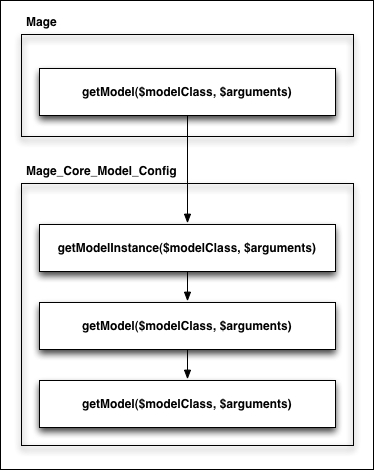
Notice that we are passing a factory name composed of group_classname/model_name. Magento will resolve this to the actual class name of Mage_Catalog_Model_Product. Let's take a closer look at the inner workings of getModel():

public static function getModel($modelClass = '', $arguments = array())
    {
        return self::getConfig()->getModelInstance($modelClass, $arguments);
    }

getModel calls the getModelInstance from the Mage_Core_Model_Config class.

public function getModelInstance($modelClass='', $constructArguments=array())
{
    $className = $this->getModelClassName($modelClass);
    if (class_exists($className)) {
        Varien_Profiler::start('CORE::create_object_of::'.$className);
        $obj = new $className($constructArguments);
        Varien_Profiler::stop('CORE::create_object_of::'.$className);
        return $obj;
    } else {
        return false;
    }
}

In return, getModelInstance() calls the getModelClassName() method that takes a class alias as a parameter. Then, it tries to validate the existence of the returned class, and if the class exists, it creates a new instance of that class and returns it to our getModel() method:

public function getModelClassName($modelClass)
{
    $modelClass = trim($modelClass);
    if (strpos($modelClass, '/')===false) {
        return $modelClass;
    }
    return $this->getGroupedClassName('model', $modelClass);
}

The getModelClassName() method calls the getGroupedClassName() method, which is actually in charge of returning the real class name of our model.

The getGroupedClassName() method takes two parameters, namely $groupType and $classId. The $groupType parameter refers to the type of object that we are trying to instantiate. Currently, only models, blocks, and helpers are supported. The $classId that we are trying to instantiate is as follows:

public function getGroupedClassName($groupType, $classId, $groupRootNode=null)
{
    if (empty($groupRootNode)) {
        $groupRootNode = 'global/'.$groupType.'s';
    }
    $classArr = explode('/', trim($classId));
    $group = $classArr[0];
    $class = !empty($classArr[1]) ? $classArr[1] : null;

    if (isset($this->_classNameCache[$groupRootNode][$group][$class])) {
        return $this->_classNameCache[$groupRootNode][$group][$class];
    }
    $config = $this->_xml->global->{$groupType.'s'}->{$group};
    $className = null;
    if (isset($config->rewrite->$class)) {
        $className = (string)$config->rewrite->$class;
    } else {
        if ($config->deprecatedNode) {
            $deprecatedNode = $config->deprecatedNode;
            $configOld = $this->_xml->global->{$groupType.'s'}->$deprecatedNode;
            if (isset($configOld->rewrite->$class)) {
                $className = (string) $configOld->rewrite->$class;
            }
        }
    }
    if (empty($className)) {
        if (!empty($config)) {
            $className = $config->getClassName();
        }
        if (empty($className)) {
            $className = 'mage_'.$group.'_'.$groupType;
        }
        if (!empty($class)) {
            $className .= '_'.$class;
        }
        $className = uc_words($className);
    }
    $this->_classNameCache[$groupRootNode][$group][$class] = $className;
    return $className;
}

As we can see, getGroupedClassName() is actually doing all the work. It grabs our class alias catalog/product and creates an array by exploding the string on the slash character.

Then, it loads an instance of Varien_Simplexml_Element and passes the first value in our array (group_classname). It also checks if the class has been rewritten, and if it has, we will use the corresponding group name.

Magento also uses a custom version of the uc_words() function that will capitalize the first letters and convert separators of the class alias if needed.

Finally, the function will return the real class name to the getModelInstance() function. In our example case, this will return Mage_Catalog_Model_Product:

Factory names and functions
Visually different images
CONTINUE READING
83
Tech Concepts
36
Programming languages
73
Tech Tools
Icon Unlimited access to the largest independent learning library in tech of over 8,000 expert-authored tech books and videos.
Icon Innovative learning tools, including AI book assistants, code context explainers, and text-to-speech.
Icon 50+ new titles added per month and exclusive early access to books as they are being written.
Magento PHP Developer????s Guide, 2nd Edition
notes
bookmark Notes and Bookmarks search Search in title playlist Add to playlist font-size Font size

Change the font size

margin-width Margin width

Change margin width

day-mode Day/Sepia/Night Modes

Change background colour

Close icon Search
Country selected

Close icon Your notes and bookmarks

Confirmation

Modal Close icon
claim successful

Buy this book with your credits?

Modal Close icon
Are you sure you want to buy this book with one of your credits?
Close
YES, BUY

Submit Your Feedback

Modal Close icon
Modal Close icon
Modal Close icon