Sign In Start Free Trial
Account

Add to playlist

Create a Playlist

Modal Close icon
You need to login to use this feature.
  • Book Overview & Buying Learning PHP 7
  • Table Of Contents Toc
  • Feedback & Rating feedback
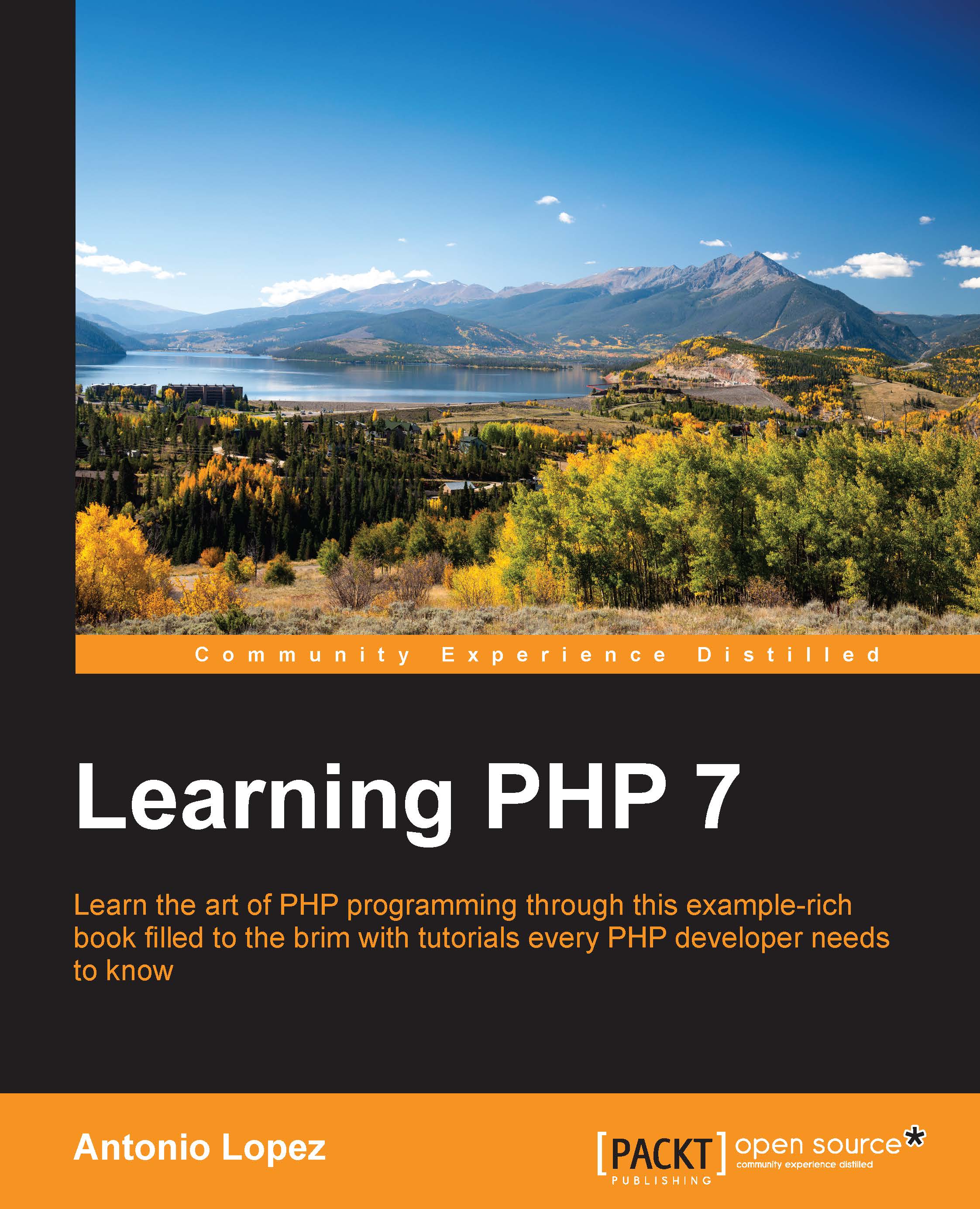
Learning PHP 7

Learning PHP 7

By : L Zapata (GBP)
3.4 (10)
close
close
Learning PHP 7

Learning PHP 7

3.4 (10)
By: L Zapata (GBP)

Overview of this book

PHP is a great language for building web applications. It is essentially a server-side scripting language that is also used for general purpose programming. PHP 7 is the latest version with a host of new features, and it provides major backwards-compatibility breaks. This book begins with the fundamentals of PHP programming by covering the basic concepts such as variables, functions, class, and objects. You will set up PHP server on your machine and learn to read and write procedural PHP code. After getting an understanding of OOP as a paradigm, you will execute MySQL queries on your database. Moving on, you will find out how to use MVC to create applications from scratch and add tests. Then, you will build REST APIs and perform behavioral tests on your applications. By the end of the book, you will have the skills required to read and write files, debug, test, and work with MySQL.
Table of Contents (12 chapters)
close
close
11
Index

Testing your REST APIs


You have already been testing your REST API after finishing each controller by making some request and expecting a response. As you might imagine, this can be handy sometimes, but it is for sure not the way to go. Testing should be automatic, and should cover as much as possible. We will have to think of a solution similar to unit testing.

In Chapter 10, Behavioral Testing, you will learn more methodologies and tools for testing an application end to end, and that will include REST APIs. However, due to the simplicity of our REST API, we can add some pretty good tests with what Laravel provides us as well. Actually, the idea is very similar to the tests that we wrote in Chapter 8, Using Existing PHP Frameworks, where we made a request to some endpoint, and expected a response. The only difference will be in the kind of assertions that we use (which can check if a JSON response is OK), and the way we perform requests.

Let's add some tests to the set of endpoints related...

Visually different images
CONTINUE READING
83
Tech Concepts
36
Programming languages
73
Tech Tools
Icon Unlimited access to the largest independent learning library in tech of over 8,000 expert-authored tech books and videos.
Icon Innovative learning tools, including AI book assistants, code context explainers, and text-to-speech.
Icon 50+ new titles added per month and exclusive early access to books as they are being written.
Learning PHP 7
notes
bookmark Notes and Bookmarks search Search in title playlist Add to playlist download Download options font-size Font size

Change the font size

margin-width Margin width

Change margin width

day-mode Day/Sepia/Night Modes

Change background colour

Close icon Search
Country selected

Close icon Your notes and bookmarks

Confirmation

Modal Close icon
claim successful

Buy this book with your credits?

Modal Close icon
Are you sure you want to buy this book with one of your credits?
Close
YES, BUY

Submit Your Feedback

Modal Close icon
Modal Close icon
Modal Close icon