Sign In Start Free Trial
Account

Add to playlist

Create a Playlist

Modal Close icon
You need to login to use this feature.
  • Book Overview & Buying Object-Oriented JavaScript
  • Table Of Contents Toc
  • Feedback & Rating feedback
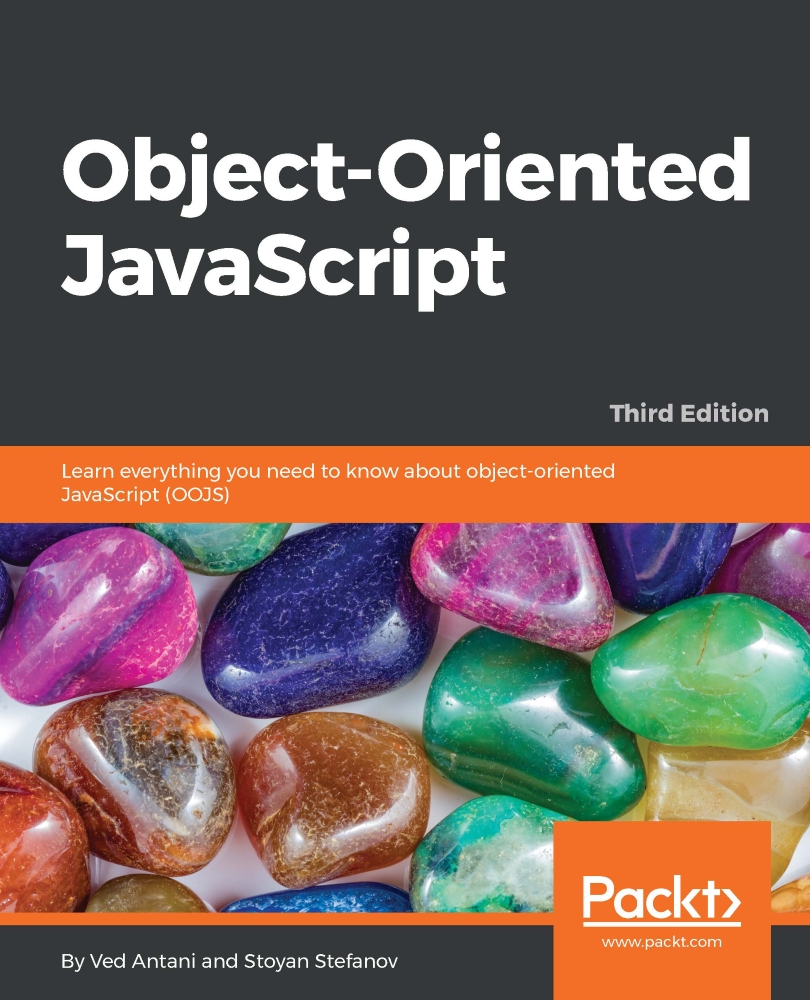
Object-Oriented JavaScript

Object-Oriented JavaScript - Third Edition

By : Ved Antani, Stoyan STEFANOV
4.5 (6)
close
close
Object-Oriented JavaScript

Object-Oriented JavaScript

4.5 (6)
By: Ved Antani, Stoyan STEFANOV

Overview of this book

JavaScript is an object-oriented programming language that is used for website development. Web pages developed today currently follow a paradigm that has three clearly distinguishable parts: content (HTML), presentation (CSS), and behavior (JavaScript). JavaScript is one important pillar in this paradigm, and is responsible for the running of the web pages. This book will take your JavaScript skills to a new level of sophistication and get you prepared for your journey through professional web development. Updated for ES6, this book covers everything you will need to unleash the power of object-oriented programming in JavaScript while building professional web applications. The book begins with the basics of object-oriented programming in JavaScript and then gradually progresses to cover functions, objects, and prototypes, and how these concepts can be used to make your programs cleaner, more maintainable, faster, and compatible with other programs/libraries. By the end of the book, you will have learned how to incorporate object-oriented programming in your web development workflow to build professional JavaScript applications.
Table of Contents (19 chapters)
close
close
15
B. Built-in Functions
17
D. Regular Expressions

For...of loop

For...of loops are introduced in ES6 along with the iterable and iterator constructs. This new loop constructs replaces both the for...in and for...each loop constructs of ES5. As the for...of loop supports the iteration protocol, it can be used on built-in objects such as arrays, strings, maps, sets, and so on, and custom objects that are iterables. Consider the following piece of code as an example:

    const iter = ['a', 'b']; 
    for (const i of iter) { 
      console.log(i); 
    } 
    "a" 
    "b" 

The for...of loop works with iterables and built-ins like arrays are iterables. If you notice, we are using const instead of var when we define the loop variable. This is a good practice because when you use const, a fresh variable is created with a new binding and storage space. You should use const over a var declaration with the for...of loop when you don't intend to modify the value of the loop variable inside the block...

Visually different images
CONTINUE READING
83
Tech Concepts
36
Programming languages
73
Tech Tools
Icon Unlimited access to the largest independent learning library in tech of over 8,000 expert-authored tech books and videos.
Icon Innovative learning tools, including AI book assistants, code context explainers, and text-to-speech.
Icon 50+ new titles added per month and exclusive early access to books as they are being written.
Object-Oriented JavaScript
notes
bookmark Notes and Bookmarks search Search in title playlist Add to playlist font-size Font size

Change the font size

margin-width Margin width

Change margin width

day-mode Day/Sepia/Night Modes

Change background colour

Close icon Search
Country selected

Close icon Your notes and bookmarks

Confirmation

Modal Close icon
claim successful

Buy this book with your credits?

Modal Close icon
Are you sure you want to buy this book with one of your credits?
Close
YES, BUY

Submit Your Feedback

Modal Close icon
Modal Close icon
Modal Close icon