Sign In Start Free Trial
Account

Add to playlist

Create a Playlist

Modal Close icon
You need to login to use this feature.
  • Book Overview & Buying Node.js Web Development
  • Table Of Contents Toc
Node.js Web Development

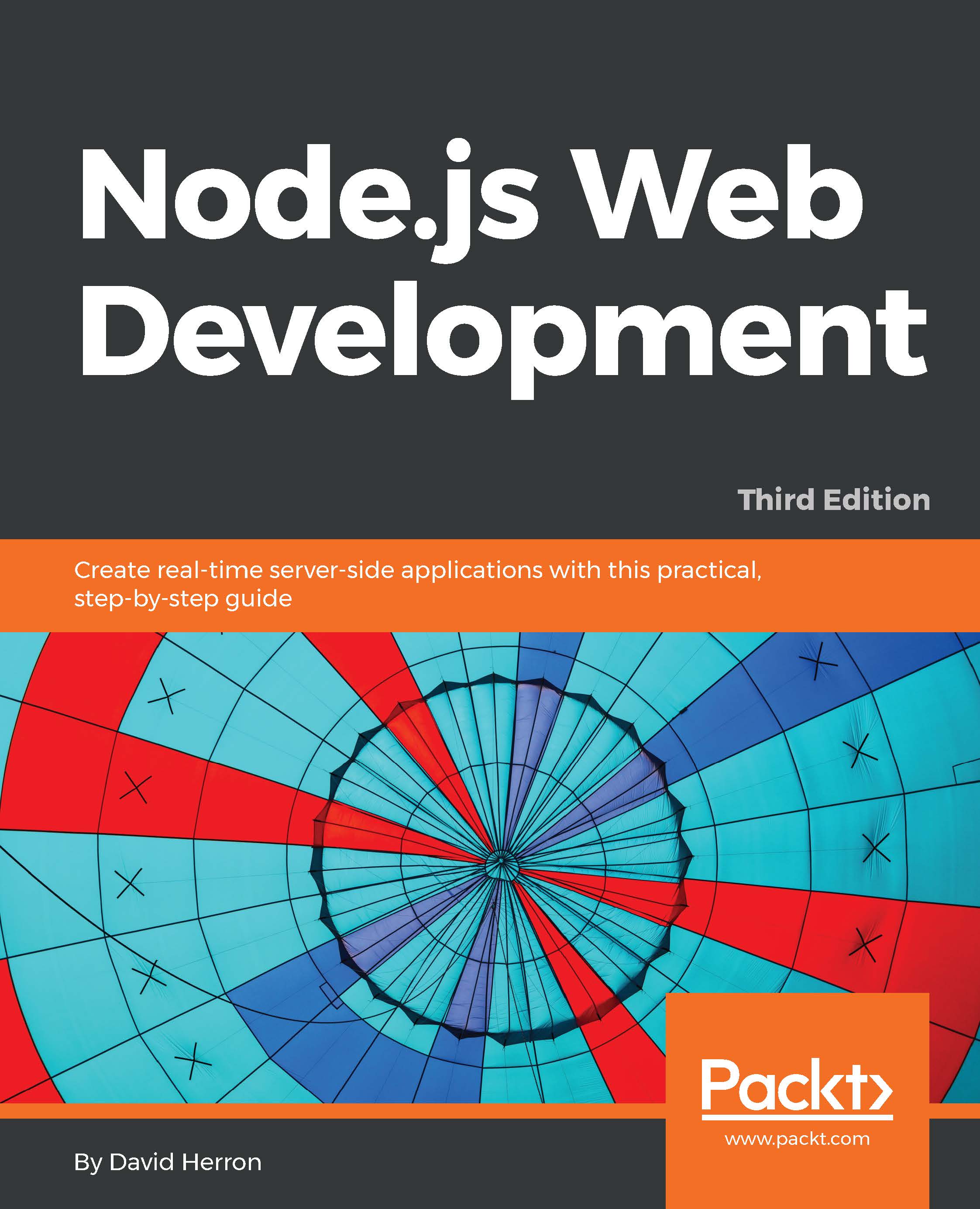
Node.js Web Development - Third Edition

By : David Herron
4.1 (18)
close
close
Node.js Web Development

Node.js Web Development

4.1 (18)
By: David Herron

Overview of this book

Node.js is a server-side JavaScript platform using an event driven, non-blocking I/O model allowing users to build fast and scalable data-intensive applications running in real time. Node.js Web Development shows JavaScript is not just for browser-side applications. It can be used for server-side web application development, real-time applications, microservices, and much more. This book gives you an excellent starting point, bringing you straight to the heart of developing web applications with Node.js. You will progress from a rudimentary knowledge of JavaScript and server-side development to being able to create and maintain your own Node.js application. With this book you'll learn how to use the HTTP Server and Client objects, data storage with both SQL and MongoDB databases, real-time applications with Socket.IO, mobile-first theming with Bootstrap, microservice deployment with Docker, authenticating against third-party services using OAuth, and much more.
Table of Contents (13 chapters)
close
close
12
Index

Chapter 1. About Node.js

Node.js is an exciting new platform for developing web applications, application servers, any sort of network server or client, and general purpose programming. It is designed for extreme scalability in networked applications through an ingenious combination of server-side JavaScript, asynchronous I/O, asynchronous programming, built around JavaScript anonymous functions, and a single execution thread event-driven architecture.

While only a few years old, Node.js has quickly grown in prominence to where it's playing a significant role. Companies, small and large, are using it for large-scale and small-scale projects. PayPal, for example, has converted many services from Java to Node.js.

The Node.js model is very different from common application server platforms using threads. The claim is that with the single-thread event-driven architecture, memory footprint is low, throughput is high, the latency profile under load is better, and the programming model is simpler. The Node.js platform is in a phase of rapid growth, and many are seeing it as a compelling alternative to the traditional Java, PHP, Python, Ruby on Rails, and so on, approach to building web applications.

At its heart, it is a standalone JavaScript engine with extensions making it suitable for general purpose programming and with a clear focus on application server development. Even though we're comparing Node.js to application server platforms, it is not an application server. Instead, Node.js is a programming runtime akin to Python, Go, or Java SE. There are web application frameworks and application servers written in Node.js, however. In the few years that Node.js has been available, it's quickly gained a significant role, fulfilling the prediction that it could potentially supplant other web application stacks.

It is implemented around a non-blocking I/O event loop and a layer of file and network I/O libraries, all built on top of the V8 JavaScript engine (from the Chrome web browser). At the time of writing this, Microsoft had just proposed a patch to allow Node.js to utilize the ChakraCore JavaScript engine (from the Edge web browser). The theoretical possibility of hosting the Node.js API on top of a different JavaScript engine may come true, in the due course of time. Visit https://github.com/nodejs/node-chakracore to take a look at the project.

The I/O library is general enough to implement any sort of server implementing any TCP or UDP protocol, whether it's DNS, HTTP, IRC, or FTP. While it supports developing servers or clients for any network protocol, its biggest use case is in regular websites in place of technology such as an Apache/PHP or Rails stack or to complement existing websites. For example, adding real-time chat or monitoring existing websites can be easily done with the Socket.IO library for Node.js.

A particularly intriguing combination is deploying small services using Docker into cloud hosting infrastructure. A large application can be divided into what's now called microservices and easily deployed at scale using Docker. The result fits agile project management methods since each microservice can be easily managed by a small team which collaborates at the boundary of their individual API.

This book will give you an introduction to Node.js. We presume the following:

  • You already know how to write software
  • You are familiar with JavaScript
  • You know something about developing web applications in other languages

We will cover the following topics in this chapter:

  • An introduction to Node.js
  • Why you should use Node.js
  • The architecture of Node.js
  • Performance, utilization, and scalability with Node.js
  • Node.js, microservice architecture, and testing
  • Implementing the Twelve-Factor App model with Node.js

We will dive right into developing working applications and recognize that often the best way to learn is by rummaging around in working code.

Visually different images
CONTINUE READING
83
Tech Concepts
36
Programming languages
73
Tech Tools
Icon Unlimited access to the largest independent learning library in tech of over 8,000 expert-authored tech books and videos.
Icon Innovative learning tools, including AI book assistants, code context explainers, and text-to-speech.
Icon 50+ new titles added per month and exclusive early access to books as they are being written.
Node.js Web Development
notes
bookmark Notes and Bookmarks search Search in title playlist Add to playlist download Download options font-size Font size

Change the font size

margin-width Margin width

Change margin width

day-mode Day/Sepia/Night Modes

Change background colour

Close icon Search
Country selected

Close icon Your notes and bookmarks

Confirmation

Modal Close icon
claim successful

Buy this book with your credits?

Modal Close icon
Are you sure you want to buy this book with one of your credits?
Close
YES, BUY

Submit Your Feedback

Modal Close icon
Modal Close icon
Modal Close icon