
Sign In Start Free Trial
Account

Add to playlist

Create a Playlist

Modal Close icon
You need to login to use this feature.
  • Book Overview & Buying Building Microservices with .NET Core
  • Table Of Contents Toc
  • Feedback & Rating feedback
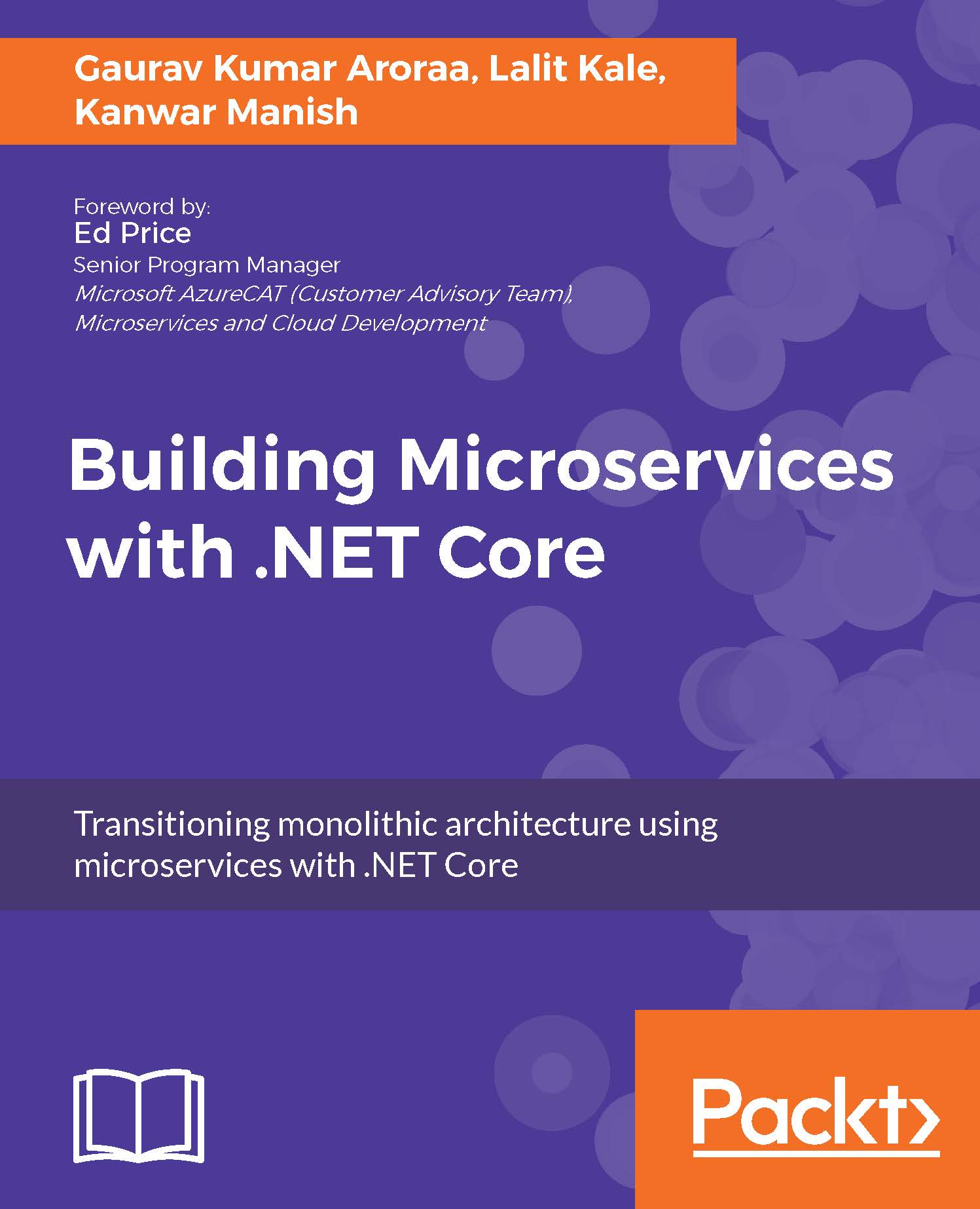
Building Microservices with .NET Core

Building Microservices with .NET Core

By : Soumya Mukherjee, Gaurav Aroraa, Lalit Kale, Manish Kanwar
3.3 (4)
close
close
Building Microservices with .NET Core

Building Microservices with .NET Core

3.3 (4)
By: Soumya Mukherjee, Gaurav Aroraa, Lalit Kale, Manish Kanwar

Overview of this book

Microservices is an architectural style that promotes the development of complex applications as a suite of small services based on business capabilities. This book will help you identify the appropriate service boundaries within the business. We'll start by looking at what microservices are, and what the main characteristics are. Moving forward, you will be introduced to real-life application scenarios, and after assessing the current issues, we will begin the journey of transforming this application by splitting it into a suite of microservices. You will identify the service boundaries, split the application into multiple microservices, and define the service contracts. You will find out how to configure, deploy, and monitor microservices, and configure scaling to allow the application to quickly adapt to increased demand in the future. With an introduction to the reactive microservices, you strategically gain further value to keep your code base simple, focusing on what is more important rather than the messy asynchronous calls.
Table of Contents (11 chapters)
close
close

What Are Microservices?

The focus of this chapter is to get you acquainted with microservices. We will start with a brief introduction. Then, we will define its predecessors: monolithic architecture and service-oriented architecture (SOA). After this, we will see how microservices fare against both SOA and the monolithic architecture. We will then compare the advantages and disadvantages of each one of these architectural styles. This will enable us to identify the right scenario for these styles. We will understand the problems that arise from having a layered monolithic architecture. We will discuss the solutions available to these problems in the monolithic world. At the end, we will be able to break down a monolithic application into a microservice architecture. We will cover the following topics in this chapter:

  • Origin of microservices
  • Discussing microservices
  • Understanding the microservice architecture
  • Advantages of microservices
  • SOA versus microservices
  • Understanding problems with the monolithic architectural style
  • Challenges in standardizing the .NET stack
Visually different images
CONTINUE READING
83
Tech Concepts
36
Programming languages
73
Tech Tools
Icon Unlimited access to the largest independent learning library in tech of over 8,000 expert-authored tech books and videos.
Icon Innovative learning tools, including AI book assistants, code context explainers, and text-to-speech.
Icon 50+ new titles added per month and exclusive early access to books as they are being written.
Building Microservices with .NET Core
notes
bookmark Notes and Bookmarks search Search in title playlist Add to playlist download Download options font-size Font size

Change the font size

margin-width Margin width

Change margin width

day-mode Day/Sepia/Night Modes

Change background colour

Close icon Search
Country selected

Close icon Your notes and bookmarks

Confirmation

Modal Close icon
claim successful

Buy this book with your credits?

Modal Close icon
Are you sure you want to buy this book with one of your credits?
Close
YES, BUY

Submit Your Feedback

Modal Close icon
Modal Close icon
Modal Close icon