
Sign In Start Free Trial
Account

Add to playlist

Create a Playlist

Modal Close icon
You need to login to use this feature.
  • Book Overview & Buying Mastering Reactive JavaScript
  • Table Of Contents Toc
  • Feedback & Rating feedback
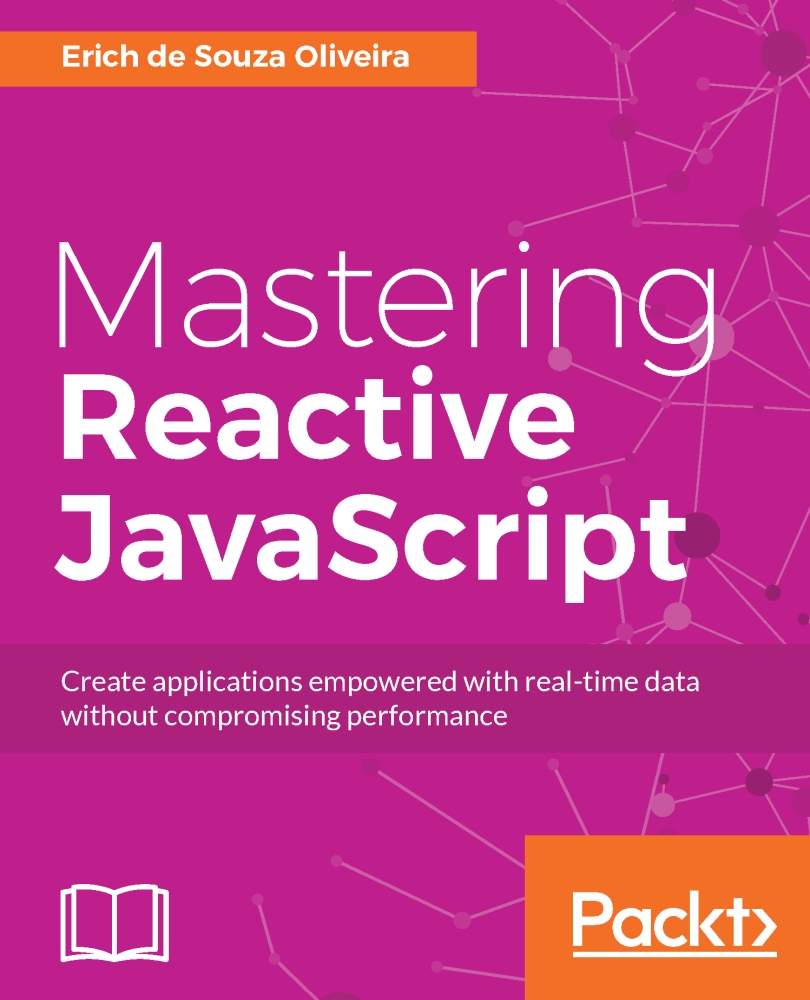
Mastering Reactive JavaScript

Mastering Reactive JavaScript

By : Erich de Souza Oliveira
3.5 (4)
close
close
Mastering Reactive JavaScript

Mastering Reactive JavaScript

3.5 (4)
By: Erich de Souza Oliveira

Overview of this book

If you’re struggling to handle a large amount of data and don’t know how to improve your code readability, then reactive programming is the right solution for you. It lets you describe how your code behaves when changes happen and makes it easier to deal with real-time data. This book will teach you what reactive programming is, and how you can use it to write better applications. The book starts with the basics of reactive programming, what Reactive Extensions is, and how can you use it in JavaScript along with some reactive code using Bacon. Next, you’ll discover what an Observable and an Observer are and when to use them.You'll also find out how you can query data through operators, and how to use schedulers to react to changes. Moving on, you’ll explore the RxJs API, be introduced to the problem of data traffic (backpressure), and see how you can mitigate it. You’ll also learn about other important operators that can help improve your code readability, and you’ll see how to use transducers to compose operators. At the end of the book, you’ll get hands-on experience of using RxJs, and will create a real-time web chat using RxJs on the client and server, providing you with the complete package to master RxJs.
Table of Contents (12 chapters)
close
close

Testing transducers

When using transducers you can decouple the logic to transform your data from the source of your data; this way you can create tests for each one of your transducers without having to add an observable.

To test transducers we will use the exact same tools we used to test observables so far; the difference is that we can test the logic of the transducers using any iterable source of data such as an array or an observable.

Since observables are asynchronous data structure by nature, every time we want to test an observable, or to test the transformations applied to an observable, we need to create asynchronous tests. As transducers work independently of the current source of data we can use arrays to its behavior; using arrays we can create synchronous tests, which usually make them faster and easier to write and read.

Let's see how we can use an observable to test a transducer. To do so,...

Visually different images
CONTINUE READING
83
Tech Concepts
36
Programming languages
73
Tech Tools
Icon Unlimited access to the largest independent learning library in tech of over 8,000 expert-authored tech books and videos.
Icon Innovative learning tools, including AI book assistants, code context explainers, and text-to-speech.
Icon 50+ new titles added per month and exclusive early access to books as they are being written.
Mastering Reactive JavaScript
notes
bookmark Notes and Bookmarks search Search in title playlist Add to playlist download Download options font-size Font size

Change the font size

margin-width Margin width

Change margin width

day-mode Day/Sepia/Night Modes

Change background colour

Close icon Search
Country selected

Close icon Your notes and bookmarks

Confirmation

Modal Close icon
claim successful

Buy this book with your credits?

Modal Close icon
Are you sure you want to buy this book with one of your credits?
Close
YES, BUY

Submit Your Feedback

Modal Close icon
Modal Close icon
Modal Close icon