Sign In Start Free Trial
Account

Add to playlist

Create a Playlist

Modal Close icon
You need to login to use this feature.
  • Book Overview & Buying Enterprise Application Architecture with .NET Core
  • Table Of Contents Toc
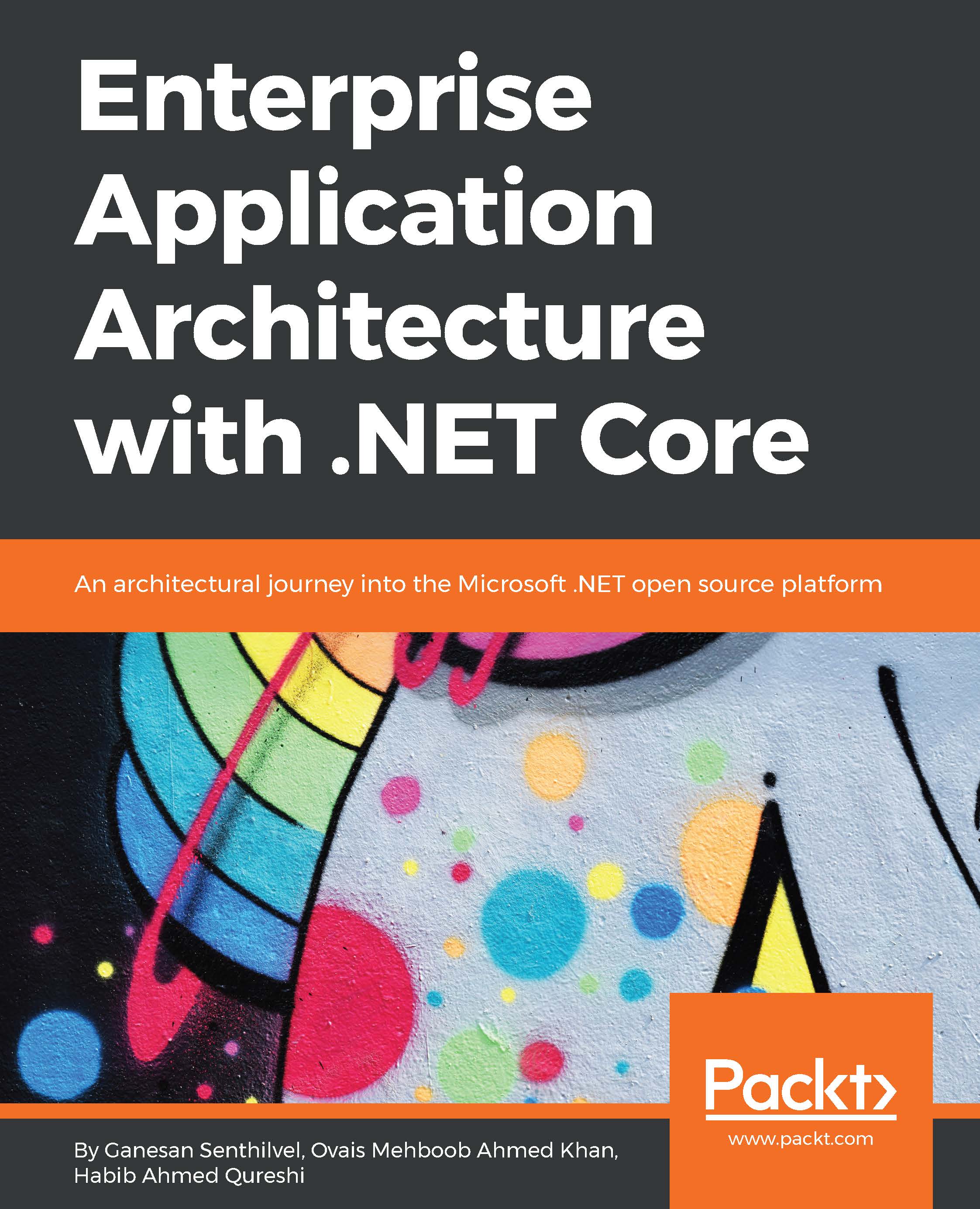
Enterprise Application Architecture with .NET Core

Enterprise Application Architecture with .NET Core

By : Senthilvel, Ullal, Qureshi, Mehboob Ahmed Khan
4 (5)
close
close
Enterprise Application Architecture with .NET Core

Enterprise Application Architecture with .NET Core

4 (5)
By: Senthilvel, Ullal, Qureshi, Mehboob Ahmed Khan

Overview of this book

If you want to design and develop enterprise applications using .NET Core as the development framework and learn about industry-wide best practices and guidelines, then this book is for you. The book starts with a brief introduction to enterprise architecture, which will help you to understand what enterprise architecture is and what the key components are. It will then teach you about the types of patterns and the principles of software development, and explain the various aspects of distributed computing to keep your applications effective and scalable. These chapters act as a catalyst to start the practical implementation, and design and develop applications using different architectural approaches, such as layered architecture, service oriented architecture, microservices and cloud-specific solutions. Gradually, you will learn about the different approaches and models of the Security framework and explore various authentication models and authorization techniques, such as social media-based authentication and safe storage using app secrets. By the end of the book, you will get to know the concepts and usage of the emerging fields, such as DevOps, BigData, architectural practices, and Artificial Intelligence.
Table of Contents (12 chapters)
close
close

Introduction to TOGAF

TOGAF is one of the well-known leading Enterprise Architecture Frameworks used in the industry. As per the common goal, TOGAF is leveraged to make the enterprise for implementing and improving business efficiency. As the name stands, TOGAF insists the industry's architecture standard using the consistent methods, processes, and communication with the group of Enterprise Architecture professionals. In turn, the openness culture supports architecture practitioners to avoid the industry pain of proprietary lock mode.

Evolution of TOGAF 9.1

TOGAF's first version was developed during mid-1990s and continuously maintained by it based on experience and exposure from the United States Department of Defense, namely Technical Architecture Framework for Information Management (TAFIM). Later, the forum started releasing successive versions based on the fundamental blocks. Consider the following image:

The preceding image is a view of the timeline for the growth of TOGAF until the latest version, 9.1. This illustrates the long maturation cycle.

TOGAF 9 Technical Corrigendum 1 can be obtained from www.opengroup.org/bookstore/catalog/u112.htm.

As TOGAF has become more mature, the time period between publications has also increased.

Core components

TOGAF's core components construct the strong fundamentals of this open architecture framework. It is depicted in the following diagram:

The preceding diagram shows the structure in a graphical overview format calling out the main components, which are briefed as follows:

Architecture Development Method (ADM) is a kind of circular flow chart aimed to building an enterprise-level architecture. It has a set of resources and the related governance to support the enterprise applications development.

The Architecture Content Framework uses the following three categories to describe the type of architectural work product within the context of use:

  • Deliverables
  • Artifacts
  • Building blocks

Deliverables are the output of the project to be agreed and signed off by the enterprise stakeholders. Artifacts are represented as the content of the architectural repository of the firm. Building blocks are commonly represented as the reusable components of the enterprise platform.

As we know, architecture repository contains the enterprise designs, policies, framework, and so on. Enterprise Continuum is the method or mode to classify the repository content.

TOGAF 9 provides an Architecture Capability Framework that is a set of reference materials and guidelines to establish an architecture function or capability within an organization.

Core components of ADM and related topics are covered in details at Open Group site. It is a great industrywide reference artifact, available at http://pubs.opengroup.org/architecture/togaf9-doc/arch/chap05.html

Industry usage

TOGAF is highly adopted/used in the industry. The following statistical points make them pretty clear:

  • More than 150k downloads
  • Individual certifications near 60k, with foundation of 18k and certified of 42k
  • Around 400 corporate members of TOGAF
  • Over 60k TOGAF series books shipped
  • Association of enterprise architects membership at more than 75k

The continental wide usage of TOGAF is depicted in the right-hand diagram, whereas the top-10 countries is on the left-hand side:

CONTINUE READING
83
Tech Concepts
36
Programming languages
73
Tech Tools
Icon Unlimited access to the largest independent learning library in tech of over 8,000 expert-authored tech books and videos.
Icon Innovative learning tools, including AI book assistants, code context explainers, and text-to-speech.
Icon 50+ new titles added per month and exclusive early access to books as they are being written.
Enterprise Application Architecture with .NET Core
notes
bookmark Notes and Bookmarks search Search in title playlist Add to playlist download Download options font-size Font size

Change the font size

margin-width Margin width

Change margin width

day-mode Day/Sepia/Night Modes

Change background colour

Close icon Search
Country selected

Close icon Your notes and bookmarks

Confirmation

Modal Close icon
claim successful

Buy this book with your credits?

Modal Close icon
Are you sure you want to buy this book with one of your credits?
Close
YES, BUY

Submit Your Feedback

Modal Close icon
Modal Close icon
Modal Close icon