
Sign In Start Free Trial
Account

Add to playlist

Create a Playlist

Modal Close icon
You need to login to use this feature.
  • Book Overview & Buying Progressive Web Application Development by Example
  • Table Of Contents Toc
  • Feedback & Rating feedback
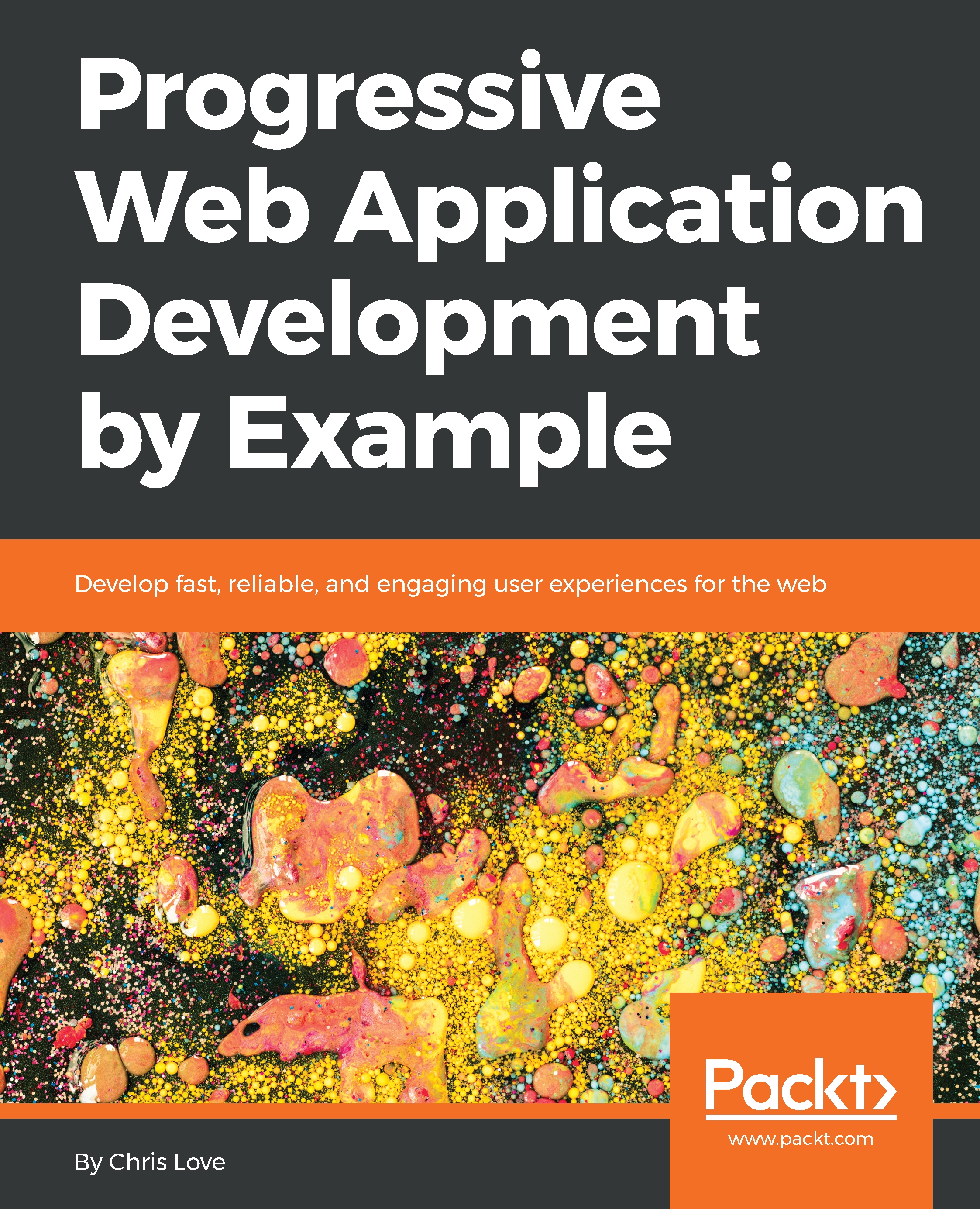
Progressive Web Application Development by Example

Progressive Web Application Development by Example

By : Love
close
close
Progressive Web Application Development by Example

Progressive Web Application Development by Example

By: Love

Overview of this book

Are you a developer that wants to create truly cross-platform user experiences with a minimal footprint, free of store restrictions and features customers want? Then you need to get to grips with Progressive Web Applications (PWAs), a perfect amalgamation of web and mobile applications with a blazing-fast response time. Progressive Web Application Development by Example helps you explore concepts of the PWA development by enabling you to develop three projects, starting with a 2048 game. In this game, you will review parts of a web manifest file and understand how a browser uses properties to define the home screen experience. You will then move on to learning how to develop and use a podcast client and be introduced to service workers. The application will demonstrate how service workers are registered and updated. In addition to this, you will review a caching API so that you have a firm understanding of how to use the cache within a service worker, and you'll discover core caching strategies and how to code them within a service worker. Finally, you will study how to build a tickets application, wherein you’ll apply advanced service worker techniques, such as cache invalidation. Also, you'll learn about tools you can use to validate your applications and scaffold them for quality and consistency. By the end of the book, you will have walked through browser developer tools, node modules, and online tools for creating high-quality PWAs.
Table of Contents (12 chapters)
close
close

Mastering the Cache API - Managing Web Assets in a Podcast Application

The most important service worker superpower is the ability to use a local response cache, making the network optional. Service workers can do this because they can intercept network requests and check if a response has previously been cached before passing the request to the network. They can also be programmed to cache any network response for future use. This allows the website to possibly load instantly and regardless of the network state, which is another way of saying your web apps can work offline.

This super power relies on two newer platform features, Fetch and the Cache APIs. Before adding caching to the Podstr application, we need to learn the details of the APIs.

You first saw fetch in Chapter 4, Service Workers – Notification, Synchronization, and Our Podcast App, but it was only a simple...

Visually different images
CONTINUE READING
83
Tech Concepts
36
Programming languages
73
Tech Tools
Icon Unlimited access to the largest independent learning library in tech of over 8,000 expert-authored tech books and videos.
Icon Innovative learning tools, including AI book assistants, code context explainers, and text-to-speech.
Icon 50+ new titles added per month and exclusive early access to books as they are being written.
Progressive Web Application Development by Example
notes
bookmark Notes and Bookmarks search Search in title playlist Add to playlist download Download options font-size Font size

Change the font size

margin-width Margin width

Change margin width

day-mode Day/Sepia/Night Modes

Change background colour

Close icon Search
Country selected

Close icon Your notes and bookmarks

Confirmation

Modal Close icon
claim successful

Buy this book with your credits?

Modal Close icon
Are you sure you want to buy this book with one of your credits?
Close
YES, BUY

Submit Your Feedback

Modal Close icon
Modal Close icon
Modal Close icon