
Sign In Start Free Trial
Account

Add to playlist

Create a Playlist

Modal Close icon
You need to login to use this feature.
  • Book Overview & Buying OAuth 2.0 Cookbook
  • Table Of Contents Toc
  • Feedback & Rating feedback
OAuth 2.0 Cookbook

OAuth 2.0 Cookbook

By : Adolfo Eloy Nascimento
3.7 (3)
close
close
OAuth 2.0 Cookbook

OAuth 2.0 Cookbook

3.7 (3)
By: Adolfo Eloy Nascimento

Overview of this book

OAuth 2.0 is a standard protocol for authorization and focuses on client development simplicity while providing specific authorization flows for web applications, desktop applications, mobile phones, and so on. This book also provides useful recipes for solving real-life problems using Spring Security and creating Android applications. The book starts by presenting you how to interact with some public OAuth 2.0 protected APIs such as Facebook, LinkedIn and Google. You will also be able to implement your own OAuth 2.0 provider with Spring Security OAuth2. Next, the book will cover practical scenarios regarding some important OAuth 2.0 profiles such as Dynamic Client Registration, Token Introspection and how to revoke issued access tokens. You will then be introduced to the usage of JWT, OpenID Connect, and how to safely implement native mobile OAuth 2.0 Clients. By the end of this book, you will be able to ensure that both the server and client are protected against common vulnerabilities.
Table of Contents (9 chapters)
close
close

Introduction

The main purpose of this chapter is to help you integrate with popular web applications and social media, although at the same time allow you to get familiarized with the foundational principles of OAuth 2.0 specification.

Before diving into the recipes for several use cases, let's look at the big picture of the most scenarios which will be covered. This will give you the opportunity to review some important concepts about OAuth 2.0 specification so we can stay on the same page with the terminologies used throughout the book.
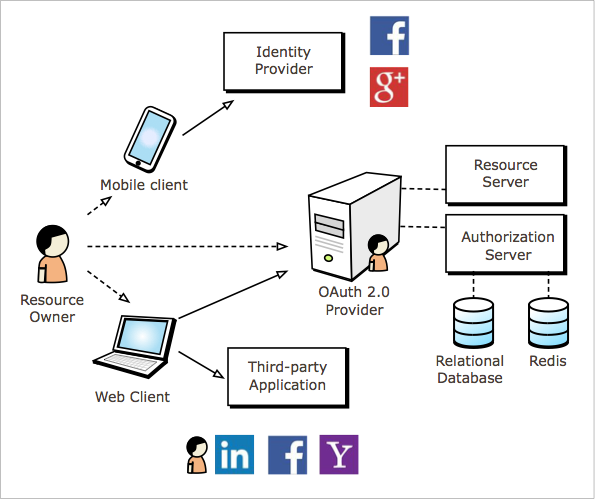
The preceding diagram shows the four main components of the OAuth 2.0 specification:

  • Resource Owner
  • Authorization Server
  • Resource Server
  • Client

Just to review the purpose of these components, remember that the Resource Owner is the user which delegates authority for third-party applications to use resources on its behalf. The third-party application mentioned is represented by the client which I depicted as Mobile client and Web Client. The user's resources are usually maintained and protected by the Resource Server which might be implemented together with the Authorization Server as a single component, for example. The composition of the Authorization Server and Resource Server are referred to as the OAuth 2.0 Provider to simplify the terminology given to the application which is protected by OAuth 2.0.

Visually different images
CONTINUE READING
83
Tech Concepts
36
Programming languages
73
Tech Tools
Icon Unlimited access to the largest independent learning library in tech of over 8,000 expert-authored tech books and videos.
Icon Innovative learning tools, including AI book assistants, code context explainers, and text-to-speech.
Icon 50+ new titles added per month and exclusive early access to books as they are being written.
OAuth 2.0 Cookbook
notes
bookmark Notes and Bookmarks search Search in title playlist Add to playlist download Download options font-size Font size

Change the font size

margin-width Margin width

Change margin width

day-mode Day/Sepia/Night Modes

Change background colour

Close icon Search
Country selected

Close icon Your notes and bookmarks

Confirmation

Modal Close icon
claim successful

Buy this book with your credits?

Modal Close icon
Are you sure you want to buy this book with one of your credits?
Close
YES, BUY

Submit Your Feedback

Modal Close icon
Modal Close icon
Modal Close icon